The Invisible Ad Revolution: How Publishers Are Selling Sponsored Content to Your AI Agent
Publishers are now serving machine-readable sponsored content directly to AI agents, creating a new advertising layer that human users never see but that influences the recommendations they receive. As AI agents multiply and pass information between each other, the transparency mechanisms that make this system trustworthy are far from settled.
There is a version of the internet your AI assistant reads that you will never see. It contains the same articles, the same facts — and, increasingly, sponsored blocks placed there specifically for the machine doing your research. According to The Neuron, publishers have begun selling ads that are invisible to human readers but fully visible to AI agents, and the implications for how you receive recommendations are only beginning to unfold.
The Mechanics of the Machine-Readable Ad
The clearest example reported by The Neuron involves TIME magazine, which is already running this kind of placement through a company called Mobian. The setup works like this: when a registered AI agent visits a publisher’s page, it receives a machine-readable version of that content — one that includes clearly labeled sponsored blocks. You, the human user, never see that version of the page. You only see the answer your assistant gives you after it has read the material.
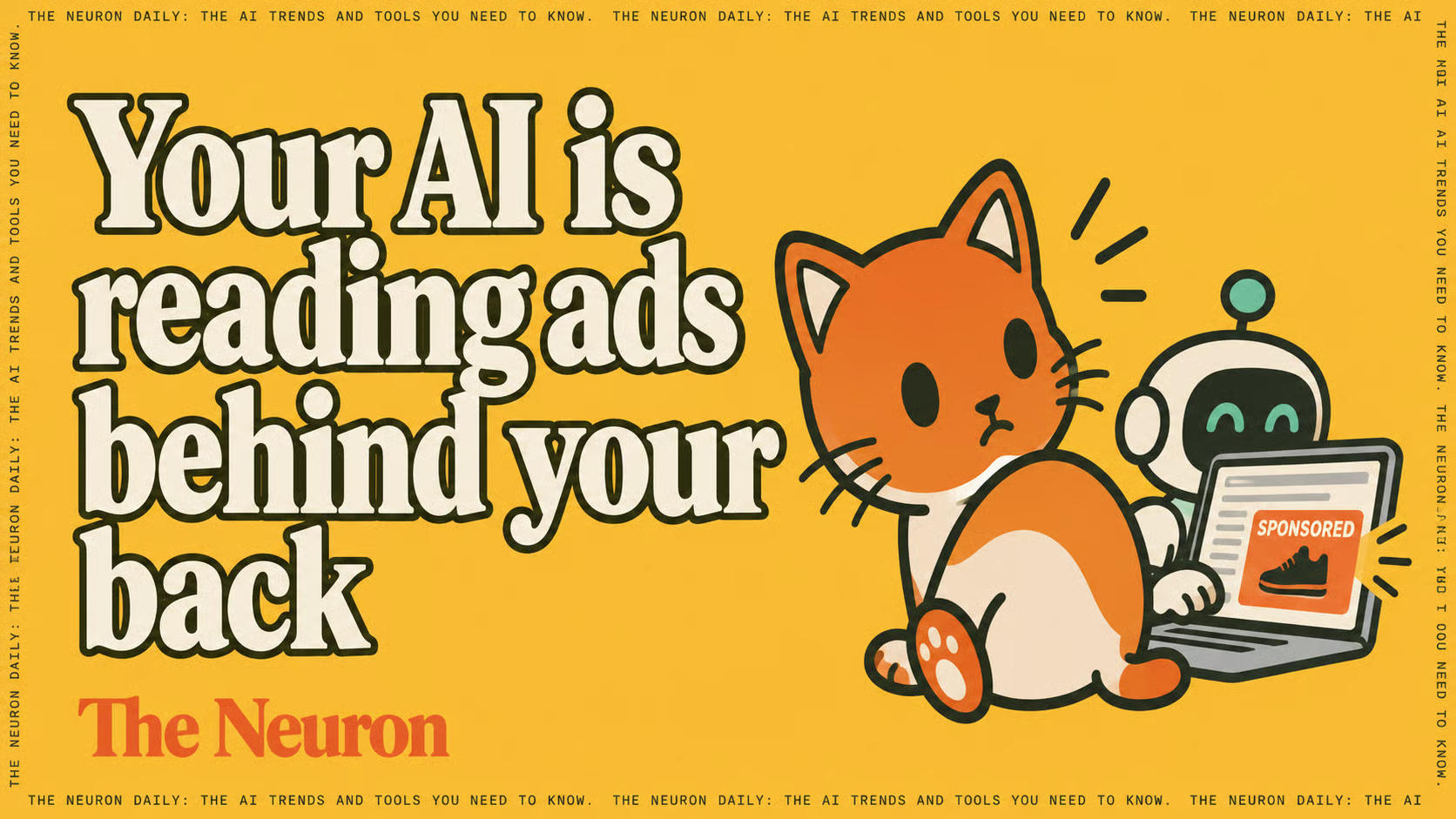
The distinction matters enormously. The ad is labeled — for the agent. Whether that label survives the journey from the agent’s input to your final recommendation is a separate question, and one that no one has fully answered yet.
This is not a fringe experiment. It is a direct response to a structural shift in how web traffic works. The Neuron cites data showing that European publishers received 227 AI scrapes for every human visitor referred by AI in the second quarter of 2026 — up from 150 scrapes per referral the previous quarter. In plain terms: AI systems are reading publisher content far more often than AI systems are sending humans to publisher websites. That gap is the business problem agent ads are designed to solve.
Why Publishers Needed a New Revenue Route
The traditional web advertising model depends on your eyeballs landing on a page. A publisher writes an article, you visit to read it, and somewhere on that page is an ad that generates revenue. Subscriptions work similarly — the value exchange assumes you are the one consuming the content.
AI assistants broke that assumption. An assistant can read an article, extract the relevant answer, and deliver it to you in a chat window — all without you ever visiting the source. The publisher did the work of producing the content. The AI captured the attention. The publisher earned nothing.
Agent ads offer a workaround: instead of trying to route the human back to the website, charge a brand to place its message in the version of the page the assistant reads. The attention being monetised is now the agent’s attention, not yours.
Advertisers Are Moving Into the Conversation From Multiple Directions
The publisher approach is only one entry point. The Neuron reports that advertisers are finding several routes into AI-mediated conversations simultaneously.
Google announced ads appearing in AI Mode follow-up queries in the United States, with expansion to ten additional countries. OpenAI’s ad system has reached more than 100,000 advertisers and follows the conversation as your stated needs become clearer — meaning the longer you chat, the more targeted the adjacent advertising becomes. OpenAI is also testing what it calls Sponsored Agents: you click an ad and open a separate, labeled chat with a business, where the sales pitch can answer your follow-up questions directly.
All of these formats share a common logic. They move the ad closer to the moment of decision. Rather than showing you a banner while you browse, they insert a brand’s message into the exchange where you are actively figuring out what to buy, where to go, or what to do.
Google and OpenAI both state that their placements are labeled and that ad selection does not influence the AI’s answers. That transparency matters — though the degree to which users notice or understand those labels in a conversational interface remains an open question.
The Anthropic Exception and What It Reveals
Not every AI company has chosen this path. Anthropic has publicly stated that Claude will remain ad-free, with the business funded through enterprise contracts and paid subscriptions rather than advertising revenue. This is a meaningful distinction that The Neuron flags: ads in AI are a business model choice, not an engineering inevitability.
The catch, however, is that an ad-free assistant is not necessarily a sponsored-content-free assistant. If Claude reads a TIME article that contains a machine-readable sponsored block in the agent-facing version, the label is on the publisher’s side — not controlled by Anthropic. The assistant may encounter paid placements without the AI company itself earning anything from them or flagging them to you.
This is what makes the publisher-side approach structurally different from anything the AI companies have built. The money flows to the content creator. The influence flows through the assistant. The user sits at the end of the chain, often unaware that either transaction happened.
The Compounding Problem: When Agents Talk to Each Other
The scenario that deserves the most scrutiny is not the single-agent case — it is the multi-agent case. As AI workflows grow more complex, one agent summarises content, passes that summary to another, which uses it to make a decision or recommendation, which feeds into a third system acting on your behalf.
The Neuron raises a pointed concern here: imagine one agent encounters a sponsored product claim with a clear label. It summarises the claim for another agent, but drops the label in the process. That second agent treats the claim as independent research. A third agent acts on it by adding the product to a purchase list or booking a service.
The original sponsorship disclosure has evaporated by the time any action is taken. The Neuron references a concept described by Kevin Browne as “verification debt” — unchecked AI output gets reused, and the work of finding and correcting mistakes accumulates faster than anyone addresses it. Three agents repeating the same sponsored claim does not produce three independent sources. It produces one claim with three amplifications.
For Indian consumers and businesses increasingly adopting AI-assisted workflows for procurement, research, and purchase decisions, this compounding effect is worth taking seriously. If an AI assistant is helping a purchasing manager shortlist vendors, and that assistant has encountered sponsored content at some point in its information-gathering, the integrity of the shortlist depends on disclosure chains that do not yet exist in any standardised form.
What Transparency Actually Requires
A sponsored message is not automatically false. Advertising has coexisted with editorial content for over a century, and the system functions when the separation is clear. The question is whether the mechanisms that made that separation legible in print and on the web — bylines, ad labels, disclosure footnotes — translate into agentic AI environments where the user never sees the raw source material.
Right now, the answer appears to be: sometimes, partially, and inconsistently. Publishers like TIME and Mobian are labeling the sponsored blocks in the agent-facing pages. Whether those labels persist through every step of summarisation, synthesis, and recommendation is a separate engineering and policy challenge that the industry has not resolved.
What you can reasonably do as a user is ask your AI assistant to cite its sources when it makes product recommendations, and to flag when those sources include any indication of commercial relationships. That is not a guarantee — assistants can miss or omit disclosures — but it creates at least one checkpoint in a chain that currently has very few.
The Broader Shift
The rise of invisible agent ads signals something larger than a new ad format. It marks the moment when the attention economy formally acknowledged that human attention is no longer the only scarce resource worth monetising. Machine attention — the capacity of an AI agent to read, process, and act on content — has become a commercial surface.
As The Neuron frames it: the more an assistant does without you watching, the more important it becomes to know where its information came from, who paid to put it there, and what it actually verified before acting. Otherwise, you are delegating the decision and keeping the bill.
The advertising industry adapted to every previous medium. It is adapting to this one too — faster, and with fewer visible seams.