3,000 Exam Scores Wiped: How AI Cheating Brought Mexico’s Top University to a Standstill
Mexico's UNAM cancelled roughly 3,000 entrance exam scores after the university moved online for the first time and detected a suspicious spike in perfect scores, pointing to AI-assisted cheating. The scandal exposes a widening gap between digital testing infrastructure and the integrity tools needed to make it trustworthy — a problem that institutions worldwide, including in India, will soon face.
When Mexico’s most prestigious university moved its entrance exam online for the first time, administrators hoped to democratise access for students outside Mexico City. What they got instead was a national scandal — one that has now reached the desk of the country’s president.
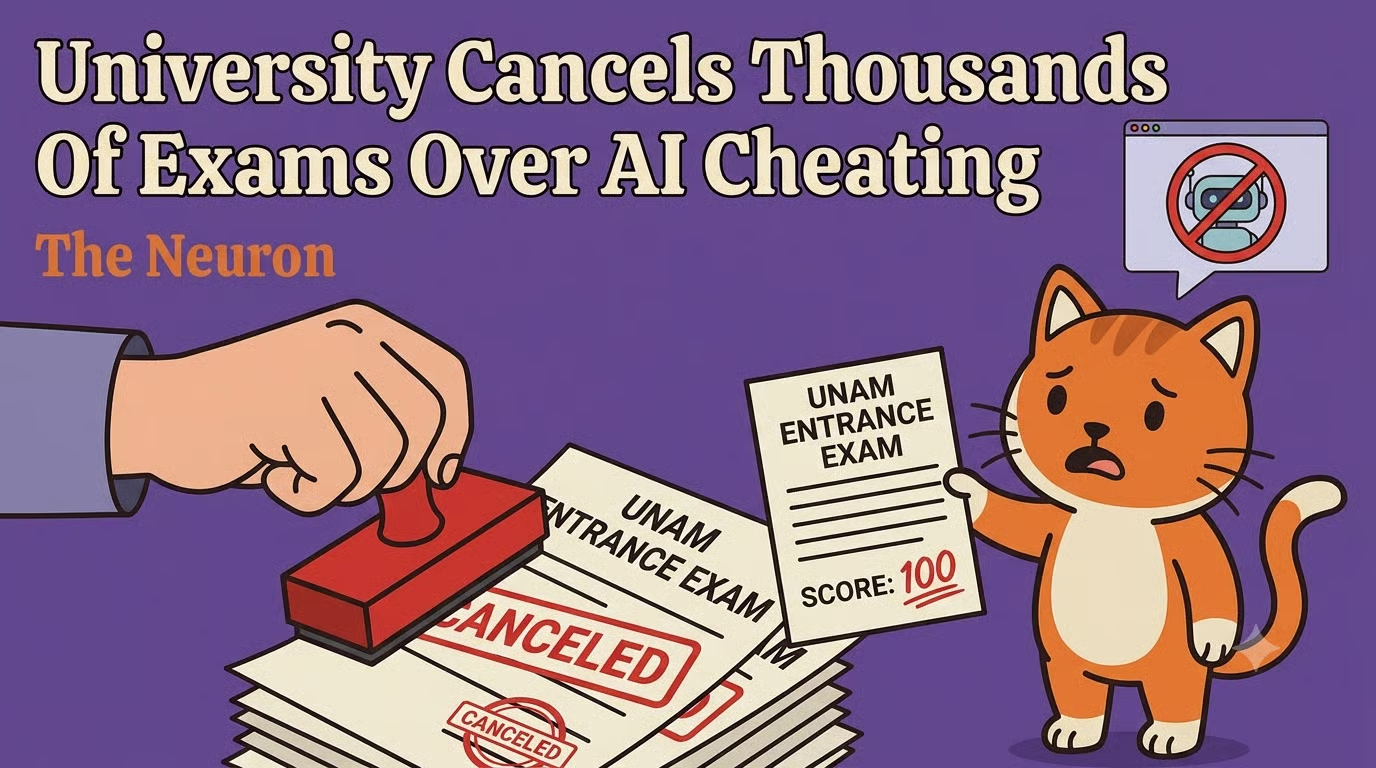
According to The Neuron’s reporting on the story, the Universidad Nacional Autónoma de México (UNAM) has cancelled roughly 3,000 of approximately 150,000 entrance exam results after detecting suspiciously high scores that, officials believe, point to widespread AI-assisted cheating. The semester is set to begin on August 10, and new-student enrollment has been suspended while the investigation continues — a disruption affecting tens of thousands of students and families across the country.
What Actually Happened at UNAM
The story begins with a straightforward ambition. UNAM put its entrance exam online for the very first time in 2026, enrolling more than 158,000 applicants who sat the test between May and June. The digital format was meant to lower barriers, sparing students who live outside Mexico City from making the journey to sit a paper-based exam.
The results came back and immediately looked wrong. Historically, between 2021 and 2025, around 3.5% of applicants scored 100 or more correct answers. This year, that rate spiked sharply enough to trigger a formal institutional review. The anomaly wasn’t subtle — it was statistically dramatic enough that UNAM’s leadership could not simply ignore it.
The university ultimately annulled roughly 3,000 tests linked to suspiciously perfect scores. Officials suspect the culprits were a combination of AI tools such as ChatGPT and more traditional methods, including leaked questions. In other words, this wasn’t purely a technology problem — it was a technology problem layered on top of older vulnerabilities that online delivery may have amplified.
The Software in the Middle
The exam platform was built by a Mexican company called Territorium Life, and it was specifically designed to prevent exactly this kind of cheating. The software blocked test-takers from opening additional browser tabs during the exam and used its own AI to flag suspicious behaviour in real time.
So why didn’t it work?
Students who took the exam argue that the system leaned too heavily on automated detection and not enough on human oversight. When an algorithm is the only referee in the room, there is no second opinion, no moment of contextual judgement. Territorium Life, for its part, maintains that its software functioned as intended, and places partial responsibility on the university itself, arguing that stopping cheating also requires the institution to enforce academic honesty on its end.
This points to a genuinely uncomfortable reality: the two parties responsible for running a fair exam both believe the other party holds the critical accountability. In the gap between those two positions, thousands of legitimate students are now caught waiting.
When the President Gets Involved
The story escalated beyond a university administration problem when President Claudia Sheinbaum — herself a UNAM graduate — weighed in publicly. Her involvement transformed what might have been a contained institutional failure into a national news event, raising questions that go far beyond one exam cycle.
The political dimension matters because UNAM is not just any university. It is one of the largest universities in the world, a symbol of Mexican public education, and the institution that trains a significant share of the country’s professional class. When 3,000 applicants have their scores cancelled and enrollment grinds to a halt days before a semester is due to begin, the human cost is immediate and concrete. These are young people whose futures are directly in the balance.
The Broader Problem: AI as Referee
As The Neuron notes in its analysis of the story, the real scandal here is not simply that students cheated. The real scandal is that nobody has yet built a system that can reliably tell the difference between a student who used AI to generate answers and a student who just studied exceptionally hard.
That gap is widening fast. High-stakes testing is moving online at every level of education — competitive university entrance exams, professional licensing tests, national scholastic assessments. In India, where entrance exams like JEE and NEET carry enormous weight and have historically been plagued by paper leaks and impersonation fraud, the move to digital-first testing is already underway and accelerating. The UNAM case is a preview of the pressure that administrators everywhere will face.
The detection tools available today fall into two broad categories, and both have serious limitations. Behavioural monitoring — tracking mouse movements, tab switching, eye position — can catch inattentive or careless cheaters but is easily circumvented by anyone who knows how the system works. Statistical analysis of score distributions can flag anomalies at a population level but cannot tell you anything definitive about any individual test-taker. A perfect score is suspicious in aggregate; it is not, by itself, proof of wrongdoing.
This is why the UNAM situation is so thorny. When the university annuls 3,000 scores, it is almost certainly sweeping up some number of genuinely high-performing students along with the cheaters. Those students have no obvious path to demonstrating their innocence, because the very tool used to accuse them — an algorithm — cannot explain its reasoning in terms a human can challenge.
What Institutions Need to Learn Right Now
- Hybrid oversight is not optional. Automated monitoring without a human review layer creates accountability gaps that are extremely difficult to close after the fact. If thousands of scores can be cancelled in one move, the detection pipeline needs a human checkpoint before consequences are applied.
- Moving online does not automatically mean moving to better security. Digital delivery solves logistics problems but introduces new attack surfaces. Browser-lock software and AI behaviour flags are a starting point, not a complete solution.
- Shared accountability must be contractually defined before the exam, not disputed after it. The public disagreement between UNAM and Territorium Life about who was responsible for enforcement is a governance failure, not just a technical one.
- Students need a clear appeals process. Any system that can flag thousands of results in bulk must also have a proportionally robust mechanism for individual review. Without it, the cure for cheating punishes the innocent alongside the guilty.

The Uncomfortable Trajectory
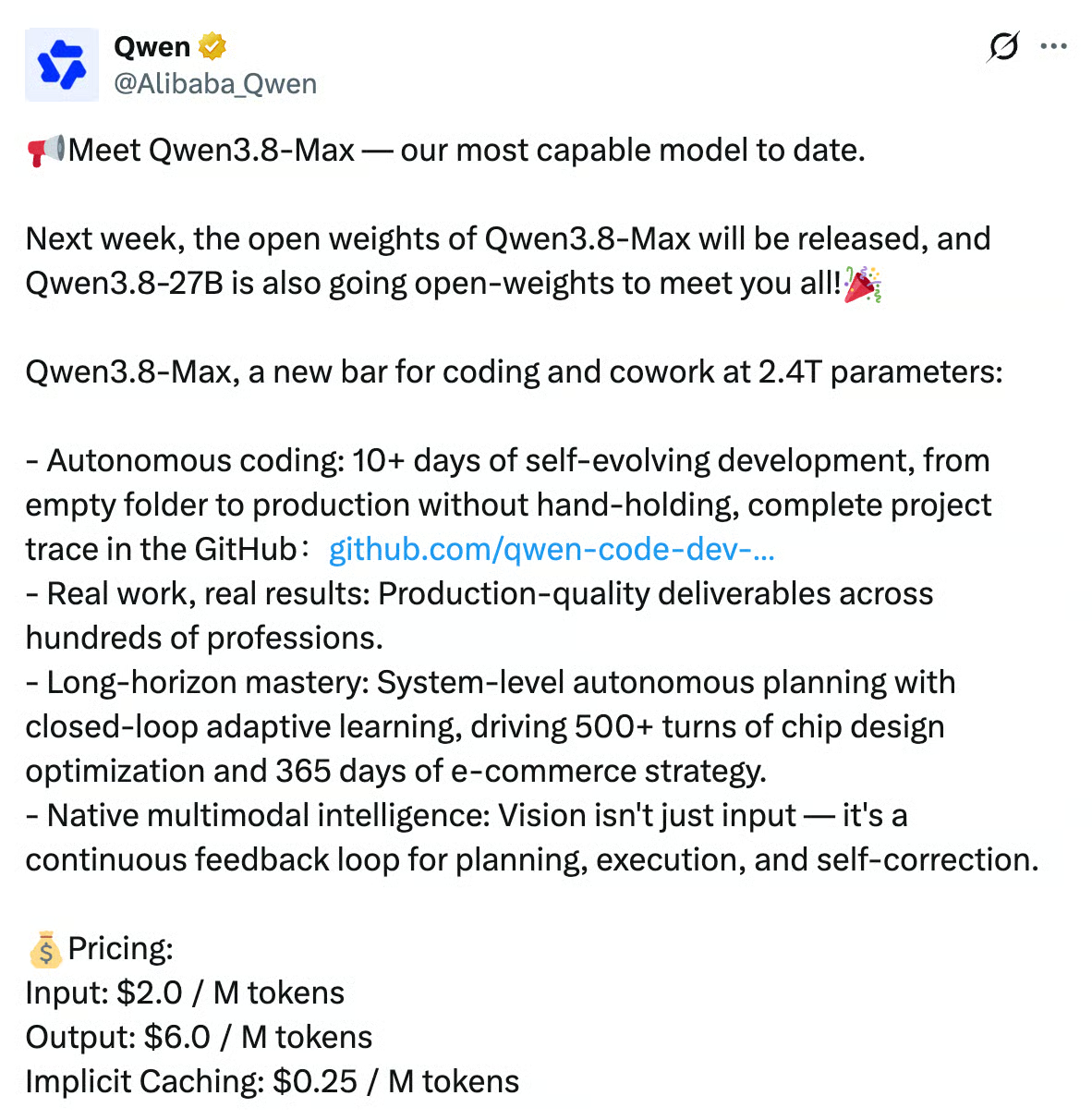
The timing of this story is worth pausing on. In the same week that Alibaba announced a coding agent capable of working unsupervised for over ten days — moving from an empty folder to a finished product without human intervention — a national university is trying to figure out whether its students used a chatbot to answer multiple-choice questions. The capability gap between what AI can do and what our institutions are built to handle has rarely looked this stark.
For students and educators in India and across the developing world, the UNAM case carries a specific warning. The promise of online testing is genuine: it extends access, reduces travel costs, and can in theory make high-stakes assessments more fair. But that promise only holds if the integrity infrastructure keeps pace with the delivery infrastructure. Right now, it clearly is not.
As The Neuron puts it, “trust but verify” gets messy fast when the verifier is an algorithm nobody fully understands. Until that changes, every institution moving its critical exams online is running a version of the same experiment UNAM just ran — and hoping the results look cleaner than they did in Mexico City.
The question facing every exam board, university, and credentialing body in 2026 is no longer whether students will use AI. It is whether institutions can build systems fair enough to respond to that reality without punishing the students who played by the rules.