OpenAI’s 5% Gambit: What a U.S. Government Stake in the World’s Most Valuable AI Company Really Means
OpenAI has reportedly discussed offering the U.S. government a 5% equity stake worth tens of billions of dollars, framed as a public benefit move ahead of an IPO. The Neuron's analysis highlights that direct citizen ownership through a sovereign wealth fund is structurally far sounder than government equity, which would create serious conflicts of interest between regulators and the companies they oversee.
OpenAI Is Reportedly Offering Washington a Seat at the Cap Table
When a private AI company reportedly discusses handing the federal government a 5% ownership stake, the conversation shifts from Silicon Valley deal-making into something far larger: who actually owns the AI future, and what do they get to do with that ownership?
That is exactly the question raised by a report cited in The Neuron’s July 3, 2026 issue. According to reporting from the Financial Times — picked up by The Guardian, CNBC, and Axios — OpenAI has held early discussions about giving the U.S. government a 5% stake in the company. The reported motivation is twofold: reduce political blowback as OpenAI courts Washington, and set up a narrative of public benefit ahead of a future IPO.
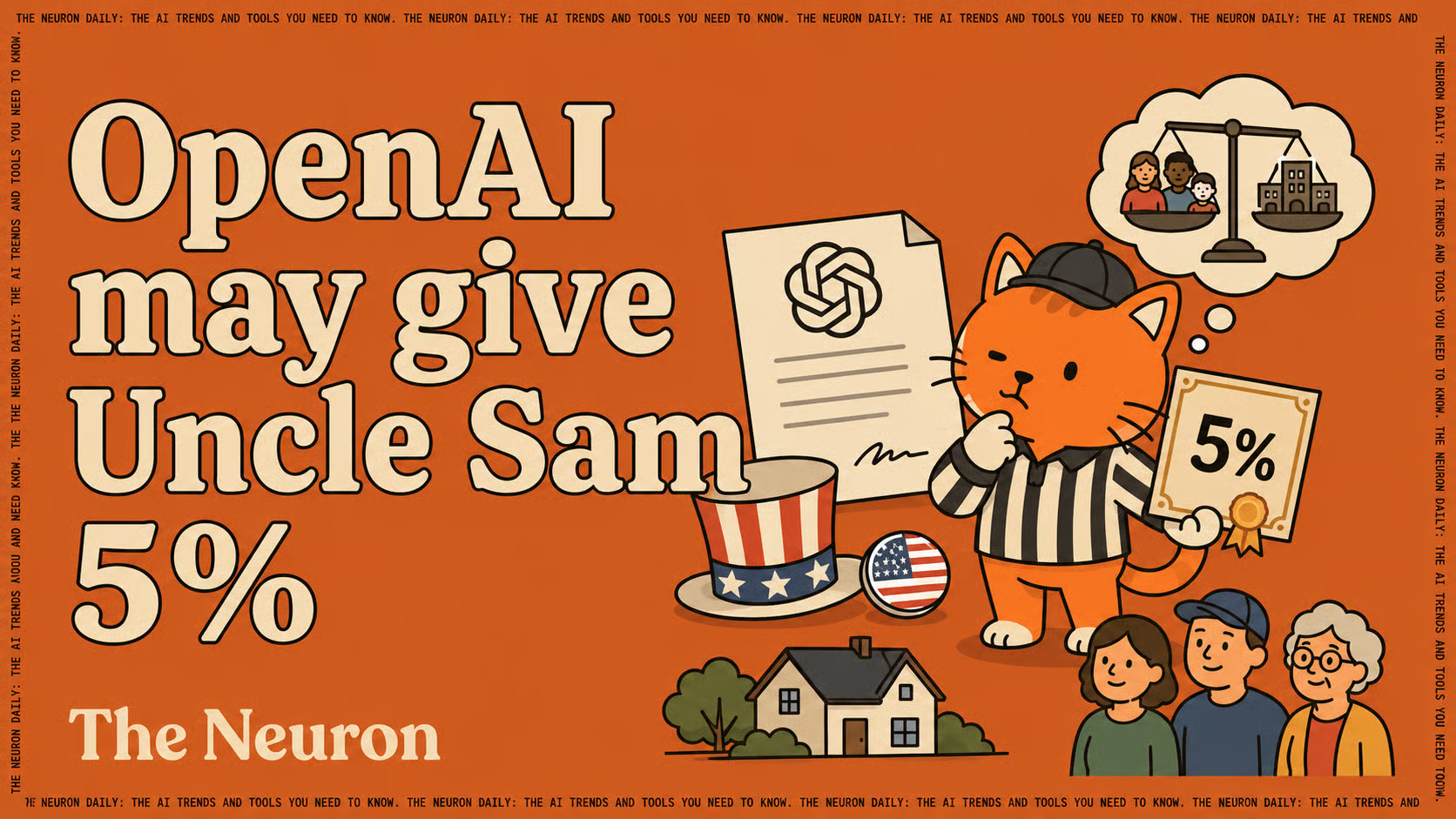
CNBC reported the proposed stake could be worth tens of billions of dollars. To put that in an Indian context, even a conservative valuation of that slice would run into multiple lakh crore rupees — a sum that dwarfs the GDP of several Indian states. This is not a symbolic gesture. This is a structural question about how wealth generated by frontier AI technology gets distributed across society.
Two Very Different Versions of “Public Ownership”
The most important analytical lens here comes from AI policy analyst Dean W. Ball, whose perspective The Neuron highlighted. Ball drew a sharp distinction between two fundamentally different proposals that often get blurred under the phrase “public ownership”:
- Direct household ownership: Citizens receive a stake directly, perhaps through a public wealth fund, dividend mechanism, or investment accounts. The value flows to people.
- Government ownership: The state holds the equity. Politicians and regulators control the asset.
These are not variations on the same idea. They are structurally opposite arrangements with entirely different incentive structures.
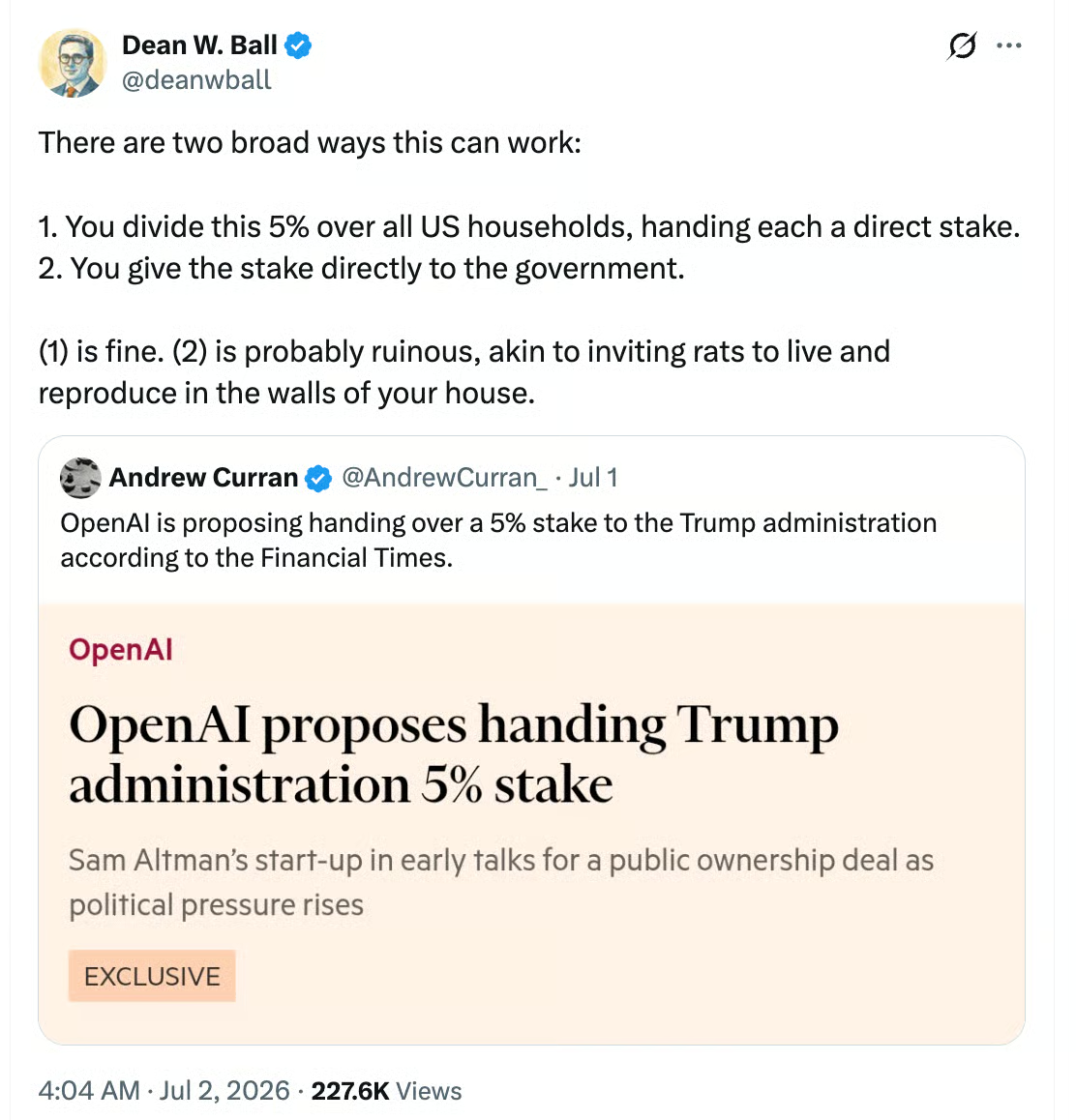
If the U.S. government holds a 5% stake in OpenAI, the same officials who regulate frontier AI models would have a financial interest in the commercial success of one of the companies they oversee. Axios noted that any such deal would likely require Congressional approval and could raise serious questions about government influence over model releases. Think about what that means in practice: safety decisions, competitive rulings, export controls, and IPO timing would all be made in a context where regulators are also shareholders. The conflict of interest would not be theoretical — it would be baked into the institutional structure.
Ball’s framing, as reported by The Neuron, goes further: handing a collective stake to Washington could make half the country view the deal as blatant corruption, while the other half wonders why they personally never received a check. That is not a political outcome that benefits OpenAI, the government, or the public.
Why OpenAI Is Making This Proposal Now
Understanding the timing requires reading the political context. OpenAI has been navigating an increasingly complex relationship with Washington as it prepares for what would be one of the most anticipated IPOs in technology history. The company has faced scrutiny over its transition from nonprofit to a for-profit structure, questions about concentration of AI power, and broader anxieties about whether ordinary Americans will benefit from the AI boom or simply watch a small group of technology executives and investors capture all of the upside.
A 5% government stake is, at its core, a political de-risking strategy. CNBC reported explicitly that the proposal is meant to reduce political blowback. Giving Washington a financial interest in OpenAI’s success is a way of aligning incentives — making it harder for regulators to impose punishing restrictions on a company in which the government itself holds equity.
Whether that alignment serves the public interest is a separate question entirely.
The Sovereign Wealth Fund Model: A Better Path?
The Neuron’s own take on the story points toward a more structurally sound alternative: the sovereign wealth fund model. Norway, Singapore, Qatar, and the UAE have all demonstrated that national windfalls — from oil revenues, in their cases — can be pooled, professionally managed, and converted into long-term public wealth that citizens actually feel.
The logic applied to AI wealth is compelling. If OpenAI and its peers generate extraordinary returns over the coming decades, a sovereign fund structure could ensure that a meaningful portion of those returns flows back to citizens in a tangible way, rather than being absorbed into general government revenues or disappearing into bureaucratic management.
The critical requirement, as The Neuron notes, is that the public must feel the ownership directly. A government holding shares on behalf of the public, with no transparent distribution mechanism and no citizen-level benefit, is not wealth sharing — it is wealth capture by a different set of hands. For Indian readers, this maps onto familiar debates about the difference between government-managed public sector assets and direct benefit transfers: one approach keeps citizens at arm’s length from the value, the other puts resources in their hands.
What Happens If This Goes Through — And What Happens If It Doesn’t
Axios flagged that any government stake deal would likely need Congressional approval. That is a significant obstacle in a polarized legislative environment. But the proposal’s significance extends beyond whether it succeeds.
The very fact that OpenAI is reportedly floating this idea signals that the political pressure to demonstrate public benefit from AI is intense and growing. The narrative of AI as a technology that enriches a small elite while displacing workers and concentrating power is gaining traction. OpenAI needs a counter-narrative, and a government stake — however structurally messy — offers one.
For competitors and the broader AI industry, the proposal sets a precedent. If OpenAI offers Washington equity, other frontier AI companies may face similar expectations. The question of who owns AI’s upside is moving from think-tank white papers into actual term sheets.
The India Angle: A Question Worth Asking Here Too
While this specific proposal concerns U.S. domestic politics, the underlying question has global resonance. India is building significant AI infrastructure, nurturing domestic AI companies, and watching global frontier models reshape its economy. The debate about whether AI wealth gets shared broadly or captured narrowly is not American-specific.
If the U.S. establishes a model — whether a sovereign fund, a direct household stake, or a government equity position — it will influence how other governments frame their own relationships with AI companies operating within their borders. India’s policymakers, investors, and civil society should be paying close attention to how this experiment unfolds.

The Bottom Line
OpenAI’s reported 5% government stake proposal is best understood as a political maneuver ahead of an IPO, not a genuine wealth-sharing innovation. As The Neuron’s analysis makes clear, the structure of ownership matters enormously. Government holding equity in a company it regulates creates conflicts that could distort both AI policy and market competition for years.
The cleaner alternative — direct public ownership through a sovereign wealth fund or household-level mechanism — is harder to execute politically but far sounder in practice. Societies that have done it well, from Norway to Singapore, show that it is possible to turn a national windfall into durable public wealth rather than a political liability.
The AI industry is generating wealth at a scale and speed that existing policy frameworks were not designed to handle. The question of who captures that wealth, and through what mechanisms, is one of the defining governance challenges of this decade. OpenAI’s proposal, whatever its ultimate fate, has forced that question onto the table in a way that is difficult to ignore.