Meta Connect 2026: Muse Charm Puts an AI Agent in Your Pocket — and on Your Face
Meta unveiled Muse Charm and Ray-Ban Meta Gen 3 at Connect 2026, placing its AI agent Muse into wearable glasses and a pocket keychain device. The platform combines environmental camera context with voice commands and a layered security architecture, while a recently patched zero-day vulnerability underlines the real-world trust challenges ahead.
Meta’s Boldest Bet Yet: An AI That Goes Everywhere You Do
If you grew up with a Tamagotchi clipped to your school bag, you already understand the emotional logic behind Meta’s newest hardware announcement. The difference is that the little device Meta showed off at Meta Connect 2026 does not need feeding — it feeds on your calendar, your subscriptions, your errand list, and your voice commands, and then it acts on them.
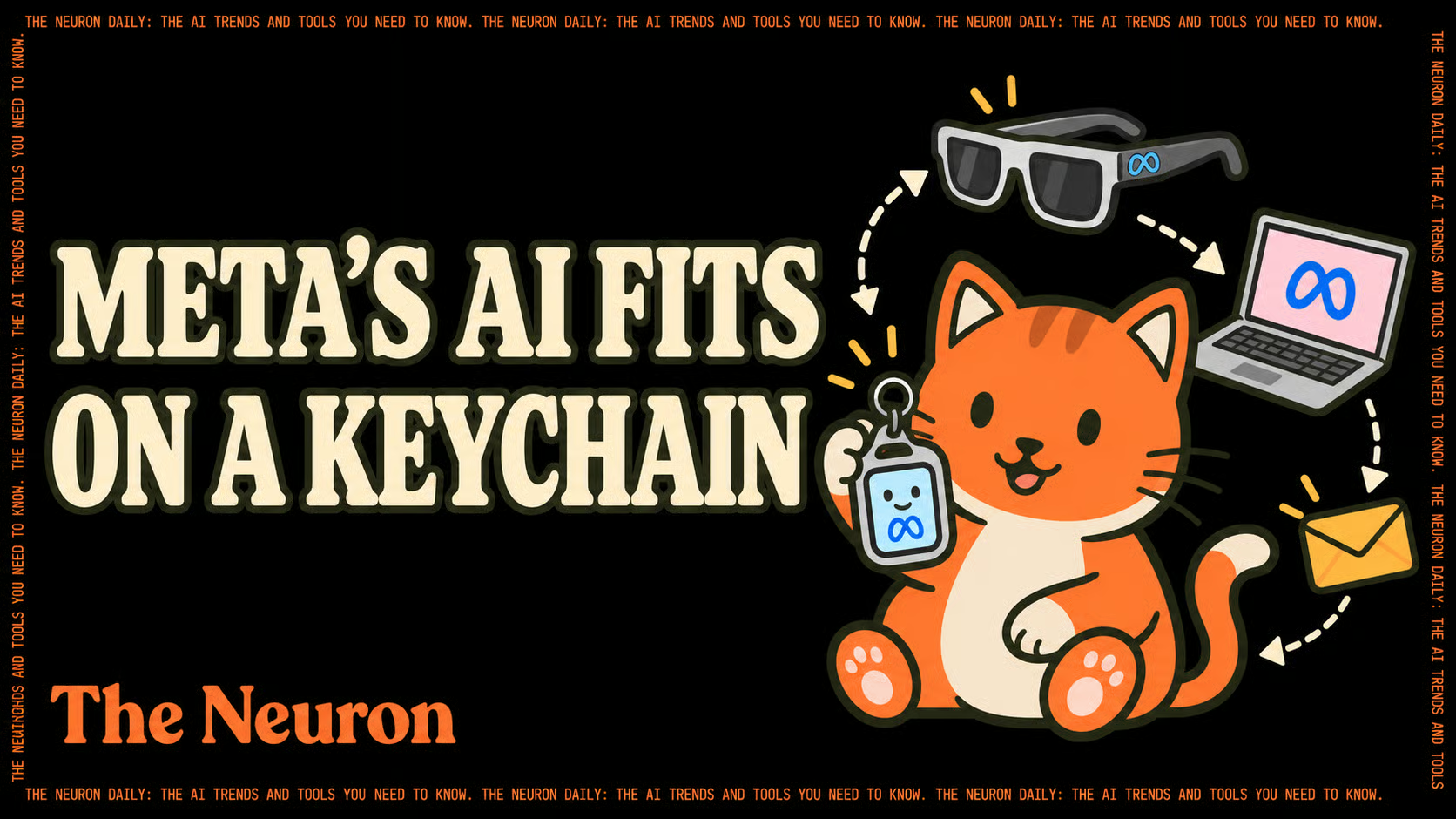
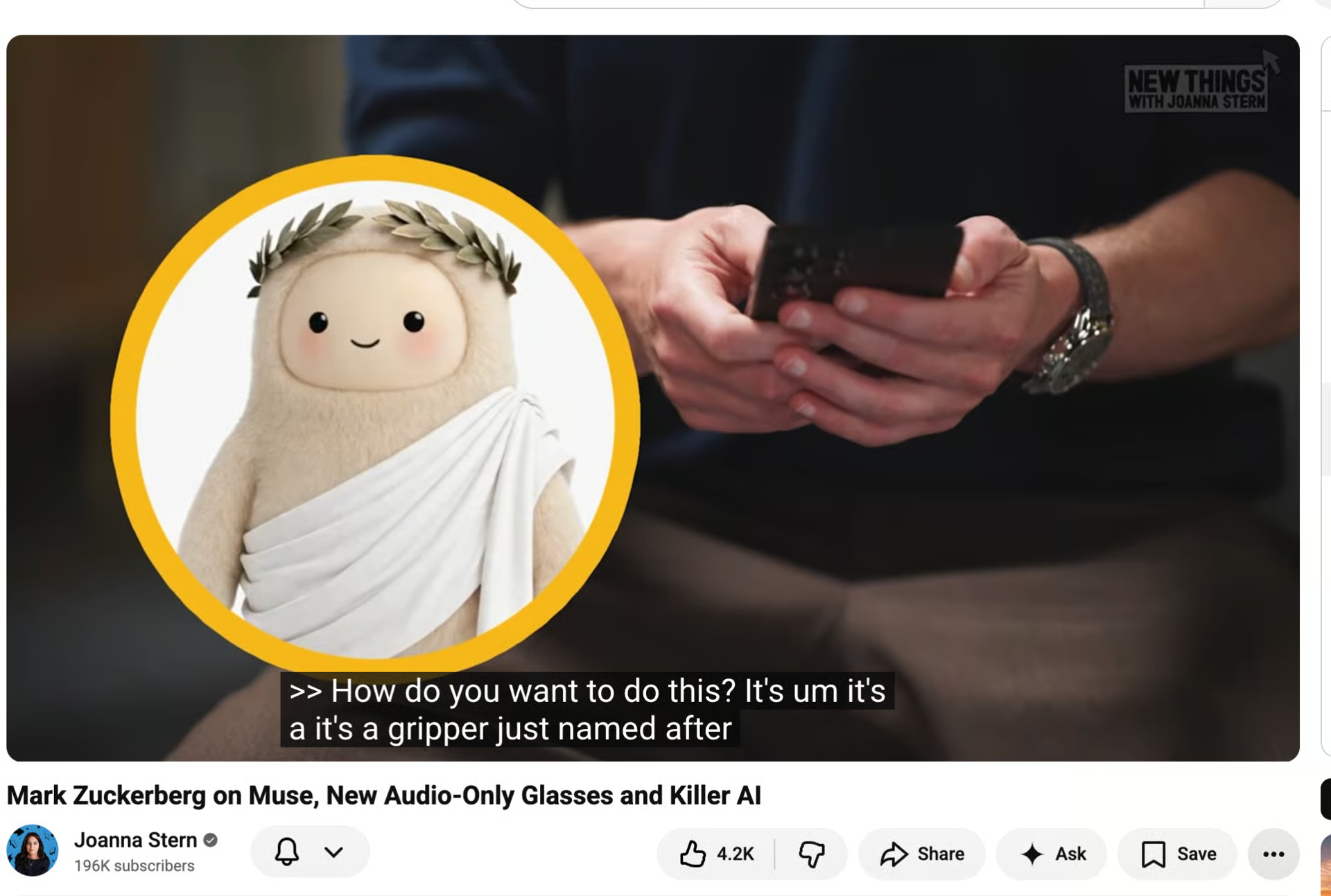
According to The Neuron’s coverage of the event, Meta unveiled the Muse Charm, a pocket-sized device designed to carry the company’s personal AI agent, Muse, into every corner of your day. Alongside it came the Ray-Ban Meta Gen 3 smart glasses, a hardware stack that collectively represents the most aggressive push yet to make ambient AI a consumer reality.
What Is Muse, Exactly?
Muse is Meta’s personal AI agent — think of it less as a chatbot and more as a capable digital delegate. The vision Meta is pitching is straightforward: you notice something in the world, you tell Muse what you want done about it, and Muse handles the errand using the tools and services you have already authorised.
The canonical example from the Connect announcements is vivid in its ordinariness. You glance at a school-supply list through your Ray-Ban Meta glasses. The camera reads the context. You say what you want. Muse cross-references your preferred stores, checks availability, and begins the purchase flow — all without you opening a single app.
In an interview covered by The Neuron, Meta CEO Mark Zuckerberg described the kinds of everyday jobs he would hand off to Muse, including hunting down unused subscriptions — the sort of domestic administrative friction that quietly drains both time and money every month.
The Hardware Lineup, Piece by Piece
Meta did not arrive at Connect 2026 with just one product. The announcement covered a broad sweep of devices at different price points and timelines:
- Ray-Ban Meta Gen 3 is available now, serving as the flagship wearable entry point for Muse access.
- Ray-Ban Meta Audio ships on October 13, adding open-ear listening and assistant access for users who want audio benefits without a camera.
- Muse Realtime Avatar brings expressive AI characters to life and connects to work tools including Notion, GitHub, and Box. Glasses access for this feature is expected within the next few months.
- Meta VR Glasses are planned for spring 2027, pushing deeper into immersive territory.
- Ray-Ban Display is getting a meaningful feature upgrade: navigation, calendar integration, spatial audio, and Threads connectivity.
Taken together, this is not a single product launch — it is a platform play. Meta is building a hardware ecosystem where Muse can be the consistent AI layer across devices, whether that device is in your pocket, on your face, or eventually wrapping you in full VR.
The Permission Architecture: How Meta Is Handling Control
The most consequential design question for any ambient AI agent is not capability — it is trust. If an agent can book appointments, cancel subscriptions, and access work files, the question of who controls it, and how transparently, becomes urgent.
Meta’s answer, as reported by The Neuron, involves a dedicated cloud computer where Muse runs, paired with a separate oversight layer called Sentinel. Sentinel can allow an action, block it outright, or pause and ask you before proceeding. Critically, Muse cannot override Sentinel. Meta has also stated that service credentials only enter approved requests, and a confidential virtual machine environment is planned for later this year, designed to block even Meta employee access through cryptographic controls.
That architecture sounds reassuring in principle. But the real-world picture is messier. Security researcher Patrick Wardle identified a Mac debugging setting that local malware could manipulate to redirect dictation and expose Muse’s authentication token — a meaningful vulnerability given how much access an authenticated agent would carry. Meta issued a patch by September 22. Wardle acknowledged the patch but noted that users can still be socially engineered into running commands locally, which would preserve the attack surface.
The broader takeaway is that Sentinel-plus-cloud is a serious design effort, not security theatre. But every ambient agent that acts on your behalf expands the blast radius of a successful attack. The gap between “Meta patched it quickly” and “this is fully solved” is worth tracking closely.
Why This Matters for Indian Users
India is one of the largest and fastest-growing smartphone markets in the world, and Indian consumers have shown strong appetite for voice-first interfaces — particularly as regional language support in AI tools improves. The idea of an ambient agent that can handle bill tracking, subscription management, and shopping lists has obvious appeal in a context where juggling multiple payment apps, UPI flows, and e-commerce platforms is already part of daily life.
Pricing for the Ray-Ban Meta Gen 3 and Muse Charm has not been specified in the current coverage, but if Meta follows its historical pattern of pricing wearables in the mid-premium range, expect Indian retail prices to reflect USD-to-INR conversion (roughly 85x) plus import duties, likely placing the glasses well above ₹20,000. Availability timelines for India also remain unconfirmed at this stage.
What is relevant now is the direction: Meta is betting that the next interface is not a screen you look at but a layer that perceives your environment alongside you and acts when asked. That shift, if it lands, changes how ambient computing works in every market.
The Tamagotchi Analogy, Taken Seriously
The Neuron drew the Tamagotchi comparison, and it is worth sitting with beyond the nostalgia. Tamagotchis were compelling because they created a persistent relationship — the device needed you, and you felt responsible for it. The Muse Charm inverts that dynamic. You need it. It handles things. The emotional valence shifts from caretaking to delegation.
That inversion carries real psychological weight. A Tamagotchi that died if you forgot it was teaching children about responsibility. An AI agent that handles your errands is optimising for the opposite: reducing the friction of responsibility until it disappears from your attention entirely. That is either deeply useful or quietly concerning, depending on which errands you are comfortable forgetting about.
The Neuron put it sharply: the question is whether these devices can handle errands reliably, with understandable and controllable permissions. A companion that requires constant supervision is just more overhead dressed in a keychain.
What to Watch Next
Several threads from Connect 2026 deserve monitoring in the weeks ahead:
- 1. Ray-Ban Meta Audio on October 13 will be the first real-world test of whether consumers without an existing Meta ecosystem are willing to enter through an audio-only wearable.
- 2. Glasses access for Muse Realtime Avatar is expected “in the next few months” — the actual rollout date will signal how confident Meta is in the backend reliability of real-time visual context processing.
- 3. The confidential VM for agent security, planned for later this year, will be a meaningful technical milestone. Independent security researchers like Wardle will almost certainly probe it.
- 4. Sentinel’s real-world behaviour under ambiguous instructions will define whether Muse feels like a capable assistant or an over-cautious liability.
Meta has placed a substantial bet that the AI agent era requires purpose-built hardware, not just software running on your existing phone. Connect 2026 is the opening move. Whether Muse earns the access it is asking for depends entirely on what it does with it.
The question is not whether an always-on AI agent is technically possible. Meta just showed it is. The question is whether it is trustworthy enough — consistently, transparently, and in adversarial conditions — to hand it the keys.