When AI Becomes the Doctor’s Second Opinion: OpenAI’s Reasoning Model Cracks 18 Unsolved Rare-Disease Cases
OpenAI's o3 reasoning model helped physicians at Boston Children's Hospital and Harvard uncover 18 confirmed diagnoses from 376 previously unsolved rare-disease cases, according to The Neuron. The study illustrates a near-term model for medical AI as a tireless second reader that generates leads for human clinicians to validate, not a replacement for clinical judgment.
Imagine spending years shuttling a sick child between specialist after specialist, watching genomic tests come back inconclusive, and being told that medicine has no answer — at least not yet. For roughly half of rare-disease patients, that is not a hypothetical. Even after exhaustive specialist review, they leave without a diagnosis. A new study suggests that an AI reasoning model may be able to help change that, at least for some families.
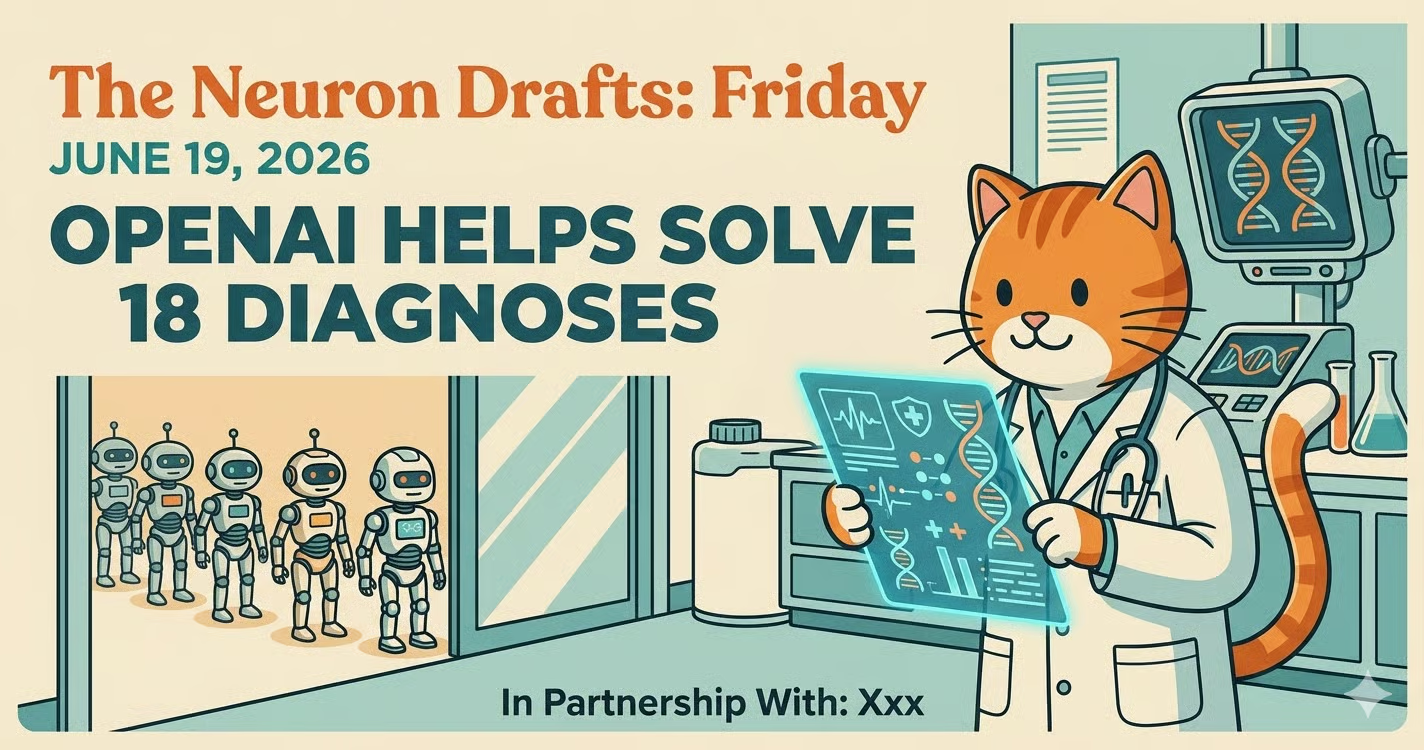
According to The Neuron, OpenAI collaborated with researchers at Boston Children’s Hospital and Harvard to revisit 376 de-identified unsolved rare-disease cases using its o3 Deep Research reasoning model. The result: physicians confirmed 18 new diagnoses after expert review, targeted testing, and full clinical validation. That is not a chatbot guessing at symptoms — it is a structured research pipeline that surfaces evidence-linked leads for human clinicians to investigate and confirm.
The Scale of the Problem AI Is Trying to Solve
Rare diseases are, by definition, uncommon. But collectively they affect hundreds of millions of people worldwide, and the diagnostic journey is notoriously brutal. Clues can be scattered across years of clinical notes, genomic variant reports, old lab results, and a constantly expanding body of medical literature that no single physician could realistically track in full.
OpenAI notes that even after genomic sequencing — one of the most powerful diagnostic tools available — roughly half of rare-disease patients remain undiagnosed following extensive specialist review. The volume of data is not the bottleneck; the capacity to synthesize it across sources and flag meaningful patterns is.
That is precisely where a large reasoning model has a structural advantage. It does not tire, does not have a cognitive load limit in the way a human does after a ten-hour clinic shift, and can cross-reference medical literature against a patient’s history at a speed that would be impossible manually.
What the Study Actually Did — and Did Not Do
It is worth being precise about the methodology, because the framing matters enormously in healthcare contexts. The researchers did not feed patient data to a model and accept whatever diagnosis it returned. Instead, as The Neuron reports, the model was used to generate evidence-linked leads — essentially a ranked set of hypotheses with supporting references — which human clinicians then evaluated independently.
Doctors decided which hypotheses deserved follow-up. Testing was ordered and conducted through standard clinical channels. The 18 confirmed diagnoses emerged only after that full cycle of expert review and clinical validation.
This is the near-term shape of useful medical AI: a tireless second reader that widens the net of possibilities, not a replacement for the physician making the final call. The distinction is not merely ethical — it is practical. Rare diseases often involve presentations that require physical examination, family history depth, and clinical intuition that a model cannot replicate from text alone.
ChatGPT Is Already in the Waiting Room
While the rare-disease study represents a carefully controlled research setting, OpenAI is also making moves that put AI health tools directly into the hands of ordinary users. The Neuron highlights that more than 230 million people ask ChatGPT health and wellness questions every week — a number that makes it one of the most widely consulted health resources on the planet, ahead of many established medical information services.
OpenAI has now made GPT-5.5 Instant available to free users with limits, specifically improved for health evaluations around urgent-care recognition, uncertainty communication, and context gathering. The intent appears to be raising the floor for health queries across a very large user base, many of whom may not have easy access to in-person medical advice.

For Indian users, this has a particular resonance. India has a significant shortage of specialist physicians in many regions, and the cost of consulting a specialist in a private hospital can range from a few hundred to several thousand rupees per visit — with rare-disease specialists concentrated almost entirely in metro cities like Mumbai, Delhi, Chennai, and Bengaluru. A tool that helps a patient or caregiver in a tier-2 city organize their symptoms, flag what is urgent, and arrive at a consultation better prepared could meaningfully improve the quality of that limited appointment time.
The Risk That Comes With a Confident Answer
None of this is without tension. The Neuron puts it plainly: the risk is that consumers will treat a polished answer like a final answer, especially when care is expensive or slow. A well-structured, calmly worded response from a language model can carry an authority that its actual certainty does not warrant — particularly at midnight, when someone is frightened and the doctor’s portal is closed.
This is not a hypothetical concern. Health misinformation has historically spread precisely because it sounds plausible and arrives at moments of vulnerability. The difference with AI is that the answer is personalised, confident, and conversational in a way that a static webpage is not.
OpenAI’s stated improvement in uncertainty communication with GPT-5.5 Instant is a meaningful design choice. A model that says “this could be several things, and you should discuss it with a clinician” is doing different work than one that delivers a clean differential diagnosis. Whether that calibration holds reliably across the enormous diversity of health queries remains an open empirical question.
AI as Infrastructure for Care, Not a Replacement for It
Perhaps the most clarifying frame is to think of AI health tools the way you think about other clinical decision support infrastructure — electronic health records, radiology software, genomic sequencing pipelines. None of those replaced physicians. All of them changed what physicians could do with the time and cognitive resources they have.
The rare-disease study is a concrete illustration of this. The 376 previously unsolved cases were not failures of physician intelligence — they were failures of synthesis capacity across an overwhelming volume of data. The model did not outsmart the specialists. It read more, faster, and returned leads that clinicians could then pursue using their own judgment.
As The Neuron frames it, the real test for OpenAI’s health ambitions is whether these tools can make people better prepared for care without convincing them they can skip care entirely. That balance is harder to strike than it sounds, especially as the products become more capable and the answers sound increasingly authoritative.
What to Watch Next
The 18 confirmed diagnoses from the Boston Children’s Hospital and Harvard study represent a genuinely significant proof-of-concept, but it is important to keep the scope in view. The study examined 376 cases and confirmed diagnoses in 18 — a meaningful yield, but one that also reflects how hard rare-disease diagnosis is even with the best available tools.
- Broader clinical validation studies will be needed before workflows like this become standard of care.
- Regulatory frameworks in India, the US, and Europe will need to catch up with how AI is actually being used in clinical settings.
- The question of data privacy — especially for paediatric rare-disease patients whose cases are highly sensitive — will require careful governance as these tools scale.
- Access equity matters too: the populations most likely to benefit from AI-assisted rare-disease diagnosis are often the least connected to the research hospitals and specialist networks where these tools are being piloted.
OpenAI is clearly treating health as one of ChatGPT’s most important mainstream applications. The rare-disease study gives that ambition a concrete, peer-reviewed anchor. The path from research result to widespread clinical benefit, however, runs through health systems, regulators, and insurance structures that AI cannot simply reason its way around.