Why SpaceX’s $75B IPO Has Nothing to Do With Rockets and Everything to Do With AI Infrastructure
SpaceX's record $75B IPO reflects Wall Street's bet on space-based AI infrastructure as terrestrial data centers face scaling constraints. The trillion-dollar valuation prices orbital computing potential alongside traditional space business, though practical viability remains unproven.
The Real Story Behind SpaceX’s Record-Breaking IPO
When SpaceX priced its IPO at $135 per share this week, raising $75 billion and achieving a valuation around $1.77 trillion, Wall Street wasn’t just buying into rockets and space exploration. According to The Neuron, investors were making a much more calculated bet on the future of AI infrastructure.
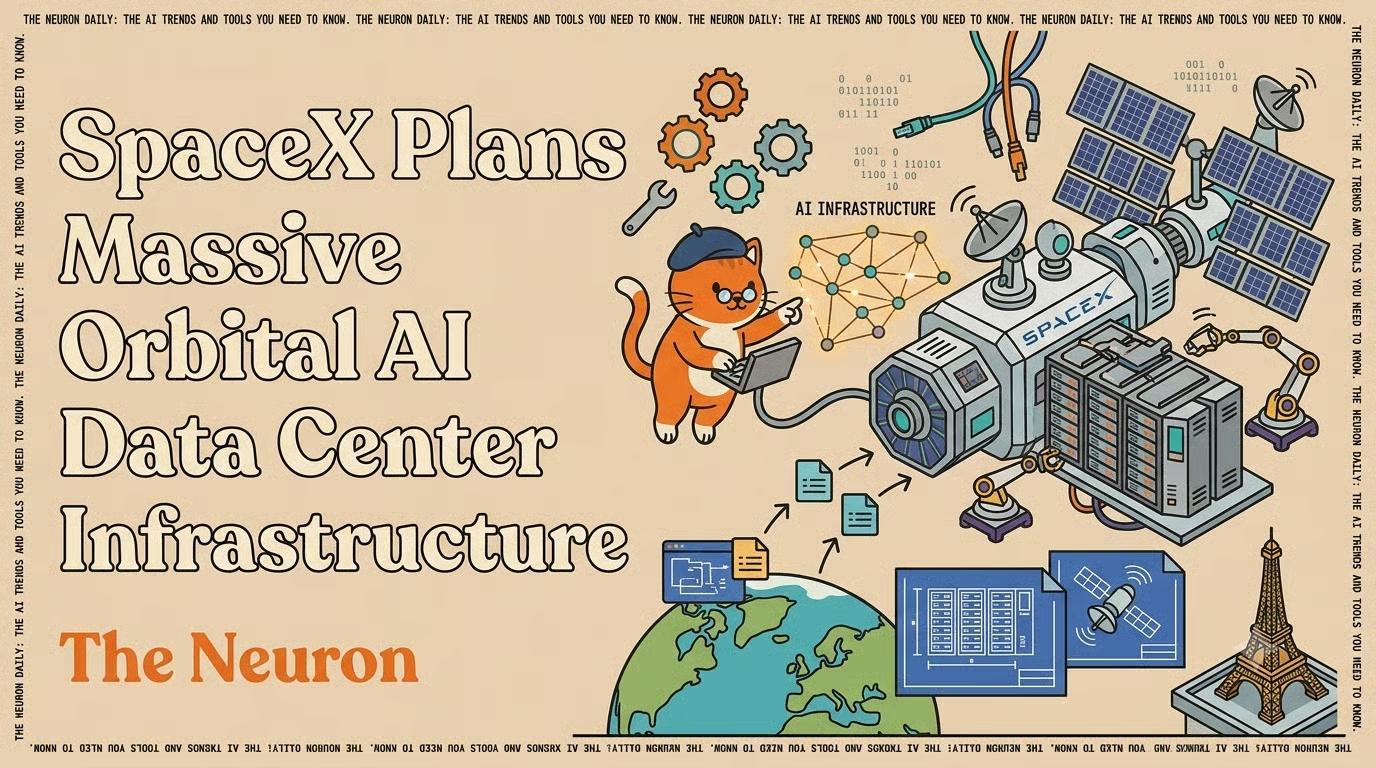
The numbers tell a compelling story. With demand reportedly hitting roughly $250 billion and BlackRock placing a $5 billion order alone, this became the largest IPO in history. But here’s what makes this different from typical space company valuations: investors are pricing rockets, Starlink, and AI infrastructure as one interconnected story.
Why Data Centers, Not Rockets, Drive the Valuation
The obvious narrative focuses on SpaceX’s launch capabilities and satellite internet through Starlink. The actual investment thesis runs much deeper into the physical constraints facing AI companies today. As The Neuron points out, AI companies are increasingly running into very real bottlenecks: chips, electricity, cooling, land, and the infrastructure needed to move data efficiently.
This shift represents a fundamental change in how the AI industry operates. What once felt like pure software is now behaving more like heavy industry, with companies fighting over power grids, water access, labor pools, and construction permits for massive data centers.
SpaceX occupies a unique position within this infrastructure puzzle. The company already controls a global satellite network through Starlink and possesses unmatched launch capacity for deploying additional hardware in orbit. If AI computational demands continue their exponential growth trajectory, this combination starts looking less like transportation and more like critical infrastructure.
The Infrastructure Bottleneck That’s Reshaping AI
To understand why investors are willing to pay a trillion-dollar premium, you need to consider the physical reality of AI scaling. Every major AI breakthrough requires exponentially more computational power, but Earth-based data centers face increasingly difficult constraints.
Land acquisition in suitable locations becomes more competitive and expensive. Power grid capacity in many regions can’t support the electricity demands of large-scale AI training. Cooling requirements strain local water resources. Environmental regulations create lengthy approval processes for new facilities.
SpaceX potentially sidesteps many of these limitations. Orbital infrastructure doesn’t compete for terrestrial real estate, power grids, or water supplies. The regulatory framework for space-based computing remains largely undefined, potentially offering faster deployment timelines.
The Bull and Bear Cases for Space-Based AI Computing
Investors backing SpaceX’s astronomical valuation are betting on a clear progression: Starlink becomes the high-speed data pipeline, SpaceX launches provide the deployment capability, and AI companies purchase capacity or connectivity as a service.
This bull case envisions a future where major AI training runs happen in orbital data centers, connected to Earth through Starlink’s low-latency satellite network. The model offers scalability without terrestrial constraints and potentially lower operational costs once initial deployment hurdles are overcome.

The bear case raises fundamental questions about the practicality of space-based computing. Maintenance and upgrades become exponentially more complex in orbit. Radiation exposure affects electronic components. Launch costs, despite SpaceX’s improvements, still represent significant overhead compared to building terrestrial facilities.
Thermal management in space presents unique challenges, and the economics of orbital computing remain largely theoretical. Critics argue that investors are paying premium prices for an unproven concept that may never achieve cost parity with Earth-based alternatives.
What This Means for India’s AI Ambitions
For Indian investors and companies watching this development, SpaceX’s IPO represents both opportunity and challenge. At roughly ₹11,475 per share (converting from the $135 USD price), retail investors gained unusual access to what’s typically an institutional-only investment.
India’s own space program through ISRO and growing AI sector could potentially benefit from or compete with SpaceX’s infrastructure play. Companies developing AI applications might eventually access orbital computing resources, while Indian space technology firms could explore similar infrastructure opportunities.
The pricing also signals where global capital sees the future of AI infrastructure heading. If space-based computing proves viable, it could level the playing field for countries without extensive terrestrial data center infrastructure.
The Elon Premium and Market Psychology
As The Neuron observes, this valuation includes a substantial “Elon premium” on top of the core infrastructure thesis. Musk’s track record with Tesla and previous SpaceX achievements creates investor confidence, but also introduces volatility based on leadership perception rather than fundamental business metrics.
The market didn’t buy a traditional space company worth over a trillion dollars. Instead, investors purchased a potential solution to AI infrastructure constraints, with significant speculation about future technological feasibility.
Implications for the Broader AI Industry
SpaceX’s IPO success signals a broader recognition that AI’s continued advancement depends as much on physical infrastructure as algorithmic breakthroughs. Companies focusing solely on model development may find themselves constrained by infrastructure availability and costs.
This shift could accelerate investment in alternative computing paradigms, from quantum systems to distributed edge networks. It also highlights the increasing importance of infrastructure companies in AI value chains, potentially reshaping how the industry allocates capital and resources.
The Reality Check
While the IPO represents massive investor confidence, SpaceX now faces the challenge of proving that orbital computing can deliver on its theoretical advantages. The company must demonstrate that space-based AI infrastructure offers genuine benefits over terrestrial alternatives, not just an expensive proof of concept.
Success would fundamentally alter how we think about AI scalability and global computing resources. Failure could represent one of the most expensive investor mood boards in history, as The Neuron wryly notes.
For now, SpaceX has the capital to test whether the future of AI computing lies not in massive terrestrial facilities, but in the infinite expanse of space itself. The next few years will determine whether this trillion-dollar bet pays off or becomes a cautionary tale about the limits of ambitious infrastructure speculation.