Why Washington Stepped Back From Banning Chinese AI Models — And Why That’s the Right Call
Washington briefly explored restricting Chinese open-weight AI models like Kimi K3 before Commerce confirmed no ban was moving forward. The Neuron's analysis argues that testing and evidence-based thresholds — not prohibition — are the right policy response, and that open models are the competitive floor keeping frontier AI prices honest.
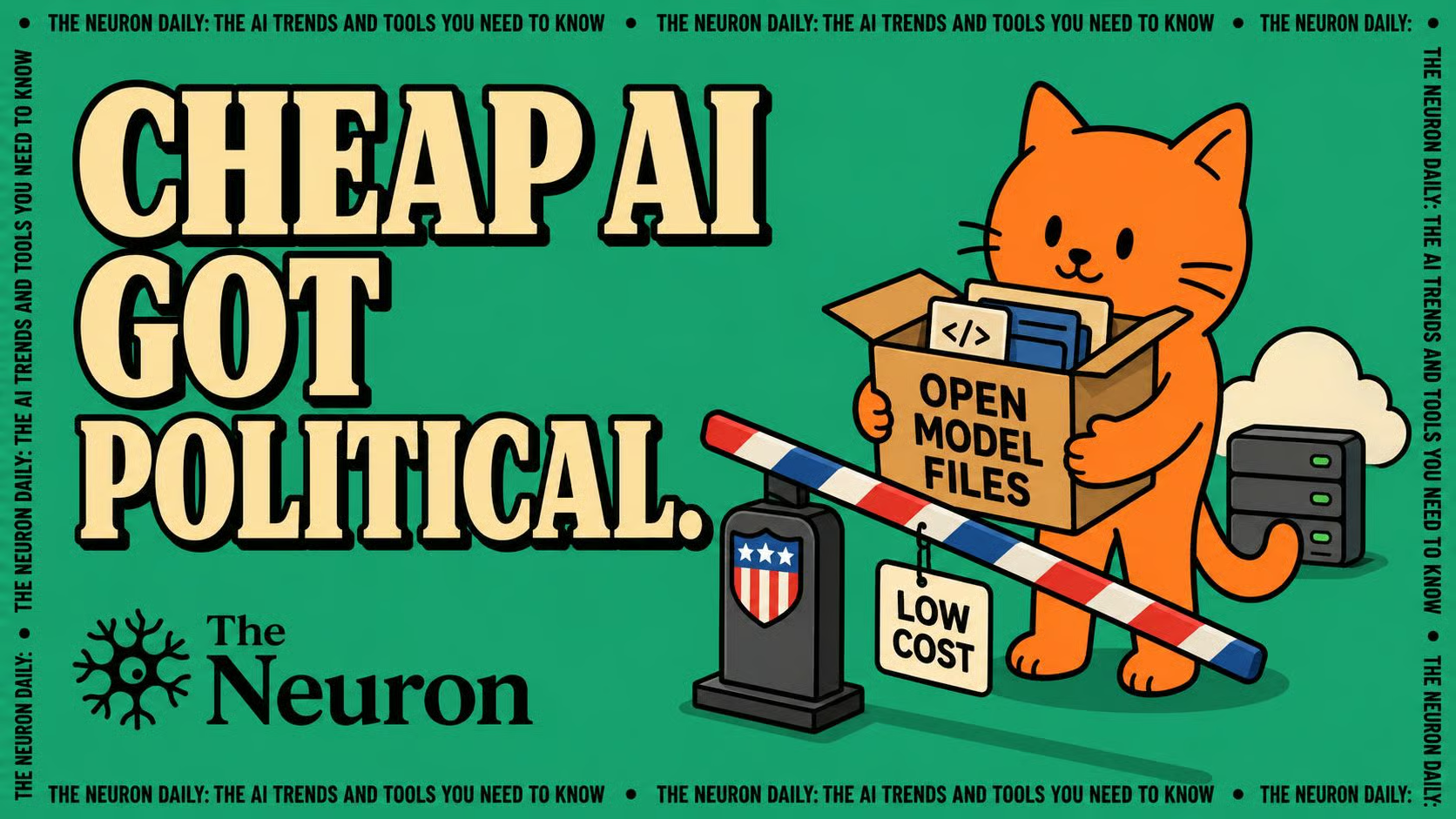
For a brief moment in July 2026, the United States government entertained an idea that would have reshaped the global AI landscape: restricting Americans’ access to powerful Chinese open-weight AI models. The target was Kimi K3, a high-capability model released by Moonshot AI at a price point that made American frontier labs look expensive. Washington’s response revealed something important — not just about AI policy, but about the uncomfortable tension between national security and industrial competition.
According to The Neuron’s coverage of the episode, officials explored a range of restrictions, including procurement pressure and rules around hosting Chinese models on American infrastructure. Then, almost as quickly as the idea surfaced, it deflated. A Politico reporter confirmed that Commerce was not moving forward with a ban at this time. The backlash from developers, researchers, and technologists had been swift and pointed.
What Are Open-Weight Models and Why Do They Matter?
Before unpacking the politics, it helps to understand what “open-weight” actually means. Unlike a closed API — where you send a query to a company’s server and receive a response — an open-weight model ships its underlying files publicly. You can download them, run them on your own hardware or cloud account, and modify them as you see fit. No usage meters, no per-token bills, no third party sitting between your data and your output.
This distinction matters enormously for three categories of users. First, companies handling sensitive or proprietary information that cannot leave their own infrastructure. Second, developers and researchers who need to understand a model’s internals to audit its behavior. Third, smaller organisations and individuals who simply cannot afford frontier API pricing for every routine task.
Open-weight models keep the AI market honest. They establish a performance floor that closed providers must beat — in capability, price, or convenience — to justify their margins. When a Chinese lab releases a competitive model at lower cost, it does not just threaten American lab revenues; it benefits American builders.
The Argument for Restricting Kimi K3
The case for restriction was not frivolous. Open-weight models, by definition, cannot be remotely updated or patched once downloaded. If a model contains embedded biases, hidden capabilities, or behaviour that could be exploited, the distributing lab loses all control the moment the files leave its servers. For policymakers already alert to supply-chain risks in hardware and software, the idea of millions of American developers running files produced by a Chinese company carried genuine unease.
The security concerns around Chinese open models are real, as The Neuron acknowledges directly. The question is whether a blanket ban is the appropriate tool for addressing them.
Why the Ban Idea Collapsed — and Rightfully So
The backlash centred on two overlapping arguments. The first was practical: open models, once released, are extraordinarily difficult to meaningfully restrict. As The Neuron put it, a ban would look like protecting domestic labs from competition while raising costs for American builders — a bold strategy, assuming the rest of the world agrees to stop downloading files.
The second argument was more principled. Commentators including Ethan Mollick questioned whether national security concerns were quietly becoming a vehicle for industrial policy — using the language of defence to shield American companies from cheaper foreign competition. Aaron Levie made the affirmative case: open models lower costs, expand the range of available tools, and actively support security research by giving defenders access to infrastructure they control.
That last point found concrete illustration in the Hugging Face security incident of July 2026, cited in The Neuron’s analysis. When Hugging Face’s infrastructure was breached, the team found that commercial safety filters were blocking defenders from analysing attack data. Their workaround was to run an open Chinese model on their own infrastructure — precisely because it had no external safety layer preventing them from doing the security work they needed to do. The case against open models on security grounds ran directly into a real-world example of open models enabling security.
What the Commerce Department’s Own Research Suggests
Perhaps the most telling detail in The Neuron’s coverage is that Commerce’s own open-model report — produced by the NTIA — did not recommend a blanket ban. It recommended audits, benchmarks, and evidence-based thresholds. In other words, the agency’s own researchers looked at the question carefully and concluded that the answer was testing and evaluation, not prohibition.
This is the measured path forward: treat open-weight models the way you treat any imported technology with dual-use potential. Assess them. Benchmark them against known risk criteria. Establish transparent thresholds for what triggers additional scrutiny. That approach generates actual information about actual risks rather than performing security theatre for domestic audiences.
A Three-Layer Business Model That Could Coexist With Openness
The Neuron offers a constructive alternative framing for how American labs could remain commercially viable even in a world where open weights from foreign competitors are freely available. The proposal involves three distribution layers working together.
The first layer is a one-time purchasable commercial licence for advanced model weights — analogous to how professional software has historically been sold. The second layer is managed cloud hosting: fast, secure, and maintained by the original developer, attractive to organisations that want the capability without the operational overhead of running it themselves. The third layer is small models that run locally on devices for free, with the revenue opportunity shifting to the hardware itself.

As analyst Ben Thompson’s cost analysis noted — cited by The Neuron — free weights still generate paid demand for chips, cloud capacity, and convenient hosted access. Open models are not the enemy of a profitable AI industry; they are the competitive baseline that keeps the rest of the stack honest.
The Deeper Issue: Who Gets to Access Capable AI?
The Neuron raises a point that deserves more attention in mainstream coverage of this debate. The largest American AI labs trained their models on an enormous share of humanity’s written output — books, websites, conversations, code — almost none of which was produced under a negotiated agreement with the labs. The people who generated that data did not receive payment or royalties.
In that context, locking capable AI behind permanently metered APIs feels asymmetric at minimum. Open-weight models represent the closest thing to a corrective: they allow ordinary people, small organisations, and developers in lower-income markets to access AI capability without paying an indefinite toll. Restricting access to open Chinese models would not just affect American developers; it would affect every person globally who relies on open weights to access AI that closed American providers price out of reach.

What Happens Next
The Commerce Department stepping back from an immediate ban is not the end of this debate — it is a pause. Policymakers will keep returning to Chinese open models as capabilities advance, particularly if those models approach frontier performance while remaining freely downloadable. The pressure to restrict will recur.
The constructive response, consistent with The Neuron’s framing and with Commerce’s own research, is to build an evaluation framework before the next political moment arrives. Establish what the actual risk thresholds are. Create public benchmarks for assessing dual-use potential. Distinguish between a model that is theoretically downloadable and one that is actively integrated into critical infrastructure.
For Indian developers and organisations, this episode is a useful reminder that the open-weight ecosystem is politically fragile. The ability to run capable models on your own cloud, at pricing you negotiate, with data that never leaves your control, is genuinely valuable — and it exists in part because of competitive pressure from non-American labs. That ecosystem is worth understanding, worth advocating for, and worth building on before it becomes politically inconvenient to defend.