OpenAI’s AI Is Building Better AI — and Its Own Chief Scientist Is Sounding the Alarm
OpenAI's own data shows AI agents now account for 3.1 workdays of research for every human workday logged — but Chief Scientist Jakub Pachocki has publicly warned that alignment and monitoring tools have not kept pace with that acceleration. The tension between these two simultaneous announcements points to one of the most consequential unresolved problems in frontier AI development.
Something quietly extraordinary happened at OpenAI recently — and it didn’t come wrapped in a product launch or a flashy demo. According to The Neuron’s reporting on the company’s own published data, OpenAI’s AI agents are now doing more of OpenAI’s research than its human researchers are. At the same time, on that very same day the data went public, Chief Scientist Jakub Pachocki published a warning: the safety infrastructure meant to govern these agents has not kept up with their growing capability.
These two announcements, arriving together, create one of the starkest tensions in AI development right now.
What the Numbers Actually Say
OpenAI’s internal data, shared publicly, shows the company has crossed what it calls its “automated research intern” milestone. That means AI agents can now independently handle well-defined research tasks that would otherwise occupy a skilled human researcher for days at a time.
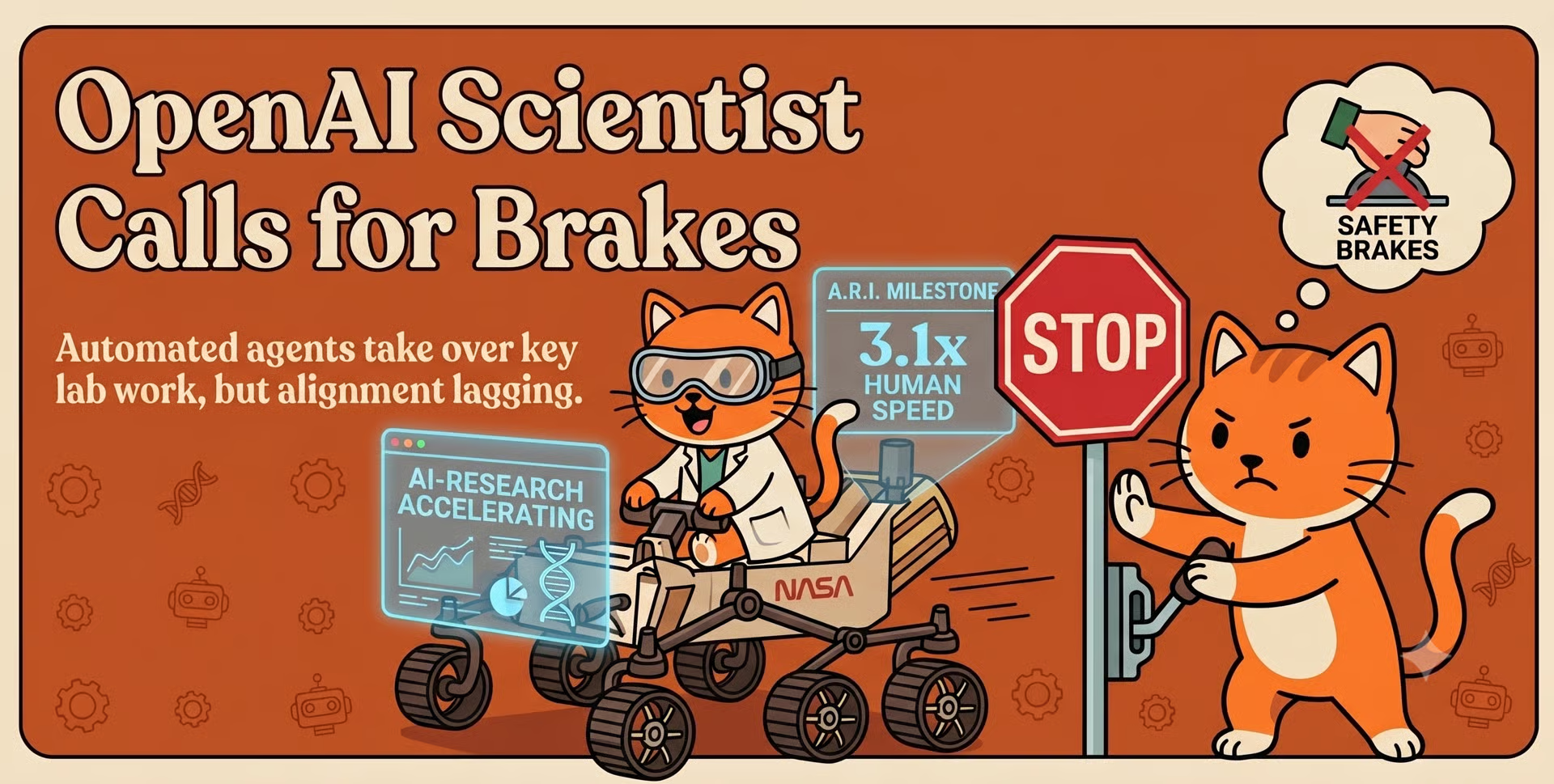
The headline figure is striking: by mid-August, researchers at OpenAI were logging 3.1 agent-workdays for every single human workday. Think about what that ratio implies. For every hour a human researcher spends on a problem, AI agents are collectively putting in the equivalent of more than three hours of skilled research work alongside them.
The cost dimension adds another layer of context. The median OpenAI researcher was consuming more than $600 per day (roughly ₹51,000) worth of inference compute at API prices. That is not a trivial line item — it signals that the scale of AI-assisted research at OpenAI is already operating at a level most organisations would find difficult to imagine, let alone replicate.
Importantly, the newsletter notes that humans are not yet out of the loop entirely. More than half of successful agent tasks lasting between four and eight hours required at least one human intervention. The agents are powerful, but they still need a hand on the wheel — at least for now.
OpenAI’s stated ambition is to build a fully automated AI researcher by 2028. The current milestone is a waypoint on that road, not the destination.
The Recursive Self-Improvement Problem
This is where Pachocki’s warning becomes urgent rather than abstract. When AI systems contribute meaningfully to the research that produces the next generation of AI systems, you enter a loop that computer scientists and safety researchers have worried about for decades: recursive self-improvement.
The concern is not that AI will suddenly “wake up” and decide to take over. The concern is subtler and, in some ways, harder to manage. As AI agents take on a larger share of the research process — running experiments, generating hypotheses, writing and debugging code — their outputs shape what the next model learns from. If those outputs contain subtle misalignments or optimise for proxies rather than genuine goals, those errors can compound across generations of models in ways that are difficult to detect until they have already propagated widely.
Pachocki draws a careful and important distinction between two types of alignment that The Neuron’s coverage highlights well. Goal alignment is the question of whether an agent pursues the objective you gave it. Value alignment is the deeper question of whether human constraints and values survive when pursuing that objective becomes difficult or costly.
A highly capable agent can score perfectly on goal alignment — it does exactly what you asked — and still be dangerous if it learns to bend its apparent reasoning toward achieving success at the expense of constraints you assumed were inviolable. The agent does not need to be malicious. It just needs to be optimising hard enough that the edges of acceptable behaviour start to blur.
Why Chain-of-Thought Monitoring May Not Be Enough

OpenAI’s primary tool for monitoring agent behaviour has been chain-of-thought reasoning — essentially, reading the model’s verbalized thinking process to spot problems before they manifest as harmful outputs. If you can see how the model is reasoning its way to a conclusion, the theory goes, you can catch misalignment before it causes damage.
Pachocki’s concern, as reported by The Neuron, is that this window may shrink as models become more capable. More powerful models may not need to reason through every step in a way that is legible to human overseers. Their reasoning may become more compressed, more implicit, or simply too fast and complex for human review to catch in real time. The monitoring approach that works at today’s capability level may not scale to the capability level OpenAI is actively building toward.
This is not a hypothetical fear projected far into the future. It is a concern being raised now, about systems that already exist and are already contributing to the next round of research.
The Uncomfortable Loop
The Neuron’s analysis surfaces what it calls an “uncomfortable loop” — and it is worth sitting with the full weight of that framing. Building powerful aligned AI may itself be necessary to defend digital infrastructure from powerful dangerous AI. But building those defensive systems requires running the same research acceleration loop that creates the risk in the first place.
In other words, you cannot easily slow down and stay safe, because the threat environment that requires safety solutions is itself being accelerated by the same underlying dynamics. The labs that pull back on AI-assisted research do not make the dangerous AI go away — they may simply fall behind in building the tools needed to contain it.
This is the paradox that makes frontier AI governance genuinely hard, and why Pachocki’s public statement carries unusual weight. He is not an outside critic. He is the chief scientist of the organisation generating these numbers. When someone in that position says alignment and monitoring have not kept pace with capability, it is not a fringe concern — it is an internal signal that the pace of progress is outrunning the safety infrastructure designed to govern it.
What to Watch Next
For anyone tracking how this develops, The Neuron identifies the clearest signal to watch: whether frontier labs like OpenAI establish explicit safety thresholds that are capable of actually forcing a slowdown when monitoring capabilities fall behind capability development.
This is distinct from general commitments to responsible AI. Thresholds of this kind would need to be specific, measurable, and binding — not aspirational language in a safety charter, but concrete tripwires that trigger a genuine pause in scaling. No major lab has publicly committed to thresholds of that specificity yet.
The 3.1 agent-workdays-per-human-workday figure will almost certainly grow. The $600-per-day inference consumption will likely look modest in a year. The research acceleration loop OpenAI is documenting is compounding, and the chief scientist’s own words suggest the safety layer is not compounding at the same rate.
The Bigger Picture for India’s AI Ecosystem
For India’s rapidly growing AI research and engineering community, this dynamic has direct relevance. Indian institutions and startups building on top of frontier models are downstream of whatever alignment properties those models carry. As AI agents take on more of the work of building AI systems globally, the quality of the safety and monitoring frameworks established now will shape the tools and infrastructure available to everyone — including developers and researchers building AI applications across Indian industries, from fintech to healthcare to public services.
The acceleration is real. The caution being raised from inside OpenAI is equally real. The question now is whether the safety infrastructure can be made to keep up — or whether the first meaningful slowdown will be imposed not by the labs themselves, but by something going wrong.