SpaceX Acquires Cursor for $60 Billion: Why Elon Musk’s Rocket Empire Just Bet Big on AI Coding
SpaceX is acquiring Cursor's parent company Anysphere in a $60 billion all-stock deal, signalling that AI coding tools have become strategic infrastructure. With a new frontier model called Composer 3 in the pipeline, the Anysphere-SpaceX combination could emerge as a serious fourth player in the global frontier AI model race.
The Deal That Shook the AI World
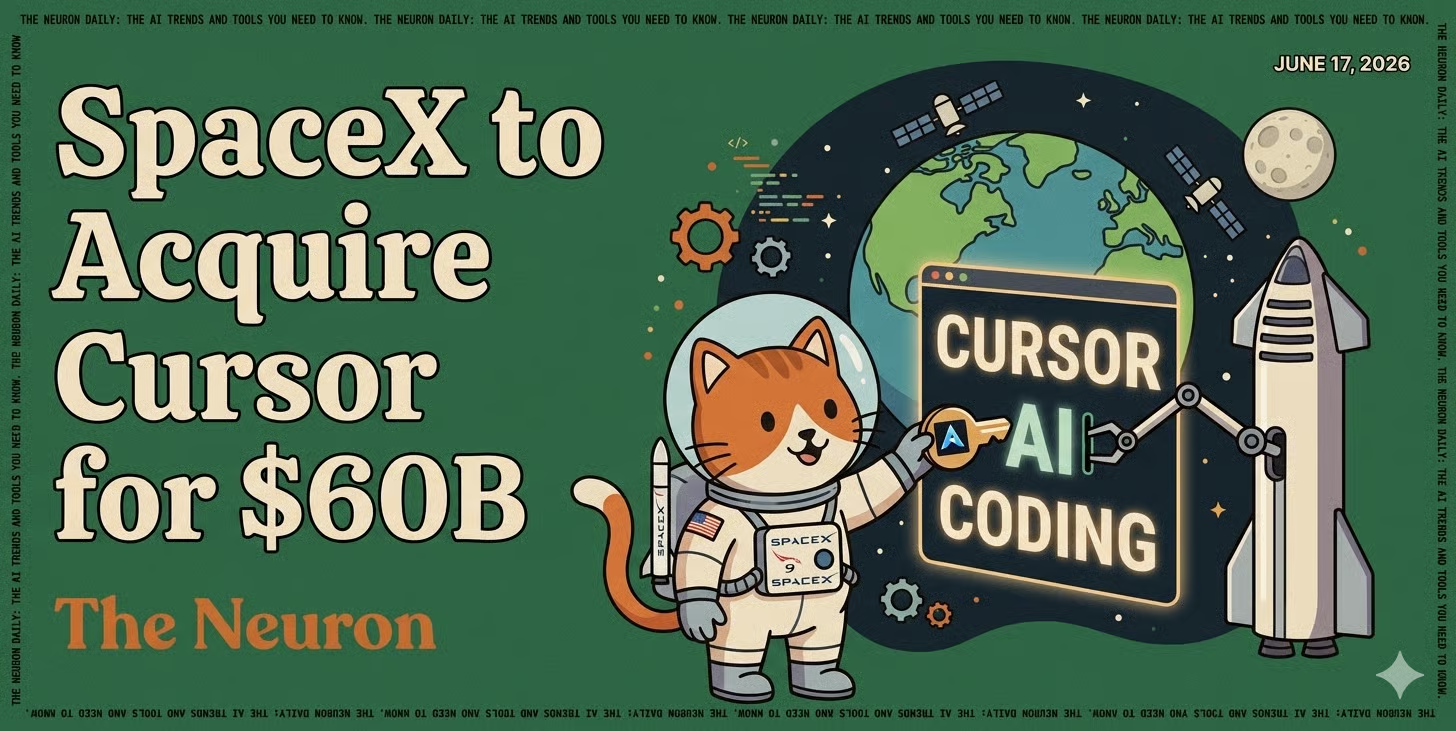
When most people think of SpaceX, they picture rockets, Starlink satellites, and Elon Musk’s ambitions to colonise Mars. They do not picture a code editor used by millions of software developers. But as reported by The Neuron citing Axios and Business Insider, SpaceX is set to acquire Cursor — the AI-powered coding tool built by startup Anysphere — in an all-stock deal worth $60 billion (approximately ₹5.1 lakh crore). The deal is expected to close in Q3 of this year, arriving just days after SpaceX’s record-breaking IPO.
To understand why this matters, you need to look at both what Cursor actually is, and what SpaceX might be trying to become.
What Is Cursor, and Why Is It Worth $60 Billion?
Cursor is an AI-native code editor — a development environment where AI isn’t bolted on as an afterthought but woven directly into the experience of writing, reviewing, and shipping software. Developers use it to autocomplete code, generate entire functions from natural-language prompts, debug errors, and navigate large codebases with conversational ease. It has grown from a niche tool to one of the most widely used AI developer products in the world.
The numbers behind the acquisition are striking. According to The Neuron, Anysphere has raised $3.38 billion since its founding in 2022, with backing from major investors including Thrive Capital, Andreessen Horowitz (a16z), the OpenAI Startup Fund, and Nvidia. More tellingly, Cursor’s annualized revenue reportedly crossed $1 billion — after growing 10x in under a year. That kind of growth trajectory is what commands a $60 billion valuation, even if it feels steep at first glance.
For Indian developers and tech professionals, the valuation puts Cursor in the same league as some of India’s largest listed companies. It signals unambiguously that AI developer tooling is now considered critical infrastructure by the world’s most powerful tech players, not a side project or a productivity novelty.
The Model Ambitions: Beyond a Code Editor
What makes this acquisition even more significant is what Cursor announced at its Compile event around the same time. According to social posts shared by multiple attendees and cited in The Neuron, Cursor unveiled a new model called Composer 3. The details shared from the event are ambitious:
- Composer 3 is reportedly in the same capability class as Claude Opus and GPT-5.5
- It was trained from scratch — not built on top of any existing open model base
- It was built using 10 to 20 times more compute than the previous Composer 1 model
- It reportedly has 1.5 trillion or more parameters and was retrained across 100,000 or more GPUs
- It is described as targeting intelligence that goes well beyond coding

This is the inflection point that transforms the narrative entirely. Cursor is no longer just a smarter text editor for developers. Anysphere is positioning itself — and now, with this deal, SpaceX is positioning itself — as a potential fourth major player in the frontier AI model race, alongside OpenAI, Anthropic, and Google DeepMind. Rather than an app that sits on top of other companies’ models, Cursor could become a company that trains and deploys its own foundational intelligence.
As The Neuron notes, the Anysphere-SpaceX combination could become a legitimate contender in the frontier model landscape — and not merely a polished wrapper around someone else’s API.
Why SpaceX? The Strategic Logic
The question many observers are asking is: why would a company that builds rockets and spacecraft want to own a code editor?
The answer becomes clearer when you consider the breadth of SpaceX’s engineering operations. SpaceX is not simply an aerospace company. It operates rockets, satellites, global internet infrastructure through Starlink, autonomy systems, and advanced manufacturing at scale. Every one of those domains is software-intensive. Owning a frontier-grade coding intelligence layer means faster internal software development, reduced dependency on external AI providers like Anthropic (whose Claude models power many coding tools today), and the ability to build proprietary AI capabilities tuned specifically for SpaceX’s engineering workflows.
There is also a financial and strategic dimension. The deal is being paid in SpaceX shares, meaning the company’s sky-high post-IPO valuation effectively becomes the acquisition currency. SpaceX is using its own momentum as leverage to bring in an asset it clearly sees as long-term strategic.
The Neuron also hints at a potential synergy with Grok, Elon Musk’s AI model developed through xAI. An internal coding intelligence tool of Composer 3’s calibre, combined with xAI’s model development work, could reduce reliance on third-party model providers and consolidate more of the AI stack under Musk’s various entities.
Coding Agents Are Now Infrastructure, Not Features
This deal is part of a broader pattern. Over the past eighteen months, every major technology company has concluded that AI coding tools are not optional productivity enhancements — they are competitive infrastructure. GitHub Copilot, Amazon CodeWhisperer, Google’s Gemini Code Assist, and now Cursor under SpaceX all represent bets that the companies controlling the software development loop will control the pace of innovation across every industry.

For Indian software professionals — a community that represents one of the largest developer populations on the planet — this matters in several concrete ways. First, it signals that AI coding tools will continue to receive enormous capital investment, which typically means better products and more competition. Second, as The Neuron points out, the endgame of all this investment is a world where anyone can describe what they want to build and an AI system assembles it for them in real time. Developers who understand these tools early will have an enormous advantage in that transition.
Third, and perhaps most importantly, more competition at the frontier level keeps pricing in check. If Cursor’s Composer 3 becomes a genuine rival to GPT-5.5 and Claude Opus, enterprise pricing for AI coding tools becomes a competitive battleground rather than a monopoly premium. That pressure eventually flows down to individual developers and small teams.
What Comes Next
The deal is expected to close in Q3 of this year, and Composer 3 is reportedly expected to launch within weeks of the Compile event announcements. If the model lives up to its described specifications — 1.5 trillion parameters, trained with 10 to 20 times more compute than its predecessor — it will be a meaningful moment in the frontier model race.
For now, the acquisition stands as one of the clearest signals yet that AI coding is not a feature category. It is a platform. And SpaceX, already a company that has disrupted two industries, has decided it wants to be at the centre of a third.
Whether Cursor under SpaceX can actually compete with the entrenched model labs remains to be seen. But a $60 billion bet — roughly ₹5.1 lakh crore — is a very serious statement of intent.
“Coding agents are now strategic infrastructure.” — The Neuron
The frontier model race just gained a new, unexpected entrant. And it came wearing a spacesuit.