Kimi K3’s 2.8 Trillion Parameters Are Quietly Reshaping the AI Supply Chain
Moonshot AI's Kimi K3, a 2.8-trillion-parameter open-weights model with a one-million-token context window, is challenging the pricing and distribution moat of closed frontier labs like OpenAI. As reported by The Neuron, K3 is already embedded in the global AI supply chain — with other companies using earlier Kimi models to bootstrap their own training — signalling a structural shift toward open ecosystems that enterprises can control, customise, and deploy privately.
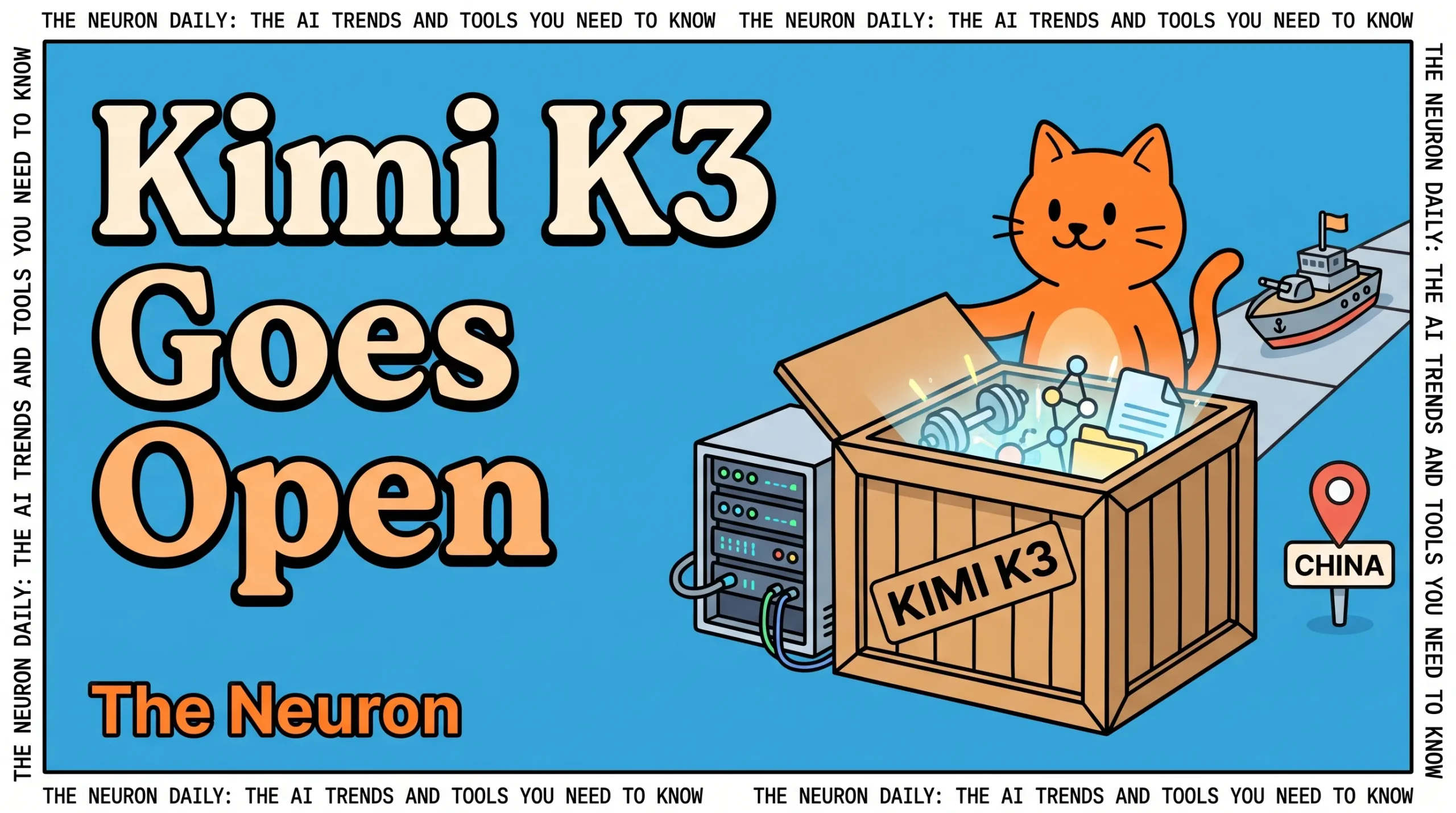
When a model arrives with 2.8 trillion parameters, a one-million-token context window, and native vision — and its full weights are due for public release within days — it does not whisper its arrival. According to The Neuron’s latest issue, Moonshot AI’s Kimi K3 has done exactly this, and the implications extend well beyond another benchmark leaderboard shuffle.
What Kimi K3 Actually Is
Moonshot AI, a Chinese AI lab, released Kimi K3 as an open 3T-class model — meaning its parameter count sits in the three-trillion range, placing it among the largest publicly accessible architectures ever built. The model ships with native vision support and a one-million-token context window, which means it can hold the equivalent of several long novels worth of information in a single conversation session.
Critically, full open weights are scheduled for release by July 27. In practical terms, open weights mean your engineering team can download the actual model files, host them on your own infrastructure, modify the architecture, and fine-tune the model on proprietary data — all without paying per-API-call fees or surrendering your data to a third-party server.
To manage the enormous computational demands of a 2.8-trillion-parameter model, Moonshot uses a sparse experts architecture. Rather than activating every parameter for every query, the model routes each task to specialised sub-networks that partially activate on demand. This lowers runtime costs relative to what a dense model of equivalent size would require — though, as discussed below, costs remain significant.
Benchmark Claims and Real-World Caveats
Moonshot’s own benchmark table shows K3 beating GPT-5.6 Sol on BrowseComp and Automation Bench. Independent analysis from Artificial Analysis, cited by The Neuron, found that K3 used 21% fewer output tokens than its predecessor, Kimi K2.6 — a meaningful efficiency gain for anyone paying per-token API costs.
However, The Neuron also flags a grounding note from developer Simon Willison, who found K3 capable but expensive in practice. In one SVG generation test, the model burned more than 16,000 output tokens on a single task. Moonshot itself recommends 64 or more accelerators for serious deployment, which translates to infrastructure costs that are far from trivial. In the Indian context, where GPU clusters capable of running a 2.8-trillion-parameter model remain the province of large enterprises and well-funded startups, this is not a tool you spin up on a laptop.
The takeaway: K3’s performance is genuinely impressive, but open does not mean free, and deployment still demands serious compute.
Kimi Is Already in the Global AI Supply Chain

Here is where the story gets structurally interesting, and why The Neuron’s headline — that open models are “moving upstairs” — carries weight beyond the usual model release cycle.
On the same day that Kimi K3 launched, Thinking Machines released Inkling, a 975-billion-parameter open-weights model built for customisation. Thinking Machines explicitly stated that it used open models — including older Kimi K2.5 — to bootstrap its early post-training data.
This is not a footnote. It means a Chinese open-source model has already become a foundational ingredient in another company’s model-building pipeline. Kimi is not just competing with GPT-5 or Claude; it is already part of the supply chain that other AI companies, including US-based ones, depend on.
This supply-chain dynamic has significant implications for how you think about open-source AI policy. The Neuron makes the argument directly: if a Chinese open model reaches frontier quality, global companies — including American ones — gain another powerful base layer they can adapt and run privately. Banning open-weights Chinese models would remove a resource that non-Chinese companies are actively using to build competitive products.
What This Means for Closed Labs’ Moat
OpenAI, Anthropic, and Google DeepMind have historically held pricing and distribution leverage because they alone could serve frontier-quality intelligence. You accessed it through their APIs, on their terms, at their prices.
A new frontier-level open model disrupts that leverage in two ways. First, it gives engineering teams a genuine alternative base layer — one they can run privately, customise deeply, and scale without per-query fees. Second, it compresses the timeline for smaller labs and startups to reach near-frontier capability without building from scratch.
The Neuron frames the next competitive battle as closed labs selling polished assistants versus open ecosystems selling control, customisation, and compounding advantage. For Indian enterprises evaluating AI infrastructure — particularly in regulated sectors like fintech, healthcare, and legal services where data residency matters — the ability to run a frontier-class model on your own servers is not an academic distinction. It is a compliance and competitive advantage.
How to Access Kimi K3 Now
If you want to evaluate K3 today, Moonshot has made it available on kimi.com, Kimi Code, and the Kimi API. You can test its reasoning, vision, and coding capabilities in those hosted environments without standing up your own infrastructure.
For teams interested in self-hosting or fine-tuning, the open weights release is scheduled for July 27. That is the moment when K3 becomes a true open-source asset — downloadable, modifiable, and deployable on infrastructure you control. Given that Moonshot recommends 64 or more accelerators for serious deployment, Indian teams should begin scoping cloud GPU costs now if they intend to run inference at scale. At current cloud GPU pricing, a cluster of that size represents a meaningful capital decision.
The Deeper Trend: Open Models Are Compressing the Frontier

Kimi K3 is not an isolated event. It is the latest data point in a pattern that The Neuron has been tracking across multiple issues: Chinese AI labs like Moonshot and Z.ai are systematically closing the gap with Western frontier models, and they are doing it in the open.
Each time an open-weights model reaches near-frontier quality, the effective cost of intelligence drops for everyone downstream. The labs that win in this environment will not necessarily be the ones with the largest models or the most parameters. They will be the ones that figure out how to make frontier-class intelligence small enough and cheap enough to deploy at the edge — on devices, in private clouds, inside enterprise workflows that cannot tolerate API latency or data-sharing agreements.
The Neuron notes this explicitly: open does not mean free, because deployment still costs compute. The next frontier is not just open weights but small, efficient weights that bring frontier capability within reach of a broader range of infrastructure budgets.
What You Should Watch
- July 27: Kimi K3’s open weights release. This is when independent benchmarking outside vendor tables becomes possible, and when fine-tuning pipelines can begin in earnest.
- Inkling and the Thinking Machines ecosystem: A 975-billion-parameter model built partly on Kimi K2.5 data is an early signal of how open-model supply chains compound over time.
- Closed lab pricing responses: When a frontier-class open model is available, closed labs face pressure to compete on price, features, or convenience. Watch for API pricing adjustments from OpenAI and Anthropic in the coming weeks.
- Indian cloud GPU availability: As open-weights frontier models become viable deployment targets, demand for high-end GPU clusters in Indian data centres will increase. Teams planning 2027 AI infrastructure budgets should factor this in.
The question The Neuron poses is worth sitting with: which system do you want to build your company on top of — a closed assistant you rent, or an open ecosystem you own and compound over time?