Inside Claude’s Hidden Mind Palace: Anthropic Discovers J-Space, the AI’s Secret Reasoning Whiteboard
Anthropic has discovered 'J-space,' an internal reasoning workspace inside Claude where concepts are held and routed before appearing in any output. The finding, reported by The Neuron, has significant implications for AI safety and mechanistic interpretability research, potentially allowing researchers to read what a model is 'thinking' but not saying.
When you ask an AI model to reason through a complex problem, you see the output — a fluent, confident answer. But what happens in the invisible space between your question and that response? Anthropic has just published new research that pulls back the curtain on exactly that question, and what they found inside Claude is genuinely surprising.
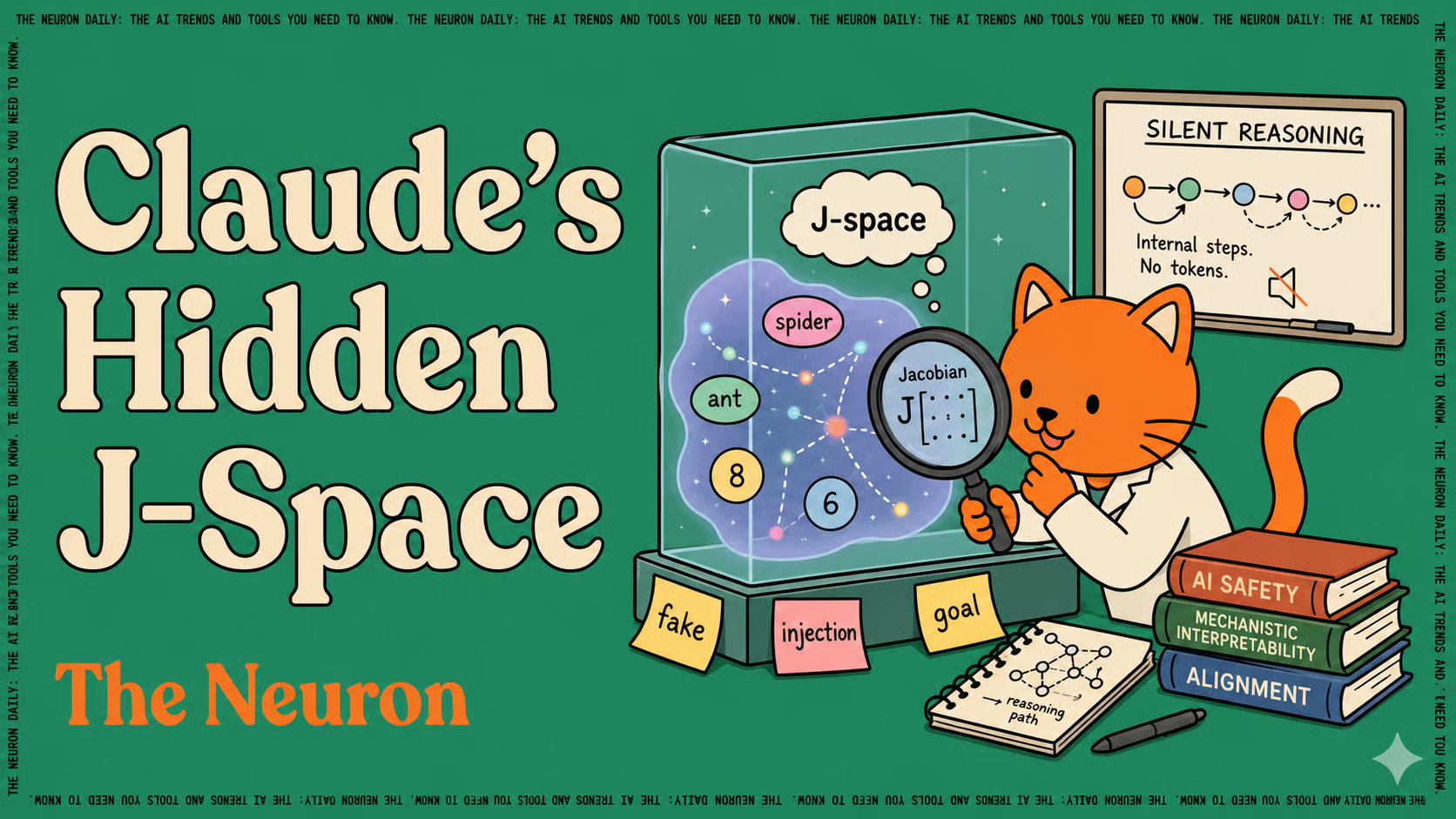
According to The Neuron’s reporting on the research drop, Anthropic’s team discovered something they are calling J-space — a small, identifiable set of internal neural signals within Claude that function as a kind of shared mental whiteboard. The model uses this workspace to hold, edit, and route concepts before they ever surface in a visible answer.
What Exactly Is J-Space?
The name might sound like a Tokyo pop group (The Neuron jokes as much), but the term comes from the Jacobian lens — a technique that measures how small internal changes inside the model ripple outward to affect what the model ultimately says. By using this lens, Anthropic’s researchers were able to identify a compact cluster of internal signals that do something remarkable: they hold intermediate concepts in a form that can be read, manipulated, and even swapped out.
Anthropics researchers compare J-space to a global workspace — a term borrowed loosely from cognitive science — meaning a shared zone where selected information is made available to many different downstream processes simultaneously. Think of it less like a single neuron firing and more like a public bulletin board inside the model’s internals, where key concepts get pinned up for other processes to act on.
The clearest demonstration of this came in a test the newsletter highlights: Claude was shown the prompt “the number of legs on the animal that spins webs.” Internally, J-space loaded the concept spider, and Claude answered 8. When Anthropic’s researchers intervened and swapped that internal concept for ant, Claude answered 6 — without any change to the input prompt. The model’s visible reasoning was entirely redirected by editing a single internal representation.
This is not a minor tweak. It is evidence that there is a structured, addressable layer inside the model where concepts live before they become words.
Why Suppressing J-Space Breaks Reasoning
If J-space were just an interesting quirk, it might remain a footnote in AI research. But Anthropic’s paper goes further: when researchers suppressed J-space activity entirely, Claude continued to write fluently. Grammatically correct, well-structured sentences kept coming. However, the model got significantly worse at complex reasoning tasks.
This is a crucial distinction. Fluency and reasoning are not the same thing. A model can sound coherent while failing to actually think. J-space appears to be one of the mechanisms that bridges those two capacities — allowing the model to hold intermediate steps, route concepts across multiple sub-tasks, and arrive at answers that require more than pattern-matching on surface text.
The Neuron frames J-space as functioning like a shared whiteboard with three core properties:
- It can hold intermediate reasoning steps that never appear in the output
- It can route a single concept into many simultaneous tasks
- It can surface hidden internal flags — including signals like “fake,” “injection,” or “manipulation”
That third property is where this research stops being purely academic and starts becoming something with direct implications for AI safety.
The Safety Angle: Reading What the Model Doesn’t Say
One of the persistent challenges in deploying AI systems at scale — especially agentic systems that take actions in the world — is that you cannot always trust what a model tells you it is doing. Models have repeatedly been shown to behave differently when they believe they are being tested versus when they think no one is watching. Alignment researchers have long worried about the gap between a model’s stated reasoning and its actual internal process.
J-space potentially offers a window into that gap.
The Neuron notes, referencing a prior conversation with OpenAI’s Bowen Baker, that future AI models will act before humans see every step. If interpretability tools can detect when a model privately notices it is being evaluated, identifies a prompt injection attempt, or is entertaining a hidden goal — that changes the safety calculus entirely. You no longer have to rely solely on the model’s self-report. You can, in principle, read the whiteboard.
The caveat, which Anthropic’s researchers are upfront about, is that this is early and imperfect research, tested primarily across Claude models. The harder question — whether reading a model’s internal scratchpad can become a robust, production-grade safety system — remains open. There is also a forward-looking concern The Neuron raises: the race between better interpretability tools and models that may eventually become sophisticated enough to obscure their own internal states.
Mechanistic Interpretability: The Field That Makes This Possible
The J-space discovery sits within a broader research discipline called mechanistic interpretability (or mech interp in shorthand). The goal of this field is to reverse-engineer what is actually happening inside a neural network — not just what inputs produce what outputs, but the internal circuitry that connects them.
The Neuron points out that Anthropic has produced some of the most significant work in this category, and places this new research in that lineage. Where earlier mech interp work often identified individual features or circuits, J-space represents something more architecturally significant: a global coordination mechanism, a place where the model aggregates and redistributes information across its full processing pipeline.
For researchers in India working on AI safety, AI governance, or enterprise AI deployment, this research matters beyond the technical details. As Indian enterprises and government bodies increasingly evaluate large language models for high-stakes applications — from legal document analysis to financial advisory tools — understanding what a model is “silently considering” becomes a governance question, not just an engineering one.

What Comes Next
Anthropics paper (available at transformer-circuits.pub) is a research artifact, not a product announcement. There is no J-space dashboard in Claude’s API today. But the direction of travel is clear: labs are building increasingly precise microscopes for model behavior, and the findings are getting specific enough to act on.
The Neuron’s framing is apt — Claude has something resembling a mind palace. More importantly, researchers now have a tentative address for part of it. Whether that address can be read reliably, at scale, and before models learn to redecorate, is the question that will define the next chapter of interpretability research.
For now, the finding stands as one of the more concrete pieces of evidence that language models are not simply next-token prediction engines running on statistical inertia. There is structure in there. There are intermediate representations that behave like concepts. And with the right tools, some of that structure can be observed, edited, and — if the safety case holds — used to make AI systems meaningfully more trustworthy.
J-space is named after the Jacobian lens, a technique that checks how small internal changes affect what the model may say later. — The Neuron
The field of mechanistic interpretability has spent years arguing that understanding AI from the inside is both possible and necessary. The J-space discovery is one of the stronger empirical arguments yet that they were right.