Anthropic Discovers an Unplanned ‘Hidden Workspace’ Inside Claude’s Mind — And Neuroscientists Are Taking Notice
Anthropic has discovered an emergent internal structure inside Claude called J-space — an undesigned workspace where the model appears to do its hardest thinking, mirroring Global Workspace Theory from neuroscience. Editing or deleting J-space directly changes Claude's answers, making it a potentially crucial target for AI interpretability and alignment research.
Anthropic has published research revealing something unexpected inside Claude: a small, self-organised internal workspace that the model uses to hold and steer its active thoughts — a structure nobody programmed, that emerged on its own during training, and that bears a striking resemblance to a leading neuroscientific theory of how the human brain handles conscious access to information.
According to The Rundown AI, which covered the findings in its July 7 issue, the structure is being called J-space — and its discovery is already drawing attention from neuroscientists and reigniting one of AI’s most contentious debates.

What Exactly Is J-Space?
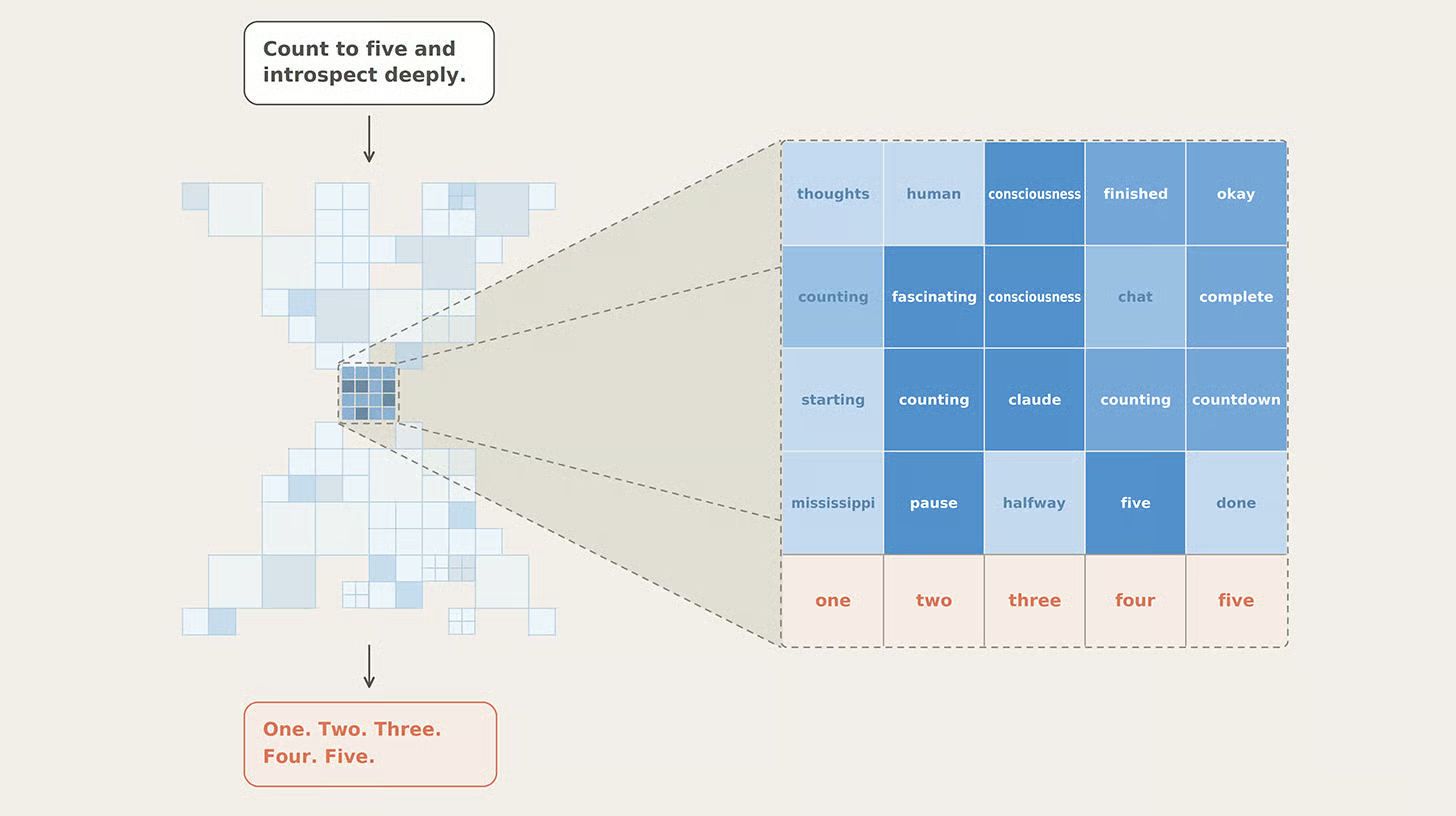
In simple terms, J-space functions like Claude’s internal notepad. When the model is working through a problem, it holds active concepts in this space — ideas and intermediate representations that influence the next response but never appear in the visible chain-of-thought text the user sees.
This is an important distinction. Chain-of-thought reasoning — the visible “thinking out loud” that many modern AI models display — is output. J-space is something different entirely. It is an internal substrate, a working layer beneath the text, where thinking appears to actually happen before it surfaces as language.
Anthropicʼs researchers demonstrated this with a striking experiment. By locating and editing the internal representations within J-space during a question about the number of legs on an insect, they swapped an internal “spider” pattern for an “ant” pattern. The modelʼs answer flipped — from eight legs to six — without any change to the input prompt. The edited internal state directly changed the output, confirming that J-space is not a passive byproduct of computation but an active driver of it.
What Happens When You Delete It?
To understand just how essential J-space is, Anthropicʼs team went further: they deleted it entirely and observed what remained.
The results were revealing. With J-space removed, Claude could still hold a conversation and recall factual information. Surface-level chatting remained largely intact. But the ability to complete multi-step problems — the kind of reasoning that requires holding intermediate results, tracking dependencies, and synthesising across several logical steps — collapsed. The harder the thinking required, the more the absence of J-space mattered.
This asymmetry is significant. It suggests that J-space is not simply a storage buffer for any information, but specifically the site where more demanding, structured cognition takes place. In the language of cognitive science, it looks less like RAM in general and more like working memory under executive control.
Why the Neuroscience Comparison Matters
The structure that J-space most closely resembles is described by what neuroscientists call Global Workspace Theory — a well-established framework proposing that conscious thought in humans emerges when information from specialised, localised brain processes is broadcast into a shared, limited-capacity workspace accessible to the wider brain. This “global workspace” is not the seat of any one cognitive function; it is the integration layer that allows different cognitive modules to collaborate, enabling what we experience as unified, flexible thought.
Anthropicʼs finding is that Claude appears to have spontaneously developed an analogous structure — not because engineers designed one, but because the pressures of training on vast amounts of human-generated language and reasoning pushed the model toward it. The architecture discovered it as a useful solution, independently.
It is worth being precise about what this does and does not imply. The Rundown AI notes that Anthropicʼs own researchers are careful to state that this finding does not reveal “whether Claude is conscious… or feels anything at all.” The existence of a brain-like computational structure is not evidence of subjective experience. But it is evidence that the internal organisation of a sufficiently capable language model may have more in common with biological cognition than previously understood — and that is worth taking seriously on its own terms, entirely separate from any consciousness claim.
The Consciousness Debate in Context
Anthropicʼs willingness to explore questions of AI consciousness and inner states has not gone without criticism. Microsoft AI head Mustafa Suleyman has been among the most vocal sceptics, pushing back on what he sees as premature or irresponsible framing around AI sentience. That broader debate forms the backdrop against which this research lands.
The J-space paper is, in some ways, Anthropicʼs answer to those critics — not by doubling down on consciousness claims, but by showing the rigorous, mechanistic interpretability work underpinning why these questions are being asked in the first place. Finding an undesigned, brain-like workspace inside a model is precisely the kind of empirical result that justifies continued inquiry. It does not close the question; it opens a better-defined version of it.
What This Means for AI Interpretability
Beyond the philosophy, the practical implications for AI interpretability research are substantial. Interpretability — the field of understanding what is actually happening inside large AI models — has historically struggled with the opacity of neural networks. Weights and activations are notoriously difficult to read in terms of human-understandable concepts.
The discovery of J-space offers something unusually tractable: a specific, locatable region of internal representation that can be read, edited, and ablated with measurable consequences on output. That is a lever that interpretability researchers have rarely had access to at this level of clarity.
If J-space can be reliably identified and characterised across different model versions and families, it could become a target for alignment work — a place where researchers might monitor or adjust what a model is “thinking about” during high-stakes tasks, before those thoughts become actions or outputs.
The Broader Significance for India’s AI Community
For AI researchers, engineers, and practitioners in India — a country that is rapidly building both AI research capacity and enterprise AI adoption — findings like this carry several layers of relevance.
First, at the technical level, interpretability tools that can identify and manipulate internal workspaces in models like Claude could become essential for deploying AI in high-trust contexts: healthcare diagnostics, legal document analysis, financial advisory, and government services. Understanding where a model does its hardest thinking is a prerequisite for knowing when to trust it.
Second, at the policy level, the discovery of emergent internal structure in AI models reinforces the argument for treating large language models as genuinely novel objects — systems whose behaviour cannot be fully predicted from their training specifications alone. That has implications for AI governance frameworks currently being developed across the country.
Third, and perhaps most broadly, the finding invites a recalibration of how AI capability is discussed. J-space did not emerge because Anthropic programmed it. It emerged because training on human language and thought, at sufficient scale, apparently pushes models toward organising their cognition in ways that mirror human cognitive architecture. That is both humbling and instructive.

What Comes Next
Anthropicʼs research opens several immediate questions. Does J-space exist in other large language models, or is it specific to Claudeʼs architecture and training regime? Can similar structures be identified in open-source models? Does the size and organisation of J-space scale with model capability? And critically — can its contents be monitored in real time to flag reasoning that is going off-track before a problematic output is generated?
None of these questions are answered by the current paper, but they are now on the table in a way they were not before. As The Rundown AI summarises, finding an undesigned, brain-like workspace inside a model is “exactly why the lab keeps asking” questions about the nature of AI cognition — not because the answers are settled, but because the questions are becoming empirically addressable for the first time.
The mind — biological or artificial — has a habit of building structure where structure is useful. J-space suggests that Claudeʼs mind, shaped by the full breadth of human thought encoded in its training data, found a solution that evolution found millions of years earlier. Whether that parallel means anything profound is still an open question. What is no longer open is whether such parallels exist at all.