Cloudflare Redraws the Rules: How AI Bot Controls Are Reshaping the Web’s Content Bargain
Cloudflare has introduced AI traffic controls that separate bots into Search, Agent, and Training categories, giving website owners granular permission management for the first time. Starting September 15, 2026, new domains will block Agent and Training bots by default on ad-supported pages, marking a significant shift in how the open web negotiates with AI companies.
For decades, the web operated on a simple, unspoken agreement: search engines crawl your content, and in return they send readers back to your door. It was a transaction that made the open internet work. Publishers got discoverability. Search engines got data. Users got answers. Everyone left the table reasonably satisfied.
AI has quietly flipped that table over.
A modern AI bot can visit your website, read every page, summarize the content into a response delivered elsewhere, and train a large language model on your writing — all without sending a single visitor back. The old bargain has been broken, and until now, most website owners had very blunt tools to respond: either allow all bots or block all bots. A nuanced middle ground simply didn’t exist at scale.
That is exactly the gap Cloudflare is now stepping into.
What Cloudflare Actually Announced
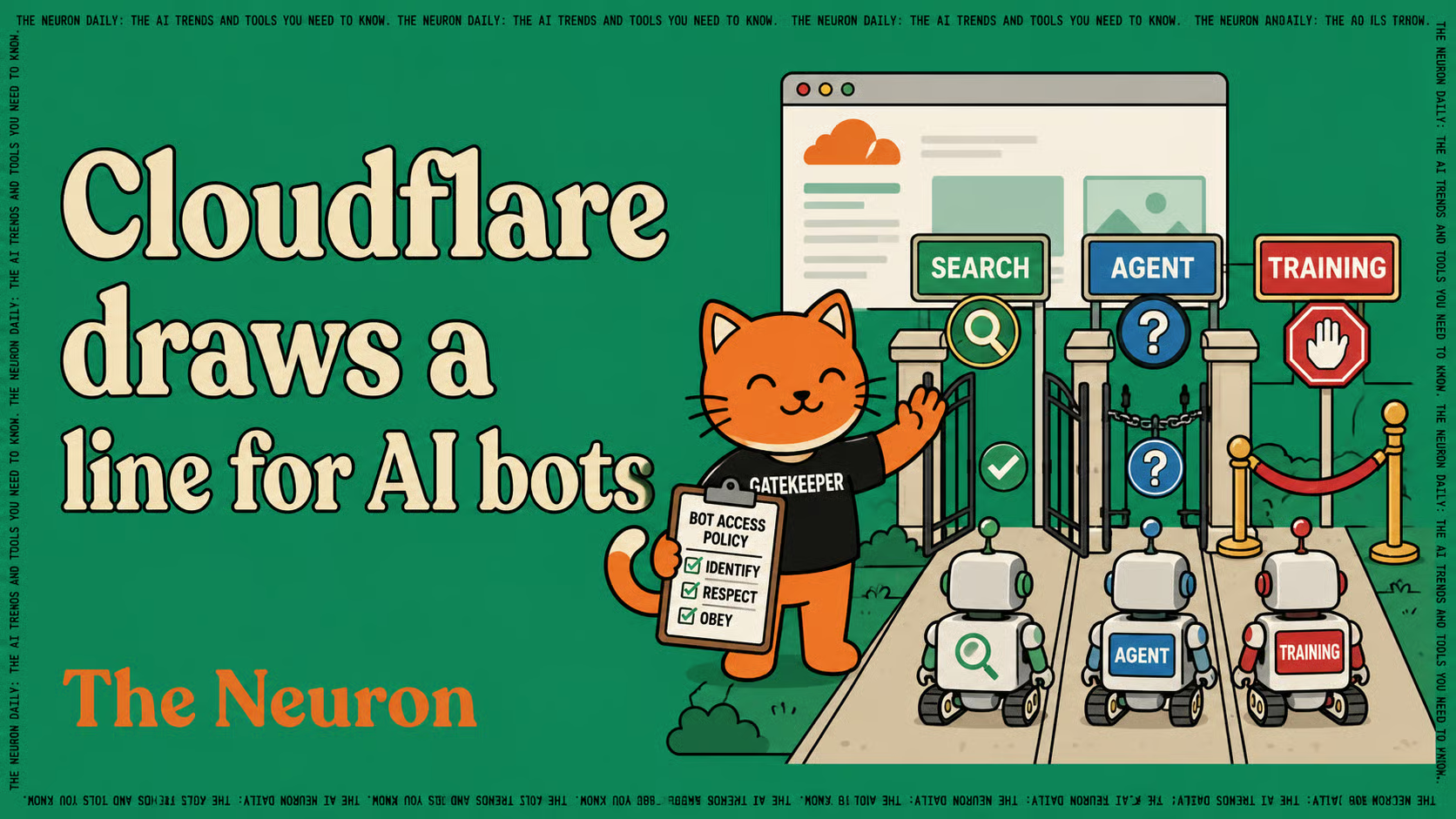
As reported by The Neuron, Cloudflare has introduced new AI traffic controls available to all customers, including those on its free tier. The core idea is deceptively straightforward: instead of treating “AI crawling” as a single, monolithic category, Cloudflare breaks bot behaviour into three distinct purposes — Search, Agent, and Training.
- Search bots index your content so it can appear in AI-powered search results and discovery tools. These are closest in spirit to the traditional search engine crawlers you already know.
- Agent bots visit your site on behalf of a specific user who has sent them to complete a task — think of an AI assistant fetching information or executing an action for someone.
- Training bots scrape your pages to build or improve AI models, often with no direct benefit returning to you as a publisher.
This taxonomy matters enormously. Each of these three use cases represents a fundamentally different deal — or lack of one — between the AI company and the website owner.
The September 15 Default Change
The policy shift carries a concrete deadline. Starting September 15, 2026, new domains joining Cloudflare will have Agent and Training bots blocked by default on ad-supported pages, while Search bots remain permitted. Existing domains are not automatically changed, but site owners are encouraged to review their AI bot traffic controls in Cloudflare’s Security settings before that date.
There is also an important nuance for multi-purpose crawlers — bots that combine Search and Training functions. If a site owner chooses to block Training bots, those hybrid crawlers fall under the stricter rule and will also be blocked. This closes a loophole where a bot could claim to be a search indexer while simultaneously harvesting training data.
The Neuron describes the effect of this architecture memorably: a robots.txt file just became a velvet rope.
Why This Is a Business Decision, Not Just a Technical One
If you publish anything online — whether you run a media outlet, a SaaS product with public documentation, a personal blog, or an e-commerce site — AI crawler policy is now inseparable from your content strategy.
Consider the different scenarios:
- A news publisher running on display advertising needs traffic. Blocking Search bots could hurt discoverability in AI-powered search surfaces. But allowing Training bots means their journalism feeds a model that may never send a reader back.
- A SaaS company with public documentation wants its product to be referenced accurately by AI assistants. Agent bots serving users who are trying to learn the product might be welcome. Training bots harvesting that documentation for a competitor’s model are a different story.
- A solo creator building a personal brand might actively want Search visibility and even Agent access, since being referenced by AI tools builds authority. But they may reasonably object to their writing style and ideas being absorbed into a commercial model without compensation.
These are genuinely different decisions, and Cloudflare’s new framework forces the question into the open. The goal, as The Neuron puts it, is not to block everything — it is to decide what kind of machine traffic actually helps your business.
The Broader Context: AI Companies and the Open Web
This move does not exist in a vacuum. The relationship between AI companies and web publishers has grown increasingly tense as the scale of training data consumption has become clearer. Publishers have argued that AI models are built on their content without meaningful compensation or traffic return. AI companies have generally pointed to fair use principles and the historically open nature of the web.
Cloudflare’s intervention is significant precisely because of its infrastructure position. Cloudflare sits between a substantial portion of the web’s traffic and the servers that host that content. When Cloudflare introduces a control at this level, it does not require publishers to individually negotiate with every AI company or manually update complex robots.txt configurations — it gives them a centralised, enforceable mechanism.
The counterargument worth acknowledging: stricter defaults could create friction for smaller AI tools and startups that rely on web data but lack the resources to strike content licensing deals. It could also make smaller, independent websites harder for AI systems to reference, concentrating AI knowledge around content from large platforms that do have licensing arrangements in place. The Neuron notes this tension directly — tighter controls may come with discoverability trade-offs.
But the broader direction of travel seems clear. The era of treating the web as an unguarded pantry for AI training data is drawing to a close.
What Should Website Owners Do Right Now?
The practical steps are more accessible than they might seem, especially for anyone already on Cloudflare.
- 1. Navigate to Security settings in your Cloudflare dashboard and look for AI bot traffic controls. These are now available on all plans, including free.
- 2. Decide on each category separately. Search, Agent, and Training bots should each be evaluated against your business model. A blanket “allow all” or “block all” is rarely the optimal answer.
- 3. Identify your high-value pages. A blog post you want discovered is different from proprietary research or premium content behind a paywall. Some pages deserve stricter protection; others benefit from broad accessibility.
- 4. Think about the September 15 deadline if you are planning to add new domains to Cloudflare. After that date, the defaults will be more restrictive for ad-supported pages, which may or may not align with your goals.
- 5. Revisit this periodically. The AI landscape is shifting fast enough that a policy set today may need revision in six months.
The Neuron frames this as making the web’s new negotiation visible — and that framing is accurate. For years, AI companies have operated in a grey zone where the rules were unclear and enforcement was nearly impossible for individual publishers. Cloudflare is not resolving the underlying economic and ethical disputes, but it is giving publishers a practical seat at the table.
The Velvet Rope Is Now Real
The web’s next chapter will likely involve layered, granular permissions governing who can access content, for what purpose, and under what conditions. Cloudflare’s three-category system — Search, Agent, Training — is an early but meaningful articulation of what that architecture looks like in practice.
For Indian publishers, this is particularly worth watching. India’s digital publishing ecosystem spans news organisations, regional language content platforms, educational resources, and millions of independent creators. Many of these publishers have seen AI tools reference and summarise their content without attribution or traffic return. The tools now available through Cloudflare offer a concrete way to assert more control, regardless of scale.
The internet has always evolved through infrastructure decisions made by a handful of companies. Cloudflare’s move to separate AI bot categories is one of those inflection points — quiet enough to miss, consequential enough to reshape how content flows across the web.