When Governments Can Switch Off AI: The Export Control Scenario That Should Be on Every Professional’s Radar
A speculative Anthropic announcement depicting US export controls that suspended access to frontier AI models globally for 18 days reveals a genuine and underplanned risk: governments can restrict cloud AI access immediately and without warning. Professionals who depend on frontier AI platforms need to understand concentration risk, tiered restoration dynamics, and the deeper question of who ultimately controls access to AI infrastructure.
There is a scenario that most AI users — professionals, developers, enterprises — have never seriously planned for. It goes like this: you wake up one morning, open your AI platform, and find that the model you built your workflow around is simply gone. Not broken. Not slow. Gone, by government order, effective immediately.
A speculative Anthropic announcement page, circulating as a hypothetical future scenario, makes this possibility viscerally concrete. It deserves serious attention — not because the specific models or dates it describes are real, but because the regulatory mechanics it depicts are entirely plausible and already partially in motion.
What the Scenario Actually Describes
The image in question depicts an Anthropic announcements page dated June 30, 2026, describing the redeployment of two frontier models — Claude Fable 5 and Claude Mythos 5 — following an 18-day suspension.
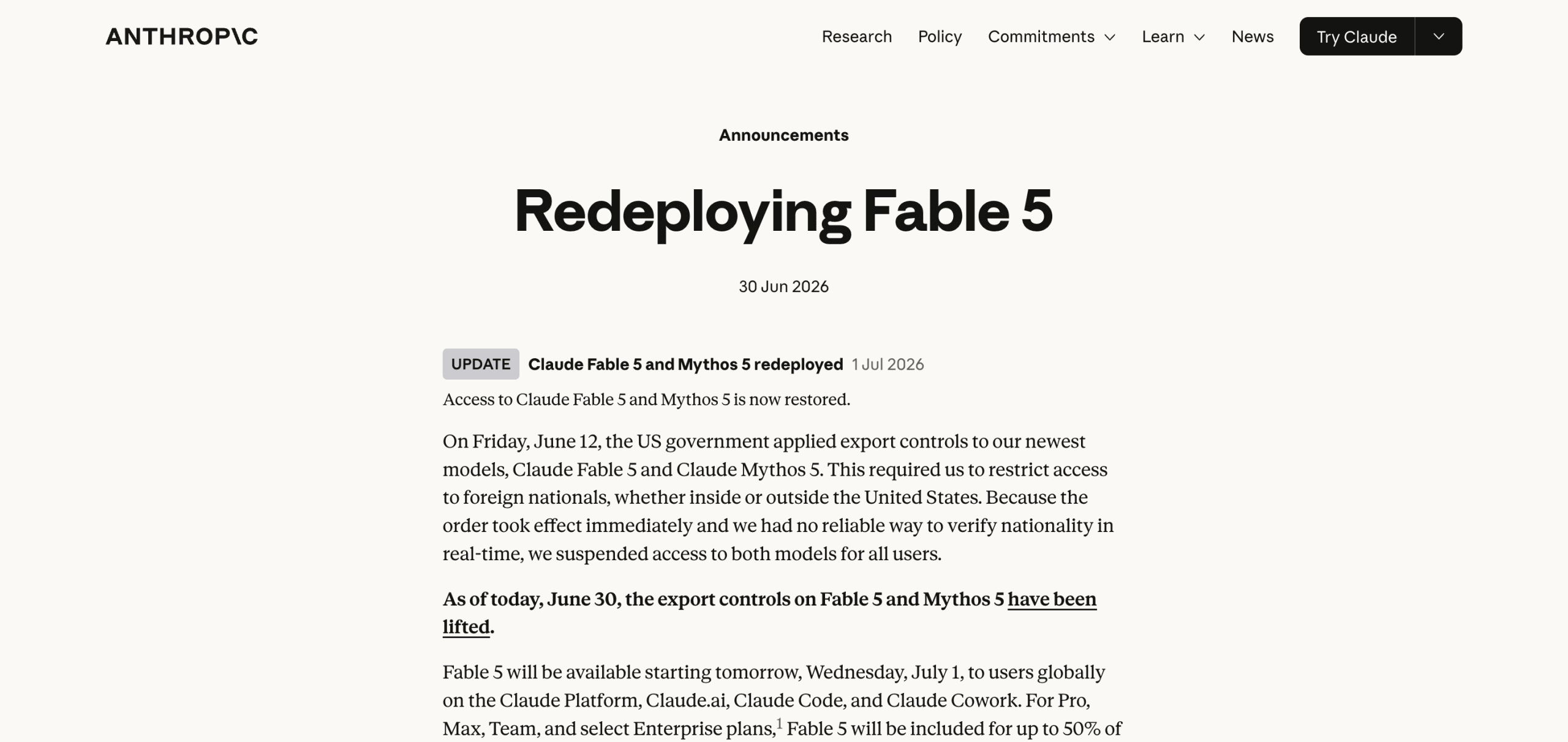
According to the scenario, on June 12, 2026, the US government applied export controls to these models. The controls required Anthropic to restrict access to foreign nationals — whether those nationals were inside or outside the United States. The critical detail: the order took effect immediately, and Anthropic had no reliable way to verify nationality in real time. The result was a full suspension for all users globally, not just foreign nationals.
The update banner at the top of the page records what happened next: as of June 30, the controls were lifted. Access was restored, with Fable 5 becoming available on July 1 across Claude.ai, Claude Code, and a future product called Claude Cowork. The partial text visible suggests that Pro, Max, Team, and select Enterprise plan users would receive access covering up to 50% of some threshold — the sentence is cut off, but the tiered restoration logic is legible.
Eighteen days. That is how long, in this scenario, a government order erased access to frontier AI capability for users worldwide.
The Regulatory Logic Is Already Real
This hypothetical does not arrive from nowhere. The United States has an extensive and evolving framework for export controls on dual-use technologies — the Export Administration Regulations (EAR), administered by the Bureau of Industry and Security (BIS). These controls already govern advanced semiconductors, the chips that train frontier AI models. The October 2022 and subsequent chip export rules that restricted sales of Nvidia’s most advanced GPUs to certain countries demonstrated that the US government is willing to use these instruments aggressively in the AI domain.
The logical extension — applying similar controls directly to AI model weights or API access — has been discussed in policy circles for years. The scenario depicted in the announcement page is not science fiction. It is a policy option that exists, has bureaucratic infrastructure behind it, and has been advocated for by researchers and officials who believe frontier AI represents a strategic technology.
What the scenario adds that most policy discussions elide is the operational problem. When a chip export control takes effect, the chips already in customers’ data centres keep working. When a model access control takes effect on a cloud-served AI, the model can vanish from every API call in the world simultaneously. The enforcement is near-instantaneous in a way that physical goods controls are not.
The Verification Problem Is the Real Story
The most technically significant detail in the scenario is buried in the first paragraph: Anthropic suspended access for all users because it had no reliable way to verify nationality in real time.
This is not a hypothetical engineering failure. It is a genuine unsolved problem. Nationality is not the same as location. Location can be approximated through IP addresses, but IP addresses are easily masked. Nationality cannot be inferred from a credit card, an email address, or even a verified government ID in most current onboarding flows. And nationality is legally and ethically distinct from citizenship, residency, and the several other categories that export control law might actually target.
For a platform serving users across every country simultaneously, the only operationally safe response to an immediate export control on nationality grounds may be exactly what the scenario depicts: suspend everything, then rebuild access verification from scratch while the lawyers work. The bluntness of that outcome — global suspension to achieve nationality filtering — is not a failure of corporate competence. It is a structural consequence of how cloud AI services work and how nationality-based export controls are written.
What This Means for Professionals Who Depend on AI Platforms
If you have built workflows, products, or client commitments on top of a frontier AI platform, this scenario is a risk you have probably not priced in. Most business continuity planning for software tools accounts for outages, pricing changes, and deprecation cycles. It does not typically account for geopolitical regulatory action that can suspend a tool globally within hours.
The implications cut several ways.
The Harder Question About AI Sovereignty
Beneath the operational detail is a more fundamental question that the scenario forces into view: who ultimately controls access to frontier AI capability, and what levers do they have over it?
The current structure of the frontier AI market concentrates that control in a small number of US-based organisations operating under US law. That is not a criticism — it reflects where the research, capital, and compute infrastructure have accumulated. But it means that regulatory decisions made in one jurisdiction propagate instantly to users in every other jurisdiction, with no prior notice and no obvious appeal mechanism for the users affected.
For any professional or organisation that treats frontier AI as critical infrastructure, this is the foundational governance question. Not which model is most capable, not which platform has the best pricing — but who can turn it off, under what circumstances, and what happens to you when they do.
The scenario on that Anthropic page is speculative. The question it raises is not.
Planning Without Panic
None of this argues for abandoning AI platforms. It argues for treating them with the same risk-aware discipline applied to any critical dependency.
That means understanding which parts of your workflow are AI-critical versus AI-enhanced. It means knowing whether your vendor has meaningful model redundancy — can they serve you on an alternative model if one is suspended? It means reading the terms of service for force majeure and government compliance clauses, which most users never do. And it means watching the policy space — US AI export control proposals, EU AI Act enforcement provisions, and bilateral technology agreements — with the same attention paid to pricing updates and feature releases.
The switch can be flipped. The question is whether you have thought about what you do when it is.