The Agentic AI Test: Which Indian BPO Jobs Face Real Disruption
While agentic AI poses real threats to basic BPO functions like data processing and simple customer service, complex roles in finance, healthcare, and legal outsourcing show greater resilience. The transformation will likely unfold over a decade, creating opportunities for human-AI collaboration rather than wholesale job replacement.
A question circulating on Reddit caught our attention: “Which industries are adopting agentic AI fastest?” For India’s 4.5 million BPO workers, this isn’t academic curiosity—it’s about economic survival. As agentic AI systems move beyond simple chatbots to autonomous decision-making, you need to understand which outsourcing jobs face genuine disruption and which remain insulated by human complexity.
The answer isn’t uniform across India’s sprawling outsourcing economy. Different BPO sectors face vastly different levels of AI penetration, and the timeline for meaningful job displacement varies dramatically depending on task complexity and client trust requirements.
Where Agentic AI Is Making Immediate Inroads
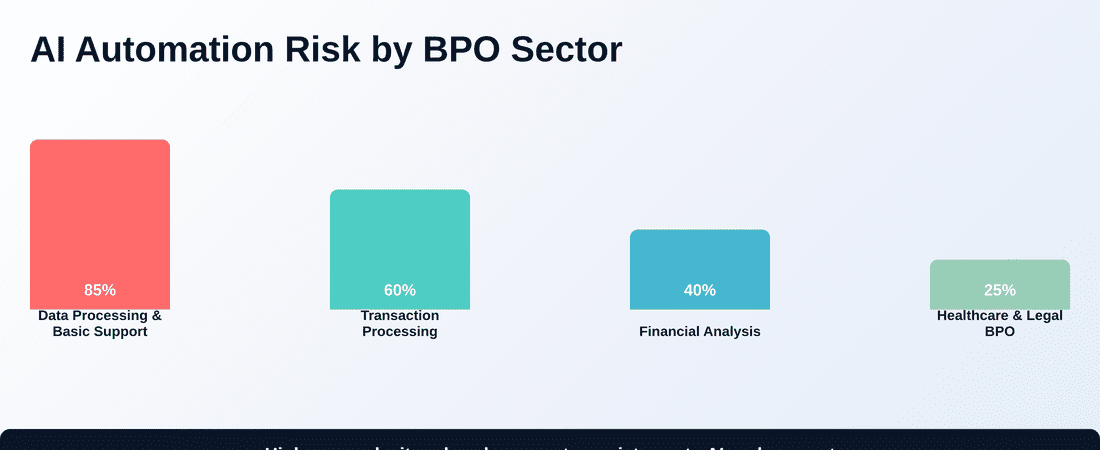
Data processing and basic customer service represent the lowest-hanging fruit for agentic AI deployment. These roles, which form a significant portion of India’s BPO workforce, involve structured tasks with clear decision trees—exactly what current AI agents handle well.
Simple transaction processing, order management, and tier-one customer support are seeing rapid AI adoption because they require minimal contextual understanding. When a customer calls to check their account balance or update their shipping address, an AI agent can handle these interactions without human intervention. The cost differential is compelling: an AI agent costs roughly ₹85-170 per month to operate, compared to ₹25,000-42,500 for a human agent including infrastructure.
Yet even in these “vulnerable” categories, the reality is more nuanced. Many Indian BPO providers report that while AI handles initial customer interactions, complex queries still route to human agents. The handoff between AI and human creates a new category of work: AI oversight and escalation management.
The Resilience of Complex Outsourcing Services
Higher-value BPO services—financial analysis, legal process outsourcing, and healthcare claims processing—show different adoption patterns. These sectors require domain expertise, regulatory compliance knowledge, and nuanced judgment that current agentic AI systems struggle to replicate consistently.
Consider financial reconciliation work, a staple of Indian accounting BPOs. While AI can identify discrepancies and flag potential issues, the investigation process requires understanding business context, regulatory requirements, and client-specific protocols. An AI agent might spot a ₹50,000 variance in accounts receivable, but determining whether it represents a legitimate business transaction or requires corrective action demands human expertise.
Healthcare BPO represents an even starker example. Medical coding, claims processing, and prior authorization reviews involve interpreting clinical documentation, understanding insurance policies, and making judgment calls about medical necessity. The regulatory environment and liability concerns mean healthcare clients move cautiously with AI deployment, preferring human oversight for critical decisions.
The Middle Ground: Augmentation Over Replacement
The most significant trend emerging in Indian BPO isn’t wholesale job replacement but human-AI collaboration. Rather than eliminating positions, many processes are evolving toward AI-augmented workflows where agents handle higher-level tasks while AI manages routine elements.
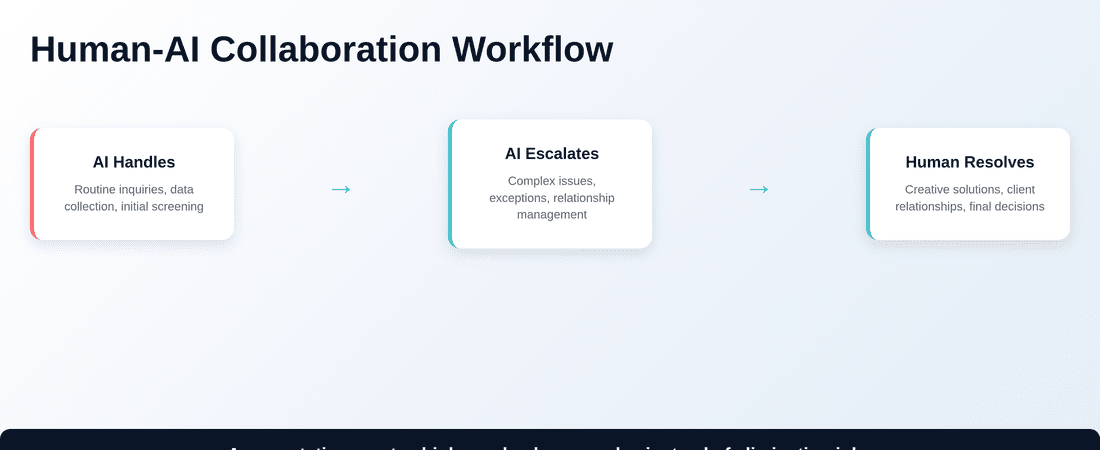
Take technical support as an example. Modern agentic AI can diagnose common software issues, walk customers through basic troubleshooting, and even execute simple fixes remotely. But when problems require creative problem-solving, understanding unique business environments, or managing frustrated customers, human agents remain indispensable.
This augmentation model actually increases the value of remaining human roles. BPO workers who adapt to working alongside AI systems often handle more complex, higher-value tasks than their predecessors. The skill requirements shift from rote process execution to AI supervision, exception handling, and relationship management.
Geographic and Market Realities Slowing Disruption
Several factors specific to the Indian BPO ecosystem slow AI adoption compared to domestic operations in developed markets. Client relationships built over decades create switching costs that extend beyond pure economics. Many Fortune 500 companies have established processes, training programs, and quality metrics designed around human agents.
Moreover, the cost arbitrage that made Indian BPO attractive remains significant even with AI alternatives. While AI agents cost less to operate than human agents, the difference isn’t always dramatic enough to justify the operational complexity of switching providers or rebuilding processes.
Regulatory considerations also play a role. Financial services and healthcare clients often require human accountability for decisions, even when AI provides recommendations. These sectors move slowly toward full automation due to compliance requirements and risk management protocols.
The Timeline Reality Check
Despite breathless headlines about AI replacing all knowledge work, the actual timeline for meaningful BPO job displacement appears more gradual. Industry analysts suggest that while certain roles will see significant AI penetration within 2-3 years, wholesale transformation of the Indian BPO sector will likely unfold over a decade.
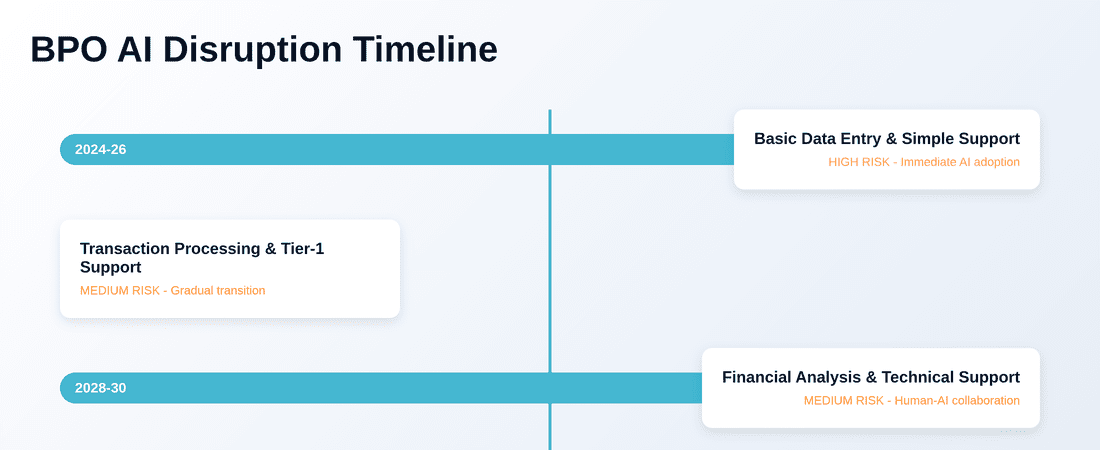
The most vulnerable positions—basic data entry, simple customer inquiries, and routine transaction processing—represent perhaps 20-30% of India’s total BPO workforce. Even within these categories, complete replacement faces practical hurdles around system integration, client acceptance, and operational reliability.
Meanwhile, roles requiring cultural understanding, complex problem-solving, and relationship management show greater resilience. Indian BPO providers who pivot toward these higher-value services position themselves better for the AI transition.
Preparing for the Inevitable Shift
While complete disruption may be years away, the writing is on the wall for certain BPO functions. The question becomes how India’s outsourcing industry adapts to remain competitive in an AI-augmented world.
Smart BPO providers are already investing in AI partnerships rather than viewing the technology as purely competitive. They’re training staff to work alongside AI systems, focusing on skills that complement rather than compete with automation. Customer empathy, creative problem-solving, and deep domain expertise become more valuable as routine tasks migrate to AI.
The transformation also creates new opportunities. AI systems require training, monitoring, and continuous improvement—tasks well-suited to India’s technically skilled workforce. Some BPO companies are repositioning themselves as AI service providers, offering not just human agents but AI agent management and optimization.
For individual workers, the message is clear: adapt or risk obsolescence. Those who develop skills in AI collaboration, exception handling, and complex problem-solving will find opportunities even as certain roles disappear. The future of Indian BPO isn’t about competing with AI—it’s about making AI more valuable through human insight and oversight.
The Reddit question about which industries adopt agentic AI fastest has a complex answer for Indian BPO. The sectors facing immediate disruption are real but limited. The broader transformation will unfold gradually, creating opportunities for those who position themselves strategically. The key is recognizing that this isn’t a zero-sum battle between humans and machines, but an evolution toward new forms of human-AI collaboration that could define the next chapter of India’s outsourcing story.