Your AI Is Not a Magic 8-Ball: The Case for Managing It Like a Workforce
A NotebookLM infographic reframes AI not as a black box but as a manageable workforce governed by structured pipelines, evaluation loops, and explicit reasoning. The essay unpacks what that shift means for professionals building reliable AI systems at scale.
There is a particular kind of frustration that comes from asking an AI model to do something complex, watching it fail, and concluding that the technology simply isn’t ready. That conclusion is, more often than not, wrong — but the instinct behind it reveals something important about how most professionals still think about AI. They treat it as a vending machine: input a request, expect an output, feel cheated when the output is broken.
A recent infographic produced by NotebookLM — titled The Prompting Playbook: Managing Your AI Workforce — challenges that mental model at its root. The metaphor it uses is not a vending machine but a factory floor. And that shift, seemingly cosmetic, carries real weight for anyone trying to build reliable, repeatable AI workflows.
The Factory Floor Metaphor and Why It Matters
The central visual in the infographic is an isometric assembly line with three clearly labeled stations: Generate, Evaluate, and Repair. Documents travel along a conveyor belt through each stage, processed by robotic arms, scanned by checkers, corrected by fixers. It is a deliberately industrial image — and it makes a pointed argument.
Managing AI well is not about finding the perfect single prompt and hoping for the best. It is about designing a system. The factory metaphor reframes the AI model as one component inside a larger pipeline, not the autonomous genius you send a vague brief to and pray over. That reframing changes everything about how you approach the work.
For professionals in India building products, automating back-office functions, or integrating AI into client deliverables, this distinction is not academic. The difference between treating AI as a black box and treating it as a manageable, optimizable process is the difference between unreliable demos and production-grade systems.
The Performance Data That Should Make You Rethink Your Stack
The infographic includes a concrete data table — labelled as a performance report on complex scheduling tasks — that illustrates the pipeline argument with numbers rather than metaphors.
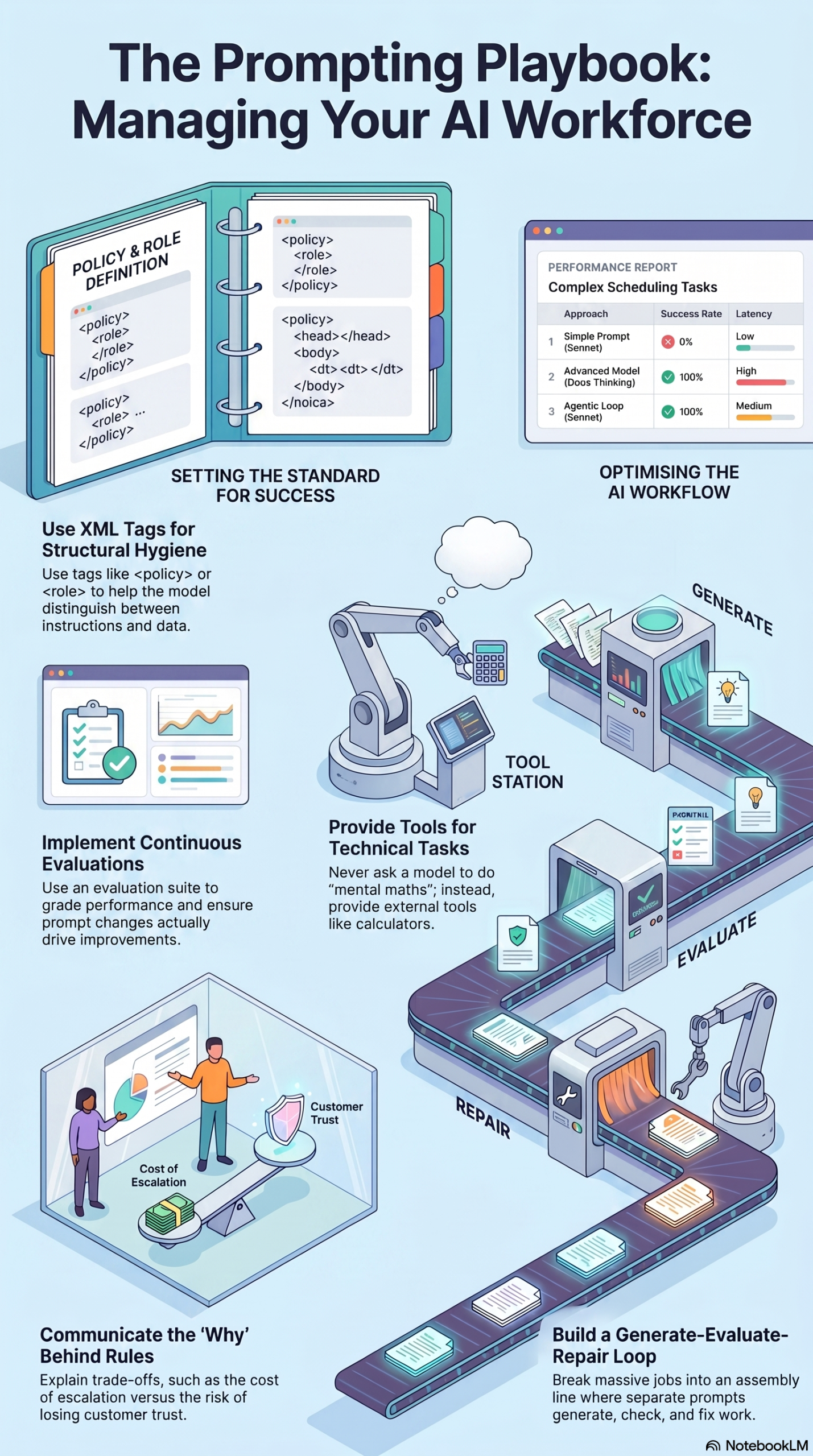
Three approaches are compared across success rate and latency:
- A simple prompt achieves a 0% success rate. It fails entirely.
- An advanced model achieves 100% success — but at high latency.
- An agentic loop also achieves 100% success — at medium latency.
The agentic loop, in other words, matches the performance of a more powerful (and presumably more expensive) model while keeping latency lower. This is a significant finding for anyone making architectural decisions about AI deployments. Throwing a bigger, costlier model at a complex task is one solution. Designing a smarter workflow around a smaller model is often a more efficient one.
For teams working within constrained compute budgets — which describes most technology organizations operating outside the largest enterprise brackets — this trade-off is directly relevant. The playbook’s argument is not that you should always use the most capable model available. It is that you should design the loop correctly first.
Structure Is Not Bureaucracy — It Is Reliability
One of the more technically specific recommendations in the playbook is the use of XML tags to achieve what it calls “structural hygiene.” The advice is to use tags like
This is not a niche concern for researchers. Any professional building prompts that combine system-level instructions with user-provided content — in a customer service bot, a document review tool, a compliance assistant — runs the risk of blurring those boundaries. XML tagging is a low-cost, high-reliability mechanism for keeping them clear.
The infographic shows a binder with tabbed sections and structured XML snippets across its pages, using the visual language of a policy manual. The implication is deliberate: prompts, at scale, need the discipline of documentation. They are not throwaway queries. They are operational instructions that should be organized, versioned, and tested.
Never Ask the AI to Do Mental Maths
Perhaps the most practically actionable piece of advice in the playbook is also the most counterintuitive for newcomers: do not ask the model to perform calculations in its head. Instead, give it access to external tools — a calculator, a code interpreter, an API.
The infographic represents this with a robotic arm at a “Tool Station” operating a calculator, a thought bubble rising above it suggesting active reasoning. The visual makes the point elegantly: the model should be directing the tool, not simulating the tool.
Language models are not arithmetic engines. They are pattern-completion systems trained on text. When you ask one to calculate precise figures across complex variables, you are asking it to do something structurally at odds with how it works. Providing a calculator-equivalent is not a workaround — it is correct system design. For any professional building AI into financial workflows, data analysis pipelines, or logistics systems, this is a foundational principle rather than a tip.
Continuous Evaluation and the Cost of Not Measuring
The playbook also addresses something that most teams skip entirely in early deployment: systematic evaluation. The recommendation is to use an evaluation suite to grade performance and ensure that prompt changes actually drive measurable improvements.
This matters because prompt engineering, without measurement, is folklore. Teams iterate on their prompts based on intuition and anecdote, with no reliable way to know whether the change they made last Tuesday made things better or worse for the 80th percentile of use cases. An evaluation suite converts that folklore into engineering.
For organizations in the process of scaling AI features — whether in SaaS products, internal tooling, or client-facing applications — the absence of evaluation infrastructure is a debt that compounds. Every undocumented prompt change is a variable you cannot control for later.
The Human Dimension: Explaining the ‘Why’ to the Model
The most humanistic section of the infographic is also the most philosophically interesting. A balance scale sits between two figures, one side weighted by the cost of escalation (represented by stacks of cash) and the other by customer trust (represented by a shield). The accompanying guidance: explain trade-offs to the model, such as the cost of escalation versus the risk of losing customer trust.
This is a striking instruction. It suggests that models perform better when given not just rules but the reasoning behind them — the same principle that distinguishes a well-managed team from a poorly managed one. An employee who understands why a policy exists is better equipped to handle edge cases than one who only knows the rule itself.
Whether or not this maps cleanly onto how large language models actually process context is a technical question worth exploring. But as a design principle — write prompts that communicate intent, not just instruction — it represents a more sophisticated relationship with AI than most workflows currently reflect.
What the Factory Metaphor Leaves Out
It is worth noting what the playbook does not address. The factory metaphor is optimized for predictability and scale, which are exactly the right objectives for production AI systems. But the metaphor also has limits: factories produce standardized outputs, while many of the most valuable applications of AI involve navigating ambiguity, exercising judgment, and handling novel situations.
The Generate-Evaluate-Repair loop is a powerful framework, but it presupposes that you can define what a good output looks like — the Evaluate stage only works if your evaluation criteria are well-specified. For complex knowledge work, those criteria are often the hardest part of the problem, not the prompting.
Still, the playbook’s core contribution stands. The professionals who will extract the most durable value from AI are not those with the best individual prompts. They are the ones who build the best systems around those prompts — measuring outputs, designing pipelines, separating concerns, and explaining the reasoning behind their rules.
The AI is not a black box you hope at. It is a workforce you design for.