Claude Sonnet 5 Is Here — But Everyone Is Waiting for Fable
Anthropic's Claude Sonnet 5 launches with meaningful upgrades in agentic coding, reasoning, and browser-use capabilities, but the release is immediately overshadowed by the return of the far more anticipated Fable 5 and Mythos 5 models after U.S. export controls were lifted. The new mid-tier model offers competitive API pricing and Opus-style agent behaviour at a lower cost, though a deliberate step back on cybersecurity benchmarks adds an unusual wrinkle to an otherwise solid upgrade.
Anthropic has officially launched Claude Sonnet 5, the first model in its new ‘5’ tier — and the timing could not be more complicated. According to The Rundown AI, the release lands just as the U.S. Department of Commerce lifted export controls on Anthropic’s far more anticipated Fable 5 and Mythos 5 models after an 18-day restriction. The result is a launch that, by almost any measure, deserves credit on its own terms but is being eclipsed before it even gets a chance to breathe.

What Sonnet 5 Actually Brings to the Table
Let’s give credit where it is due. Sonnet 5 is not a minor patch — it represents meaningful improvements in the areas Anthropic has been pushing hardest: agentic behaviour and reasoning. The Rundown AI reports that the model shows “major jumps in agentic coding and reasoning” over its predecessor, and that its knowledge work capabilities surpass even Opus 4.8, which sits higher in Anthropic’s model hierarchy. That is a notable claim, and it signals that the mid-tier Sonnet class is no longer just a cost-effective fallback — it is becoming a genuine workhorse for complex, multi-step tasks.
Perhaps the most significant practical upgrade is Sonnet 5’s ability to operate a browser or terminal and carry out longer jobs independently. This brings what The Rundown AI describes as “Opus-style agent behaviour” into Anthropic’s cheaper model tier. For developers and enterprises deploying Claude at scale in India and globally, this matters enormously. Agentic workflows — where models plan, execute, and iterate across multiple tools without constant human intervention — are rapidly becoming the standard for production AI systems. Having that capability at a lower price point opens the door for many more organisations to experiment seriously.
On pricing, the API is available at $2 per million input tokens and $10 per million output tokens (approximately ₹170 and ₹850 respectively) until 31 August, after which rates move to $3/$15 (approximately ₹255/₹1,275). The promotional window gives developers a meaningful runway to test and integrate before committing to higher spend.
The Cybersecurity Anomaly
Not everything in the Sonnet 5 scorecard is straightforward. In a detail that raised eyebrows in the AI community, The Rundown AI notes that Sonnet 5’s cybersecurity benchmarks actually come in worse than its predecessor, Sonnet 4.6. Anthropic’s own system card states the company “did not deliberately train” Sonnet 5 on cybersecurity tasks — a deliberate omission that appears directly tied to the regulatory and export-control drama surrounding Fable and Mythos.
This is an unusual admission for a major model launch. Most releases face accusations of “benchmaxxing” — the practice of optimising heavily for benchmark performance to generate headline numbers. Sonnet 5, in this particular domain, has gone the opposite direction. Whether this was a principled safety decision, a concession to ongoing policy negotiations, or simply a prioritisation choice, the outcome is an uneven capability profile that gives enterprise security teams genuine pause.
Fable’s Shadow Is Long
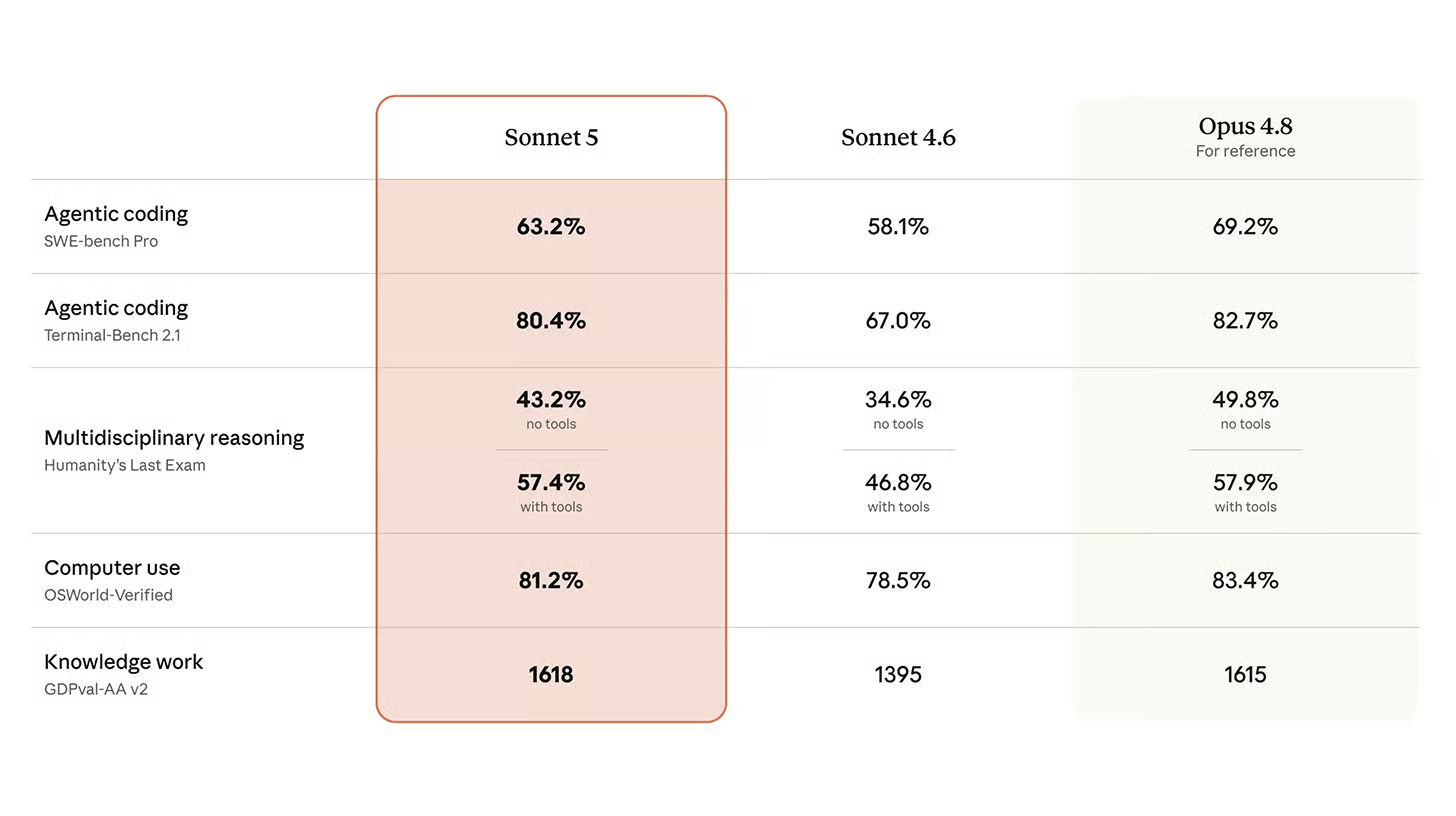
To understand why the Sonnet 5 launch feels muted despite its real strengths, you have to understand the context The Rundown AI lays out clearly. Fable 5 and Mythos 5 — Anthropic’s most powerful models — had been under U.S. Department of Commerce export controls. For 18 days, access was restricted, leaving many users in a state of anticipation. The moment Sonnet 5 launched, Anthropic simultaneously announced that those controls had been lifted and the models would return online.
This created a perception problem that no amount of benchmark improvement can fully overcome. When the AI community is starved of Fable access and then told simultaneously that both a new mid-tier model and the return of the frontier model are happening at once, attention gravitates to the latter. The Rundown AI describes the situation candidly: Sonnet 5’s arrival feels like “an underwhelming start to the ‘5’ class” not because of what the model is, but because of what surrounds it.
For Indian developers, enterprises, and researchers watching Anthropic’s model roadmap, this moment offers a useful lesson about how model launches are as much about narrative and timing as they are about capability. Sonnet 5 is a legitimate upgrade. It will handle more agentic workloads, reason more effectively, and cost less to run than the models it replaces. But its story will always be told in Fable’s shadow.
What This Means for Agentic AI Adoption
Setting the competitive drama aside, Sonnet 5’s design philosophy points toward where the broader AI industry is heading. The emphasis on browser operation, terminal access, and extended task execution reflects a fundamental shift in how AI models are being deployed. The era of the single-turn chatbot is giving way to persistent, tool-using agents that can complete end-to-end workflows.
For organisations in India building on top of Claude’s API, this shift has tangible implications. Customer service automations, coding pipelines, data analysis workflows, and research assistants all benefit from a model that can maintain context across longer sessions and interact with external systems. The fact that these capabilities are now available at the Sonnet pricing tier — rather than requiring Opus-level spend — significantly lowers the barrier to building production-ready agentic systems.
“The new Sonnet can operate a browser or terminal and carry longer jobs, bringing more Opus-style agent behavior into Anthropic’s cheaper tier.” — The Rundown AI
This is the kind of capability expansion that tends to accelerate real-world adoption. When frontier behaviour moves down the price curve, experimentation becomes affordable and deployment becomes viable.
The Bigger Anthropic Picture
Sonnet 5’s launch also needs to be read alongside other moves Anthropic is making. The Rundown AI reports separately that Anthropic has debuted Claude Science, a dedicated workspace for researchers that connects over 60 scientific databases and tools. The company has also announced its own preclinical drug discovery program targeting diseases typically overlooked by large pharmaceutical companies. Add in high-profile hires like Nobel laureate John Jumper from DeepMind, and a clearer strategic picture emerges: Anthropic is not just iterating on chat models. It is positioning Claude as infrastructure for serious scientific and enterprise work.
Sonnet 5 fits into this picture as the accessible, agentic layer — capable enough to handle knowledge work that previously required Opus, priced to encourage broad deployment, and designed for the kind of multi-tool, multi-step workflows that scientific and enterprise users increasingly demand.
Should You Upgrade?
If your workflows rely heavily on coding assistance, reasoning, or agentic task execution, the answer from the evidence The Rundown AI presents is yes — Sonnet 5 offers genuine capability improvements over Sonnet 4.6 in those areas. The promotional API pricing window until August 31 makes the decision lower-stakes.
If your use case involves cybersecurity applications specifically, the picture is murkier. The deliberately weaker cybersecurity benchmarks relative to the previous version warrant careful evaluation before migration.
And if you have been holding your breath for Fable 5, the wait appears to be nearly over. The story of Sonnet 5 may ultimately be remembered less as a standalone milestone and more as the prologue to Anthropic’s ‘5’ tier arriving in full — a capable model that shipped at the wrong moment, overshadowed by the very models it was meant to precede.
The AI model calendar moves fast. Sonnet 5 is real, it is available, and it is better than what came before. That should count for more than the current narrative gives it credit for.