AI Won’t Take Your Job. But Someone Using AI Will. Here’s How to Be That Person.
I need to tell you something about using AI at work that most writers won’t.
The people losing opportunities to AI right now aren’t losing them to AI. In fact, they’re losing them to other humans — humans who figured out how to use AI six months before they did.
That’s not a headline I’m writing for clicks. Rather, it’s something I’ve watched happen in real time. For instance, the freelance writer who lost three clients — not to ChatGPT, but to a writer who uses ChatGPT to deliver twice the work in half the time. Similarly, the analyst who got passed over for promotion — not because AI took her role, but because a newer hire used AI to produce the same reports in one day instead of five.
It’s not the technology that threatens you. It’s the gap.
And the gap is growing every week.
The real divide isn’t human vs. AI
Let’s kill this narrative right now. Essentially, AI is not coming for your job like a robot in a science fiction movie. It doesn’t want your desk. Also, it doesn’t have ambition.
However, what’s actually happening is simpler and more uncomfortable:
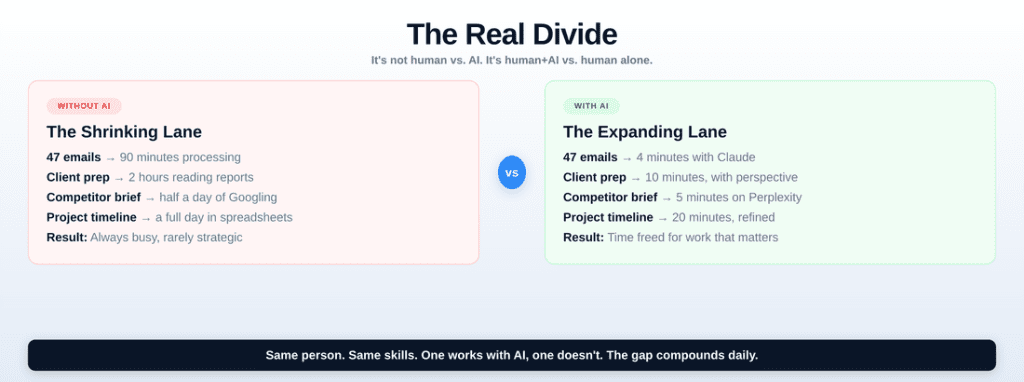
The workforce is splitting into two groups. It’s not about “technical” versus “non-technical,” or “young” versus “old,” or even “creative” versus “analytical.” The split is between people using AI at work every day and people who haven’t started yet.
And the gap between those two groups — in speed, in output quality, in the range of problems they can tackle — is getting wider every month.
What using AI at work actually looks like
In reality, this isn’t about being a prompt engineer or an AI researcher. It’s much more mundane than that.
Here’s what “using AI well” looks like for a normal professional in 2026:
A typical week when you start using AI at work
For example, Monday morning. You have 47 unread emails. Instead of spending 90 minutes processing them, you paste the important threads into Claude and say “summarize these 8 email threads, flag anything that needs my response today, and draft replies for the 3 most urgent.” That takes 4 minutes. You spend the saved 86 minutes on a strategic deck that’s been sitting in your to-do list for two weeks.
Tuesday afternoon. You need to prepare for a client meeting. Instead of spending 2 hours reading through last quarter’s reports, you upload them to Claude and ask “What are the 3 biggest risks this client should be worried about based on these reports? Give me talking points for each.” You walk into the meeting prepared — not just with data, but with perspective.
Additionally, Wednesday evening. A competitor just launched a new product. Instead of frantically Googling, you open Perplexity and ask “What did [Company X] announce today, what’s their pricing, and how does it compare to our offering?” You have a competitive brief in 5 minutes, not 5 hours.
Furthermore, Thursday morning. Your manager asks for a project timeline for Q3. Instead of spending half a day in a spreadsheet, you use the RCTF framework: “You’re a senior project manager. Our team of 6 needs to ship a new checkout flow by September. We have 3 dependencies on the backend team. Create a week-by-week timeline with milestones and risk flags.” First draft in 60 seconds. You spend 20 minutes refining it. Done.
None of this is magic. None of it requires technical skills. It requires the decision to start using AI at work — and then doing it consistently enough that it becomes second nature.
5 habits of professionals using AI at work
After watching dozens of professionals adopt AI over the past year, I’ve noticed the ones who get the most value share five specific habits:
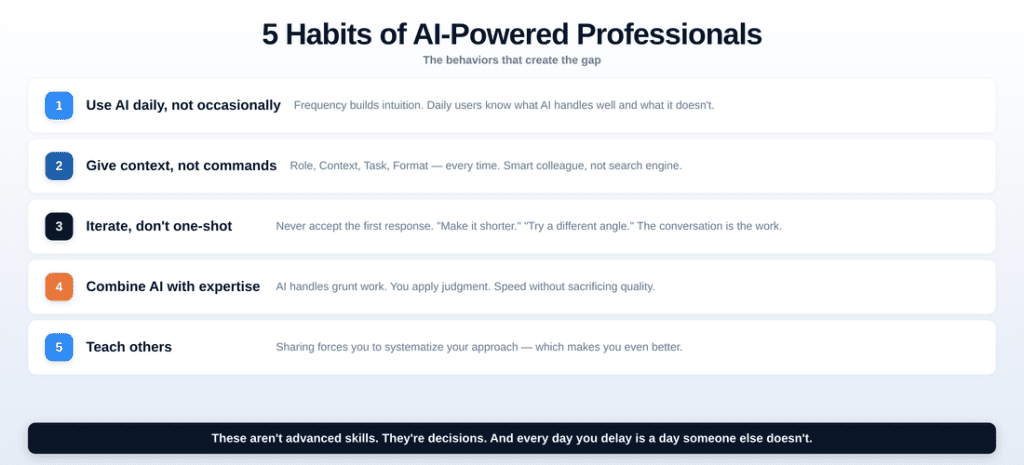
1. They use AI daily, not occasionally
The biggest predictor of success with AI isn’t intelligence or technical skill. It’s frequency. The people who open Claude or ChatGPT every single day — even for small tasks — build intuition that occasional users never develop.
Over time, these daily users know which tasks AI handles well and which it doesn’t. In addition, they’ve learned how to phrase requests. As a result, they develop a feel for when to trust the output and when to push back. This intuition only comes from repetition.
2. They give AI context, not just commands
You already know this if you’ve read Post 2 on the RCTF framework. But it bears repeating: the professionals who get the best output from AI are the ones who treat it like a smart colleague, not a search engine. Consequently, every prompt includes background, constraints, audience, tone, and format.
3. They iterate, not one-shot
Instead of accepting the first response as final, these professionals say “make it shorter,” “try a different angle,” “that’s too formal,” “add a concrete example.” Each round of feedback makes the output better. The conversation is the work.
4. They combine AI with their own expertise
Above all, the best AI users don’t outsource their judgment. Instead, they use AI to accelerate the parts of their work that don’t require judgment — research, first drafts, data processing, formatting — and then apply their expertise to the parts that do.
A great marketer using AI doesn’t become a mediocre marketer who lets AI decide. They become a great marketer who moves 3x faster because AI handles the grunt work.
5. They teach others
This one surprised me. The professionals who get the most from AI are almost always the ones who share what they’ve learned with their teams. Not because they’re generous (though they usually are) — but because teaching forces you to systematize your approach, which makes you even better.
The career math that should worry you (or excite you)
Let me put some numbers on this.
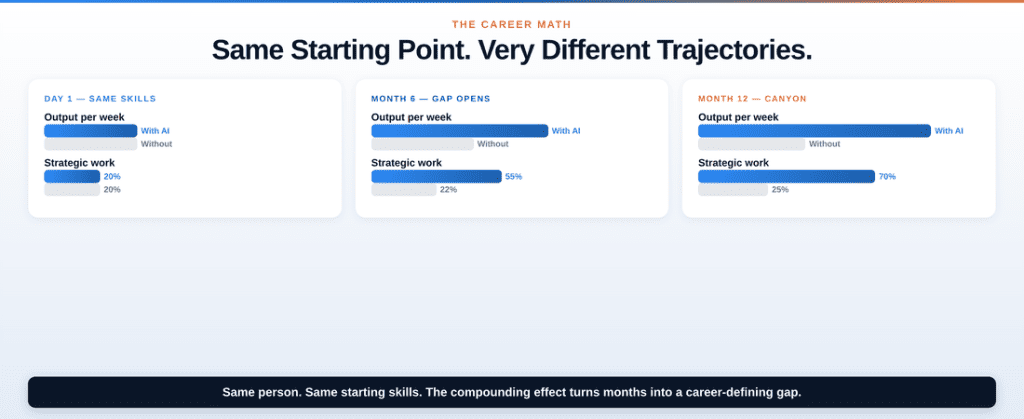
Two professionals start with the same skills, same experience, same salary. One integrates AI into their daily workflow. One doesn’t.
After 6 months, the person using AI at work isn’t just faster. In fact, they’ve taken on higher-level work because the routine stuff takes less time. Meanwhile, their project output has increased significantly. As a result, they’ve built a reputation as someone who gets things done — and developed strategic skills that their non-AI colleagues are still working toward.
After 12 months, the gap is a canyon.
This isn’t speculation. It’s happening right now, in every industry, at every level. According to McKinsey’s State of AI report, organizations adopting AI are pulling ahead faster each year. And the compounding effect means the longer you wait, the harder it gets to close the gap.
How to start using AI at work (the honest version)
So I’m not going to give you a 10-step program. Here are three things. Do them this week.
1. Make AI your default first step.
Before you start any task — any email, any report, any research project, any brainstorm — ask yourself: “Could AI give me a useful starting point here?” If the answer is yes (and it usually is), start there. You’re not replacing your work. You’re giving yourself a head start.
2. Block 30 minutes this week to learn one new thing.
Pick one task you do regularly that you’ve never tried with AI. Expense reports. Meeting prep. Competitive research. Performance reviews. Client proposals. Give it 30 focused minutes with the RCTF framework. You’ll either discover a massive time-saver or confirm that AI isn’t ready for that task yet. Either way, you’re smarter.
3. Share what works with one colleague.
For instance, send them one prompt that saved you time. Also, show them one output that surprised you. Not a lecture about AI — just one concrete example. This does two things: it helps them, and it solidifies your own understanding. Teaching is learning.
This is what The Prompt Mind is about
I started this blog because I believe the most important skill of the next decade isn’t coding, isn’t data science, isn’t “learning AI.” It’s learning to think clearly and start using AI at work so that you focus on what truly matters.
Ultimately, the people who thrive won’t be the ones who know the most about AI. Rather, they’ll be the ones who know the most about their own work — and use AI to do more of what they’re best at.
That’s not a threat. That’s an opportunity.
But only if you start. And only if you start now.
The gap is real. The gap is growing. And every day you wait is a day someone else doesn’t.
Be the person using AI. Not the person wondering what happened.
This is Post 5 of The Prompt Mind — and the last post in our launch series. If you’ve been reading from the beginning, thank you. Here’s where to start if you’re new: Post 1: Getting Started → Post 2: The RCTF Framework → Post 3: AI Agents → Post 4: Best AI Tools. Subscribe below for new essays every week.