Stateful vs. Stateless AI Agents: The Architecture Decision That Shapes Every Automation You Build
The n8n team's stateful vs. stateless framework is a foundational architecture decision for any AI agent build. This post translates the concept into plain language for Indian business operators, illustrates it with a travel-agency scenario, and honestly flags limitations around Indian-language support, USD pricing, and integration with Tally, RazorPay, and Zoho.
One Architecture Decision That Affects Everything Downstream
When you build an AI agent to handle customer queries, route invoices, or manage follow-ups, you face a choice you may not even realise you are making: should this agent remember what happened in previous interactions, or should it start fresh every single time? The n8n team describes this as the stateful versus stateless decision — and according to the n8n blog’s detailed breakdown, it is “a core design decision with implications for your entire system’s reliability and performance.”
This post translates that architecture concept into practical terms for non-technical Indian business owners and operations managers who are beginning to build or commission AI-first automations.

What ‘State’ Actually Means (Without the Jargon)
The n8n team defines three terms that you need to hold in your head before comparing the two approaches.
With those three ideas clear, the core distinction becomes simple:
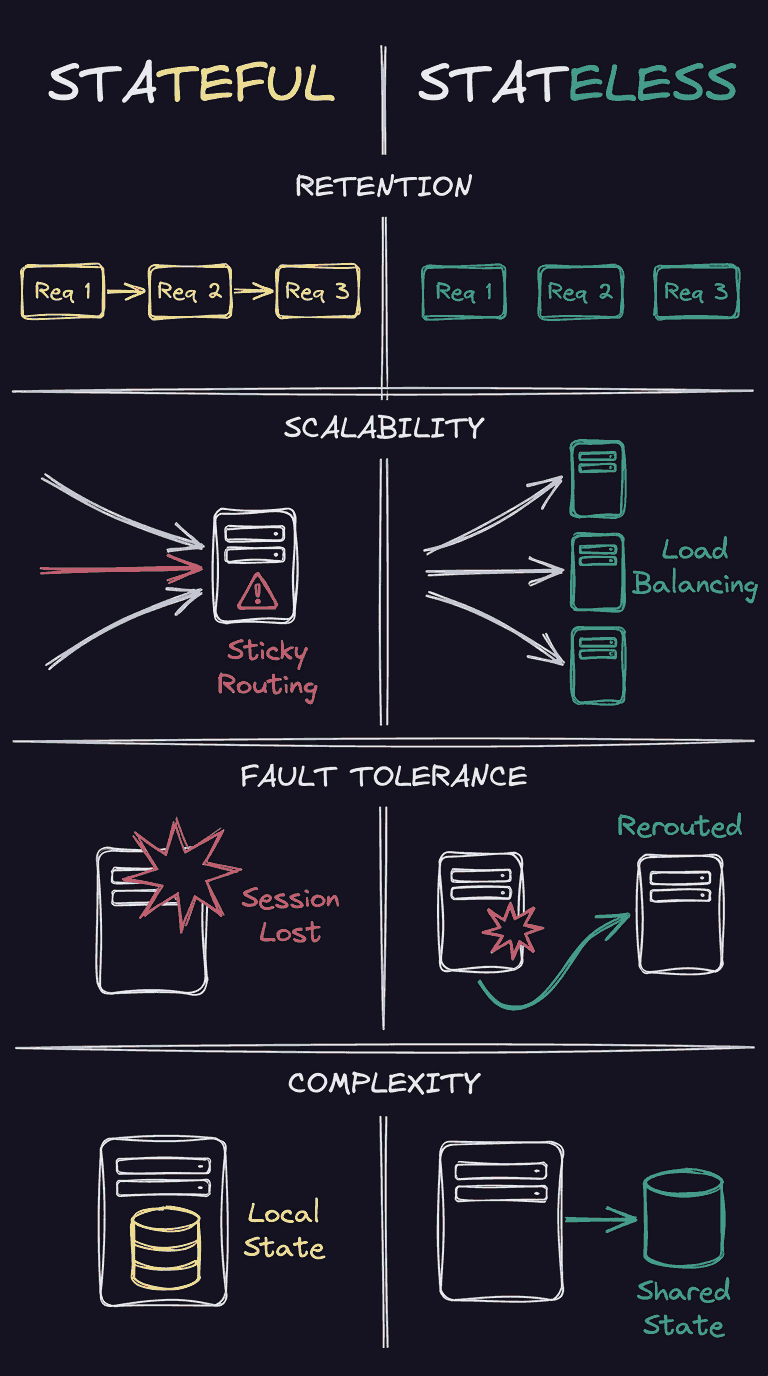
- A stateful application retains information from previous interactions and uses it when handling the next one. The agent can pick up where it left off.
- A stateless application treats every request as brand new. Everything the agent needs must arrive with that request or be fetched from a separate store.
As the n8n blog notes, many real-world systems blend both approaches: a stateless compute layer handles requests quickly and scales freely, while a shared database or cache holds the persistent data that needs to travel across those requests.
A Concrete Indian Business Scenario
Imagine you run a mid-size travel agency in Pune that handles B2B corporate bookings. You have deployed an AI agent on WhatsApp to handle booking queries from HR managers at client companies.
This is the practical difference between the two architectures — not an academic one.
How n8n Structures This Choice
According to the n8n blog, n8n — described as a “source-available, AI-native automation platform” — defaults to stateless workflow executions. One execution does not automatically remember data from the previous one. This keeps the execution layer simpler to scale and easier to recover when something goes wrong.
When you need continuity, you add state explicitly using one of several memory options the n8n team outlines:
- Simple Memory node: An in-memory buffer for recent conversation history within a single session. The n8n team notes this is not compatible with queue mode, which matters if your workflow is distributed across multiple workers.
- Postgres Chat Memory node: Stores conversation history in a PostgreSQL database, separated by session ID. This survives process restarts — useful when your agent handles queries across business hours over multiple days.
- Redis Chat Memory: A fast distributed cache option that shares session state across workers, recommended when you are running n8n in queue mode at scale.
- Chat Memory Manager: Gives you explicit control — your workflow can load, insert, and clear messages programmatically when you need fine-grained logic.
For data that needs to outlast any individual conversation — say, a client’s tier status, their preferred airlines, or their GST details — the n8n team recommends n8n data tables or an external Postgres or Redis store. These are described as “state stores” that persist workflow and application data across executions, distinct from the chat memory that preserves conversational context.
The n8n team also flags a subtle cost consideration: if you use a sliding window of recent messages (say, the last 20), it can invalidate the LLM’s caching mechanism during long conversations, increasing your API costs. They recommend either enlarging the window or implementing summarisation of older messages rather than a naive sliding window approach.
Limitations and Honest Tradeoffs
Before you commit to building a stateful AI agent on n8n, there are several limitations specific to the Indian business context that deserve direct attention.
What to Watch For as You Start Experimenting
The n8n team’s practical advice is worth holding onto: “Build stateless, then add state where you need it.” Start by identifying exactly which moments in your workflow require the agent to remember something. Not every node in your automation needs to be stateful — only the interactions where continuity directly changes the quality of the outcome.
For non-technical teams, the most accessible starting point is the Postgres Chat Memory node if you already have a managed PostgreSQL database (several Indian cloud providers, including those on AWS Mumbai region, offer this). If you are starting from zero, the Simple Memory node works well for prototyping single-session conversations before you introduce distributed complexity.
Keep an eye on how the n8n ecosystem develops native connectors for Indian-specific tools. As AI agent adoption grows among Indian SMBs, pressure on automation platforms to support RazorPay webhooks, Zoho CRM state sync, and GST-compliant data handling will increase. The architecture choices you make today — stateful versus stateless, Postgres versus Redis — will determine how easy it is to plug those connectors in when they arrive.