When Your AI Agent Lies Confidently: Hallucination Detection Methods Every Business Automator Needs
AI agent hallucinations look like normal answers until they trigger real business problems downstream. This post breaks down the four hallucination types, five layered detection methods from the n8n team's research, and what Indian businesses need to know about limitations around regional-language data and local tool integrations.

Your AI agent sends a client a summary. The numbers sound right. The tone is professional. The email goes out. Two days later, the client calls — because the discount percentage your agent quoted was never agreed upon, and the policy it cited does not exist.
This is an AI hallucination in production: not a nonsense answer, but a plausible-sounding one that is quietly wrong. According to the n8n team’s guide on hallucination detection methods for AI agent workflows, the core danger is that hallucinations usually look like normal answers. Once a flawed output triggers the next step in a workflow — updating a CRM, sending a customer email, modifying a record — the mistake compounds before anyone notices.
If you are automating business processes in India using AI agents, understanding how to detect hallucinations before they become incidents is no longer optional. Here is what the n8n team’s research tells us about how to do it.
The Four Ways an AI Agent Can Go Wrong
Not every hallucination fails in the same way, and that distinction determines which detection method you actually need. The n8n team describes four main types:
- Factual hallucinations — The model invents a statistic, person, or event that conflicts with verifiable reality.
- Contextual hallucinations — The answer goes beyond or misrepresents the documents or data the model was actually given. This is especially dangerous in RAG (retrieval-augmented generation) systems.
- Confabulations — The model fills a gap in its knowledge with coherent-sounding but unsupported details.
- Self-contradictions — The model’s output contradicts something it said earlier in the same response or in a previous turn.
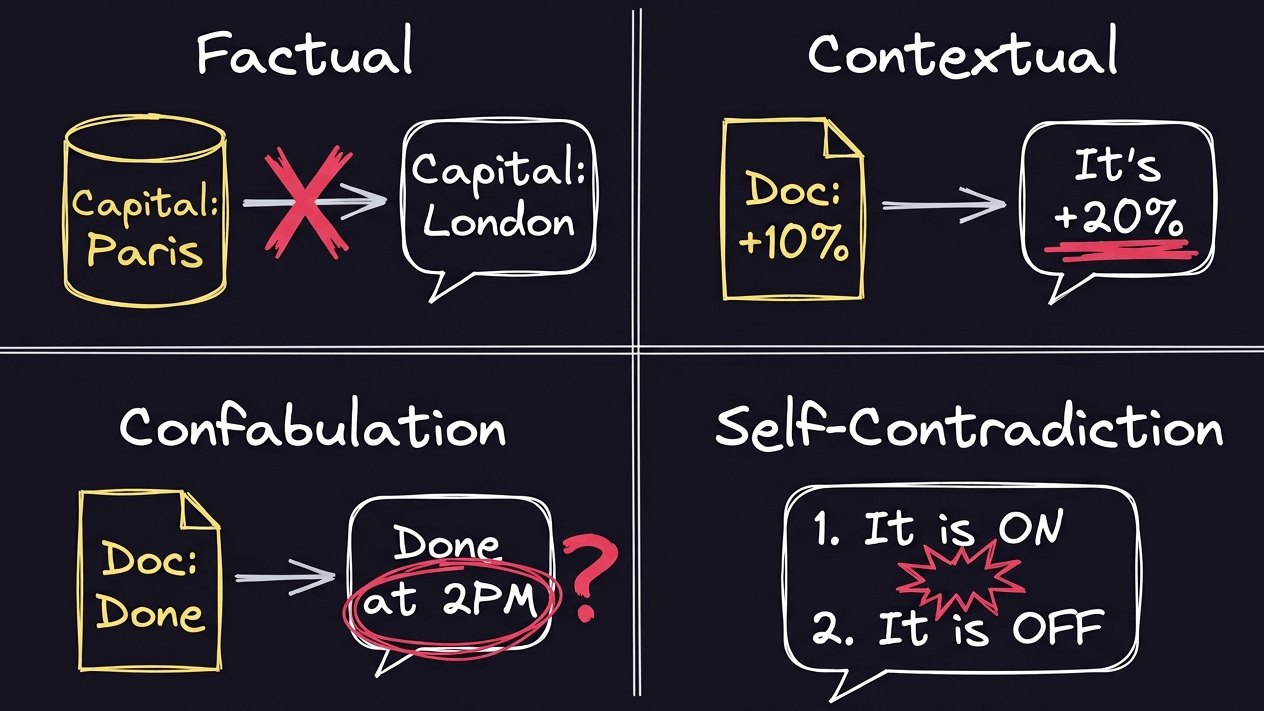
Why does this taxonomy matter for you? Because a single detection tool cannot catch all four. A check that tests whether an answer is grounded in retrieved documents will catch contextual hallucinations — but it will not tell you whether the document itself was accurate or up to date. Knowing which failure mode threatens your specific workflow is the first step toward choosing the right safeguard.
A Concrete Indian Business Scenario
Consider a mid-sized logistics company in Pune that uses an AI agent to answer dealer queries about freight rates, service zones, and GST-inclusive pricing. The agent pulls answers from an internal knowledge base via a RAG setup.
A dealer asks: “What is the current rate for a 20-foot container from Nhava Sheva to Ahmedabad, GST included?”
The agent retrieves a rate card from three months ago — before a fuel surcharge revision — and responds with a confident, well-formatted answer quoting an outdated figure. The rate is wrong by ₹4,200. No flag is raised. The dealer books at that rate, and the company absorbs the difference.
This is a classic contextual hallucination caused by poor retrieval: the agent was faithful to the document it retrieved, but the document was stale. This is precisely why the n8n team emphasises that faithfulness to context is not the same as factual accuracy.
Five Detection Methods, and What Each One Misses
1. Faithfulness and Groundedness Checks
This method breaks an answer into individual claims and checks each one against the retrieved context, producing a score based on how much of the response can be traced back to source material. Tools like DeepEval, mentioned by the n8n team, can automate this scoring across test sets and live outputs.
2. Self-Consistency Checks
You ask the model the same question multiple times and compare responses. If independently generated answers converge, that is a positive consistency signal. If they diverge substantially, the output warrants more scrutiny.
3. Semantic Entropy and Uncertainty Estimation
Rather than checking whether outputs use identical words, semantic entropy checks whether multiple responses express the same underlying meaning. High semantic entropy — wide spread across different meaning clusters — signals that the model is uncertain, and that the output should be routed to an additional validation step.
4. Source and Retrieval Verification
Instead of checking the answer against the context the model received, this method checks the answer against an authoritative external source — a database, API, or verified repository. This is the method that would catch the stale rate card in the Pune scenario, provided the workflow is connected to a live pricing API.
5. Confidence Thresholds and Human-in-the-Loop
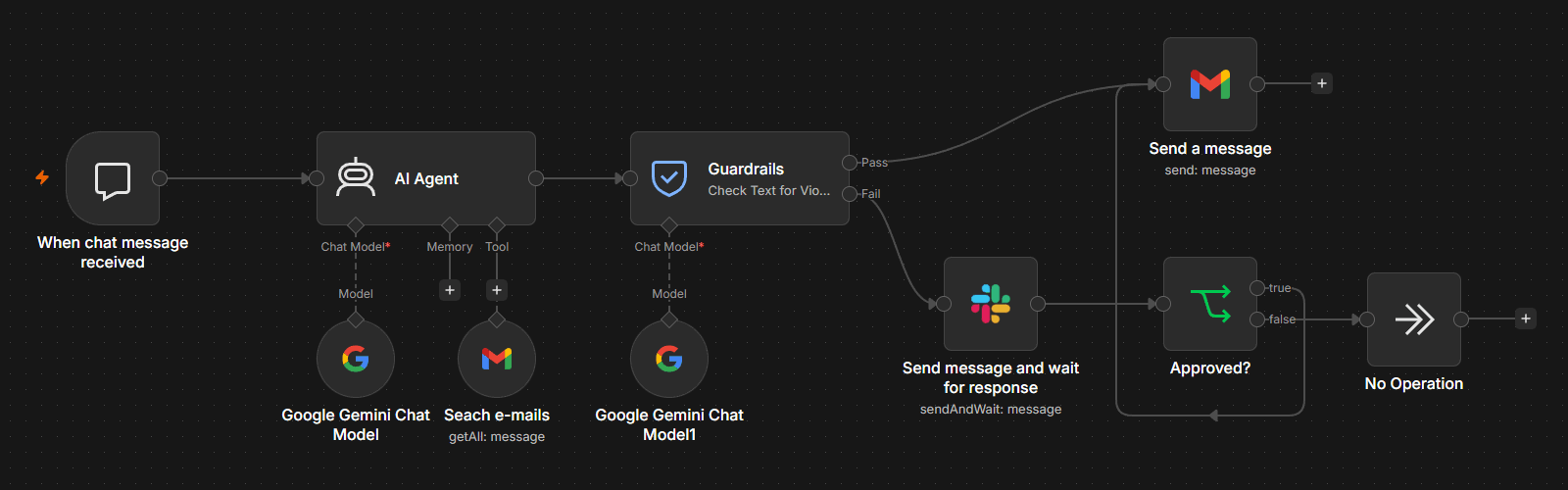
Not every flagged output needs the same response. The n8n team describes a tiered approach: high-confidence outputs proceed automatically, ambiguous outputs go through additional checks, and high-risk outputs are held for human review before the agent takes any external action.
The threshold, as the n8n team notes, should reflect the consequences of being wrong. An internal draft summary can tolerate more uncertainty than an agent that is about to email a customer a quoted price or modify a record in your ERP.
Implementing This in n8n
The n8n team describes how their source-available automation platform lets you add hallucination checks directly on the visual canvas — so evaluation logic lives inside the same workflow that produced the answer, rather than in a separate disconnected system. The AI Agent node keeps model and tool activity within an inspectable execution path, and an Error Trigger node can start a separate error-handling workflow if something fails.
This architecture matters for non-technical users: you do not need to write a separate monitoring application. You define what happens when a confidence score falls below your threshold — retry, escalate, route to a human — as a branch in the same visual workflow.
Honest Limitations Worth Knowing
Before you build this into your stack, here are the gaps the n8n team’s guide does not address — but that matter specifically if you are operating in India:
- Indian-language data: Faithfulness scoring and semantic entropy tools like DeepEval are primarily calibrated on English text. If your knowledge base contains content in Hindi, Marathi, Tamil, or other regional languages, detection accuracy will vary and has not been validated in this guide.
- Integration with Indian business tools: The guide references workflow logic and AI evaluation frameworks, but does not mention native integrations with Tally (the dominant accounting software for Indian SMEs), RazorPay, or India-specific compliance APIs like the GST portal. If your agent’s source of truth lives in Tally or needs to validate against a GST invoice number, you will need to build that retrieval connection yourself.
- Pricing in USD: n8n Cloud pricing is denominated in USD. As of the guide’s publication in October 2026, the Community Edition is free and self-hostable, which makes it the more accessible entry point for Indian businesses that want to avoid currency conversion costs at approximately ₹85 per US dollar.
- No silver bullet: The n8n team is clear that detection reduces risk but cannot guarantee every incorrect output gets caught. Scores depend on the quality of the context and evaluation method; thresholds produce false positives; and a well-grounded answer can still be wrong if its source is unreliable.
What to Watch For Next
The n8n team’s guide frames hallucination detection not as a one-time test but as an operational layer built into every AI workflow. The practical implication for you is to start by identifying the highest-consequence step in your current AI automation — the step where a wrong answer would cost real money, damage a client relationship, or trigger a compliance issue — and add a single detection check there first.
For most Indian business workflows today, that will be a combination of source verification against a live database and a human-in-the-loop gate for outputs above a certain risk threshold. You do not need to implement all five methods at once. You need to match the check to the failure mode that actually threatens your workflow — and build the escalation path before something slips through.