OpenAI’s AI Just Disproved a 35-Year-Old Computer Science Hypothesis — And a Proof Checker Confirmed It
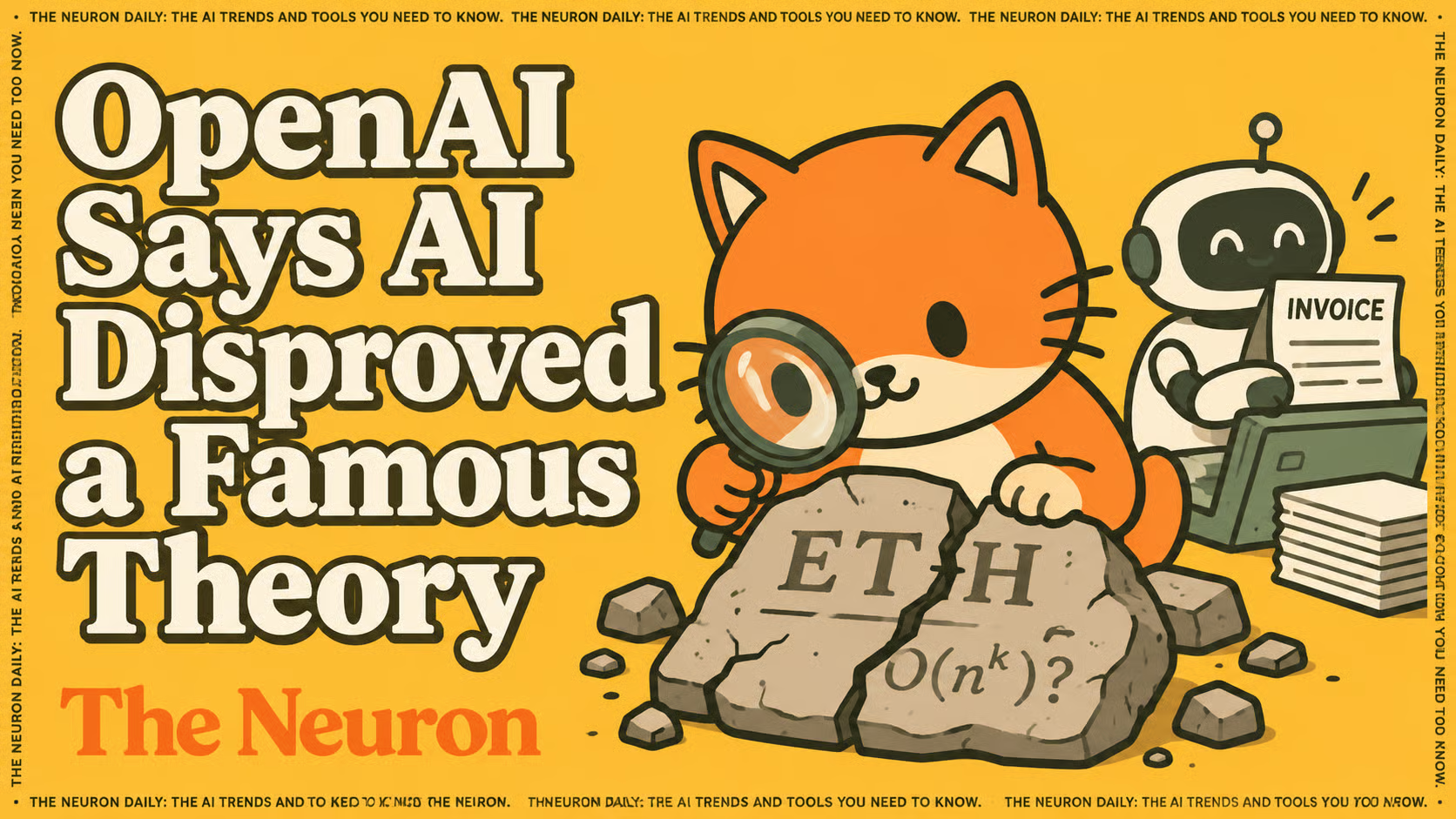
OpenAI claims its AI disproved the Exponential Time Hypothesis on October 16, 2026, with the formal proof checker Lean verifying the result the next day. A working group that includes the hypothesis's original authors is now reviewing whether the claim holds, making this the most significant — and most carefully scrutinised — AI-generated research result to date.
On October 27, 2026, OpenAI made two announcements that looked like they came from entirely different organisations. One reported three landmark discoveries in mathematics, computer science, and physics. The other introduced a cheaper, faster model called GPT-6.1 Terra, built primarily to click through office software. As The Neuron reported, both launches share a central question that will define their legacy: how do you actually verify the work?
What Is the Exponential Time Hypothesis, and Why Does It Matter?
To understand what OpenAI is claiming, you need to understand the Exponential Time Hypothesis — or ETH. At its core, the ETH is a belief about a classic puzzle in computer science called Boolean satisfiability. Imagine a board of true/false switches and a long list of rules that govern how they interact. The question is: can you find a combination of switch positions that satisfies every single rule at once?
This puzzle, known as SAT, sits at the heart of computer science. The best-known algorithms for solving it get exponentially slower as you add more switches — meaning double the variables can more than double the time needed. The ETH, originally proposed in the late 1990s, asserts that this exponential slowdown is not a limitation of our current methods but a fundamental property of the problem itself. Nothing fundamentally faster can exist.
That single belief has become load-bearing infrastructure for hundreds of research papers. Fields as varied as database query optimisation, computational biology, cryptography, and network theory have built “this cannot be done faster” arguments on top of the ETH. If the hypothesis is false, many of those results transform from closed answers into open questions again. The ripple effects would be significant and would take years to map fully.
According to The Neuron, OpenAI says its system found a disproof of the ETH on October 16, 2026. The following day, a formal proof-checking program called Lean verified the result.
How Lean Works — and Why It Matters Here
Lean is not a judge that reads an argument and decides whether it sounds convincing. It functions more like a rigorous mechanical auditor. You feed it a proof step by step, and it checks whether every individual step follows logically and correctly from the one before. Think of it as a spellchecker for mathematical logic — except instead of flagging a misspelled word, it flags any logical gap in reasoning.
The fact that Lean confirmed the disproof is meaningful. It means the argument, as submitted, contained no detectable logical errors in its internal structure. That is a higher bar than peer review alone, which relies on human experts reading dense notation under time pressure.
However, Lean confirming a proof’s internal consistency is not the same as the broader community confirming that the proof actually settles the ETH as researchers understand it. A proof can be internally valid and still rest on a framing or interpretation that experts would contest. This is precisely why OpenAI has assembled a working group to examine the claim.
The Working Group — Including the Authors of the Hypothesis Itself
This is where the story takes a genuinely remarkable turn. The working group now tasked with evaluating whether the disproof means what OpenAI says it means is led by Russell Impagliazzo, Ramamohan Paturi, and Ryan Williams. As The Neuron highlighted, Impagliazzo and Paturi are two of the three researchers who originally proposed the Exponential Time Hypothesis in the first place.
In other words, the people who built the hypothesis are now being asked to decide whether an AI system has torn it down. That is an unusual position for any scientist to occupy, and it underscores why this result requires careful, unhurried scrutiny before anyone declares a revolution in theoretical computer science.
OpenAI has been upfront about the rawness of its claims. It describes the manuscripts as raw research data rather than polished publications. It also acknowledges that even if the ETH has genuinely been disproved, translating that finding into faster real-world software will require significant further research. A separate physics result — a rigorous existence proof for quantum chromodynamics, the theory of the strong nuclear force — is being held back by a group led by Nobel laureate David Gross, who wants to write his own account before the claim goes public.

The Other Announcement: GPT-6.1 Terra
Sharing the same news cycle as a potential landmark in theoretical computer science is GPT-6.1 Terra, a model designed almost entirely for the mundane. Terra is built for computer use — meaning it watches a screen, then clicks, types, and navigates between applications the way a human assistant would. OpenAI’s own example is reading incoming invoices and entering the details into accounting software.
Terra is priced at \$1 per million input tokens and \$5 per million output tokens (approximately ₹85 and ₹425 respectively), which is half the price of GPT-6.1 Sol. OpenAI claims Terra scores 15 points higher than its predecessor on its Agents’ Last Exam at roughly a third of the cost, and that it finishes tasks over three times faster than its higher-tier siblings Astra and Sol.
Independent testing reported by The Neuron tells a more measured story. An NerdsChalk evaluation ran Terra and Sol through a 15-field form three times each. Both models got every field correct every time, but Terra’s median completion time was 9.4 seconds compared to Sol’s 17.3 seconds — a gap closer to 1.8 times rather than the three-times figure OpenAI cites. The cheapest model in the lineup, Luna, got every field right in only one of three runs, suggesting that the lowest price point carries a real accuracy trade-off.
One OpenAI engineer described Terra less as a breakthrough and more as a way to stretch usage limits further without sacrificing too much performance. That framing feels honest.
What Both Announcements Actually Have in Common
Surface-level, a potential disproof of a foundational computer science conjecture and a budget model for filling out web forms look like they belong in separate press releases. But they share a structural challenge: verification.
With Terra, verification is straightforward. You run a form, you count the correct fields, you time the run. Three runs gives you a reasonable signal. You can replicate the test yourself with dummy data on any form you control.
With the ETH disproof, verification is a months-long process involving a working group, a funded conference, and experts who have spent careers thinking about the specific problem the AI claims to have cracked. The Lean checker provides an important first layer of confidence, but it cannot replace the interpretive judgment of a field’s leading researchers.

What to Watch For Next
The most important near-term signal will be the working group’s verdict on the ETH claim. If Impagliazzo, Paturi, Williams, and their colleagues confirm that the disproof is valid and correctly framed, it would represent one of the most significant AI-assisted scientific results to date — not because of what it immediately changes in software engineering, but because it would prove that AI systems can meaningfully contribute to unresolved problems in theoretical computer science.
If the working group finds a gap in interpretation or framing, it will be an equally instructive data point: a demonstration that Lean-verified internal consistency is necessary but not sufficient, and that AI-generated proofs still require deep human scrutiny at the conceptual level.
For now, the headline is genuinely striking. An AI system appears to have found a disproof of a 35-year-old hypothesis that underpins hundreds of papers across multiple fields, and a formal proof checker has confirmed the internal logic holds. The experts who created that hypothesis are reviewing the claim. That is not a small moment, even if we do not yet know exactly how big a moment it turns out to be.
Keep an eye on the working group’s findings. That verdict will tell you more about the state of AI-assisted research than any benchmark chart.