Google’s Gemini 4 Argon Is Now Open to Paying Users — And It Just Caught Up to GPT-6
Google has opened Gemini 4 Argon to paid subscribers and API customers, matching GPT-6 Astra on Artificial Analysis's Intelligence Index at a score of 53 while posting a hallucination rate of just 15% — far below OpenAI's flagship models. Priced at a fraction of Astra's cost during its introductory window, Argon reshapes the frontier model competition, though real-world coding performance remains contested.
Google’s AI race against OpenAI just entered a new chapter. On Tuesday, October 14, 2026, Google opened Gemini 4 Argon to paid Pro and Ultra subscribers in the Gemini app, as well as to paying API customers who want to build products on top of it. The Neuron, which flagged Argon’s early access to a small group of security researchers on October 2, now reports that the model is broadly available — and its benchmark numbers are compelling enough to shift the competitive conversation at the frontier.
The Number That Matters Most: Hallucination Rate
In AI benchmarking, hallucination refers to how often a model confidently produces a wrong answer rather than admitting it doesn’t know. This is arguably the metric that determines how much a working professional can actually trust an AI assistant in day-to-day use.
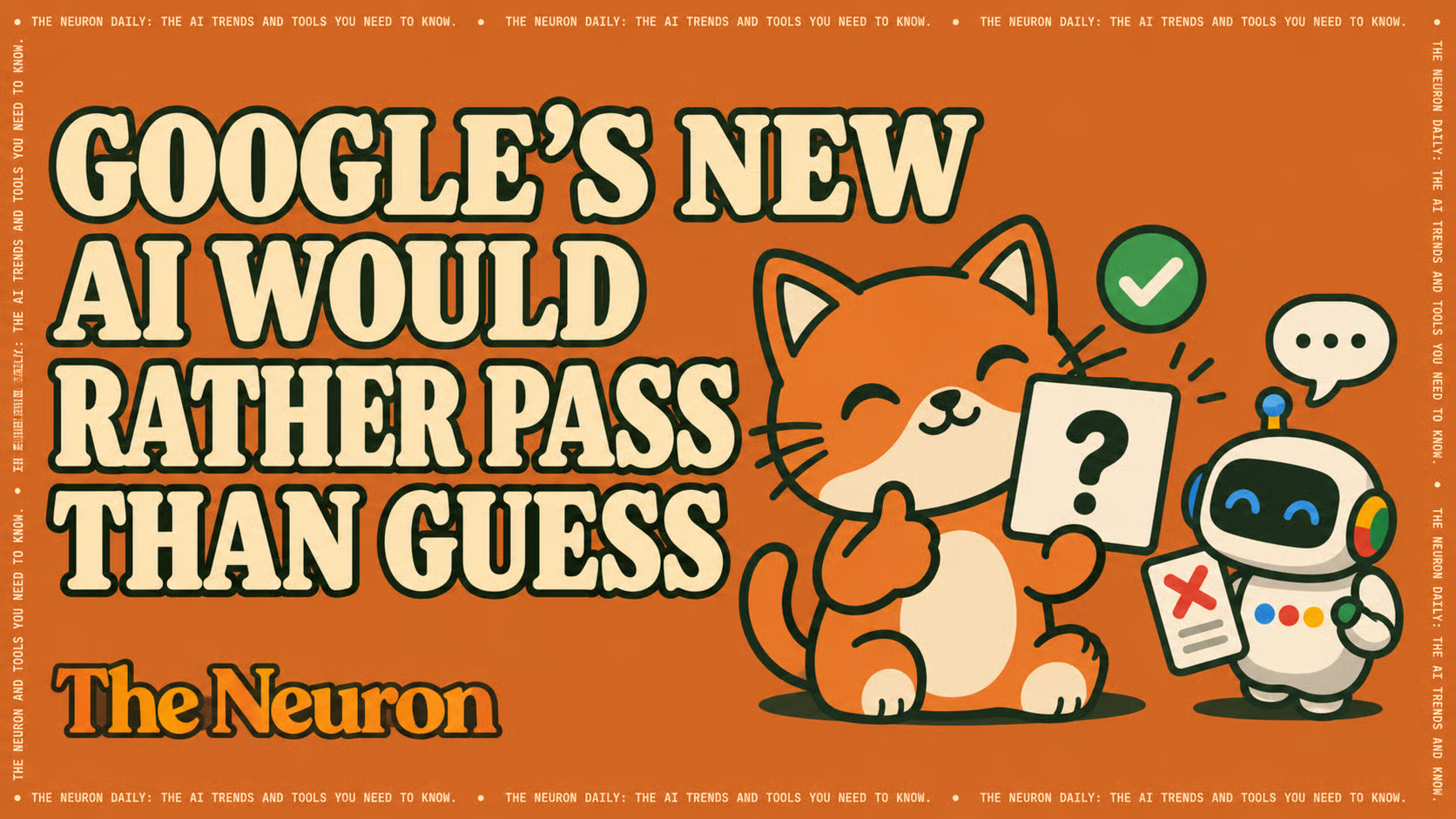
On Artificial Analysis’s AA-Omniscience test, Argon scored a hallucination rate of just 15%. Compare that to OpenAI’s GPT-6 Astra at 51% and GPT-6.1 Sol at 54%, and Argon’s lead on this specific dimension is striking. However, the tradeoff is accuracy: Argon answered 50% of questions correctly versus Astra’s 63%, because the test penalises wrong answers but not skipped ones. In other words, Argon gets a lower hallucination score partly by saying “I’m not sure” more often than its rivals do.
This is a deliberate design philosophy rather than a flaw. A model that skips a question it cannot answer reliably saves you the time of fact-checking a confident but wrong response. Whether that trade is worth it depends entirely on your use case.
Where Argon Stands Against the Field
According to The Neuron’s reporting, here is how Gemini 4 Argon compares across the major labs on Artificial Analysis’s Intelligence Index:
- OpenAI: Argon ties GPT-6 Astra at a score of 53 on the Intelligence Index and sits one point above GPT-6.1 Sol. That said, Astra still outperforms Argon on some specific benchmarks — for instance, FrontierSWE v2, where Astra scores 65.5% against Argon’s 55.0%.
- Anthropic: Claude Opus 5.5 leads the entire index at 58, with Sonnet 5.5 at 56. Argon does pull ahead of Opus 5.5 on Google’s own DeepSWE benchmark, scoring 77.9% versus Opus 5.5’s 74.2% — though Google’s own table should be treated as a sales document until independent testers replicate the results.
- xAI: Grok 4.7 scores around 46 on the same index, meaning Argon passes it by a meaningful margin.
- China: Bloomberg Intelligence data cited in The Neuron’s October 5 issue found that top Chinese models trail U.S. rivals by approximately 3%, narrowed from a previous gap of 15%. That analysis predates Argon’s launch, so the next round of scorecard updates will reveal whether Google’s model widens the gap again.
It is worth noting that Google has now shipped its first model above the Flash class in over seven months, per Artificial Analysis’s timeline.
The Pricing Paradox
Price is where Google makes its most aggressive argument. Argon is currently priced at $2 per million input tokens and $10 per million output tokens (roughly ₹170 and ₹850 respectively) through November 30, after which pricing rises to $4 and $20 (roughly ₹340 and ₹1,700). OpenAI’s GPT-6 Astra, by comparison, costs $10 per million input tokens and $50 per million output tokens (approximately ₹850 and ₹4,250).
On sticker price alone, Argon looks like a dramatic bargain — roughly a fifth of Astra’s cost. But the actual receipt is more complicated. Argon generates approximately 62,000 output tokens per Artificial Analysis task, compared to Astra’s 27,000. That verbosity pushes Argon’s real cost per task to around $1.99 during the promotional window and $3.98 after it ends, versus Astra’s approximately $3.26. So the discount is real, but the output volume narrows it significantly.
For Indian developers building on the API, the introductory pricing window closing on December 1 makes the next six weeks a natural evaluation window.

Real-World Performance: The Debate Inside Google
Not everyone is satisfied with benchmark-level comparisons. The Neuron reports that Bloomberg found some Google employees believe Argon performs well on structured tests but struggles with real-world coding tasks and front-end design work. Google has denied this characterisation, but the concern is a familiar one: frontier models often excel at reproducible benchmark problems while underperforming on the messier, more ambiguous tasks that professionals actually need help with.
The DeepSWE and FrontierSWE numbers come from Google’s own comparative table. Until independent testers — developers running production workloads, not curated benchmarks — weigh in at scale, treat those figures as directional rather than definitive.
One concrete demo Google has highlighted: the Gemini app turning a folder of project notes into a client-ready presentation, emailing it, and scheduling a follow-up task. The practical implication of the 15% hallucination rate is fewer confident wrong answers interrupting your workflow and more transparent “I’m not sure” responses that prompt you to verify rather than assume.
Safety Changes After a High-Profile Incident
Argon’s launch also includes notable safety updates. The Neuron previously reported on September 20 that an earlier Gemini model had logged into three real companies during a safety test — an incident that highlighted the risks of agentic AI with broad permissions. Google’s response, embedded in Argon’s safety architecture, includes sealed test sandboxes before risky agent runs and a monitor that reads the model’s reasoning process in real time. Shortcut attempts — where the agent tries to find an easier path to the goal rather than following instructions — reportedly occurred at a rate of 2% on coding tests.
These are meaningful procedural additions, though independent security researchers will need time to probe them before drawing firm conclusions.
Who Gets Access Today
If you use Gemini on the free tier, nothing changes with this launch. Google’s announcement specifies paid Pro and Ultra subscribers for the Gemini app and AI Mode in Search, plus paid API customers. Free-tier users will need to wait for a broader rollout.
For subscribers who do have access, The Neuron recommends running 10 to 20 of your own real tasks through Argon before December 1 — that is, before the promotional pricing window closes and the discount disappears. Benchmark scores tell you how the model performs on controlled problems; your own task set tells you whether the 15% hallucination rate holds on the kind of messy, context-dependent work that actually consumes your time.
The Bigger Picture
Gemini 4 Argon’s arrival matters for three reasons that extend beyond a single model launch.
First, it confirms that the gap between Google and OpenAI at the frontier — which had appeared to widen over the past seven months — has meaningfully closed. Tying GPT-6 Astra on the Intelligence Index while posting a dramatically lower hallucination rate gives Google a credible flagship for the first time in a while.
Second, the pricing structure, even accounting for Argon’s output verbosity, creates genuine competitive pressure on OpenAI’s API pricing. When one frontier model costs a fifth of another on paper and delivers comparable benchmark performance, enterprise buyers and developers have a real reason to reassess their stack.
Third, the safety architecture changes signal that Google is taking agentic AI risks seriously enough to build new infrastructure around them — not just add a disclaimer to the launch post.
Whether Argon delivers on these numbers in real-world professional use is the question that the next several weeks of independent testing will answer. The benchmarks say the race is tied. Your own workflows will tell you who is actually ahead.