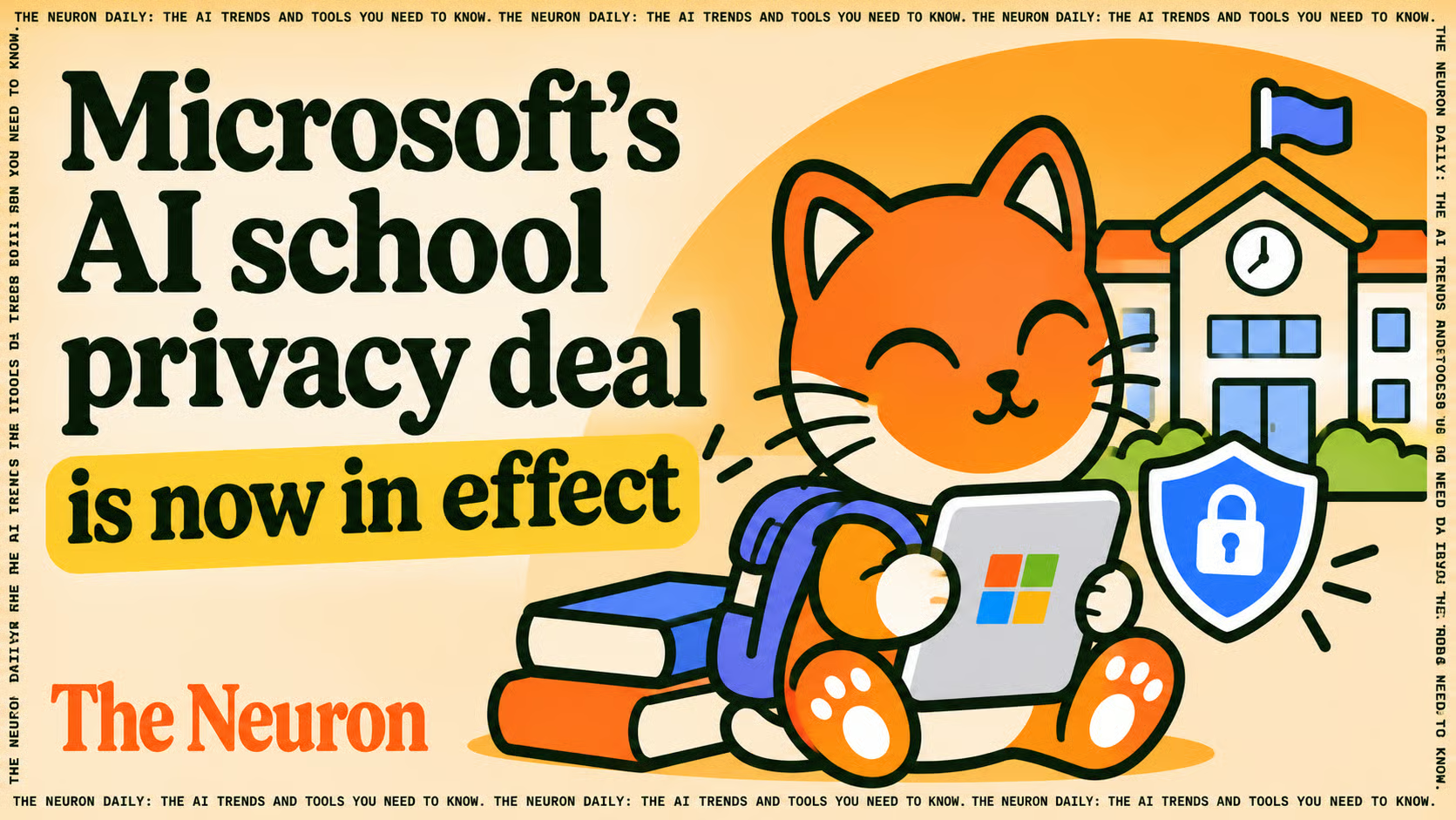
Microsoft’s Binding AI Privacy Deal for Schools Is Now Live — And It Has Real Legal Teeth
Microsoft's AI Safety & Privacy Standard — co-developed with the AFT and UFT — took effect November 1, creating legally enforceable protections for student data including a permanent ban on AI training using student information. The standard is now available to any U.S. school district via their existing Microsoft agreement, and whether OpenAI and Anthropic sign similar commitments may determine whether it becomes an industry-wide baseline.
When a technology company makes a promise about protecting children’s data, the fine print usually lives somewhere on a webpage — a page the company can quietly edit, update, or simply replace whenever it suits them. Microsoft just made a very different kind of promise: one that lives inside a legally binding contract, with real consequences for breaking it.
As reported by The Neuron, Microsoft’s AI Safety & Privacy Standard came into effect on Sunday, November 1, 2026. The standard was first announced on September 9, 2026, in partnership with the American Federation of Teachers (AFT) and the United Federation of Teachers (UFT). Any U.S. school district can now attach this standard to a new or existing Microsoft agreement — no renegotiation, no renewal cycle required, according to Microsoft’s own fact sheet.
Why a Contract, and Not Just a Policy?
The answer is accountability — and the uncomfortable reality that existing law was never designed for generative AI.
AFT president Randi Weingarten has pointed out that older regulations like FERPA (which governs student records) and HIPAA (which covers health data) were written long before AI systems existed in their current form. Fortune noted that COPPA, the federal law designed to protect children’s online data, predates the generative AI era entirely. Legislators simply haven’t caught up.
Rather than waiting for Congress to act, the teachers’ unions used the leverage they had: purchasing power and collective bargaining muscle. The result is a standard that gives school districts genuine legal recourse. Once a district incorporates the standard into its Microsoft agreement, it can cancel that contract and seek damages if Microsoft fails to comply. That’s a fundamentally different enforcement mechanism from a terms-of-service update that a company can revise unilaterally.
Microsoft also agreed to annual certification requirements, audit rights for districts, and firm deadlines to remediate any identified security problems. If a violation occurs and isn’t fixed within the required window, AI use can be paused or ended entirely.
What Microsoft Has Actually Committed To
The specific commitments in the standard are worth examining carefully, because the details matter enormously in the context of how modern AI systems are built and trained.
- No training AI models on student or educator data. This is a permanent ban, with one narrow exception for safety and security purposes. This is arguably the most significant clause in the entire standard.
- No selling student data, and no use of student data for advertising.
- No tracking students across platforms or services.
- No AI companions — meaning chatbots deliberately designed to behave like a friend or social companion for students.
- Human review for high-stakes decisions. AI can assist in the process, but a human being must make the final call on decisions that materially affect students.
- Breach notification within 72 hours, with a requirement to fix violations or halt AI use.
The training ban deserves particular attention. When an AI system trains on data, it absorbs patterns, phrasing, reasoning styles, and content from that data in ways that can persist indefinitely in the model’s behaviour. A student’s essay draft, a homework question, or a classroom discussion captured in an AI tool could — under normal commercial terms — end up influencing the next version of that AI. The standard closes that door, permanently, for Microsoft’s products used by signatory school districts.
The ban on AI companions is also notable for appearing in a legal document at all. The fact that it needed to be written explicitly tells you something about where the industry was heading without guardrails.
The Unions Behind the Deal Don’t Fully Trust AI Either
Here’s a tension worth sitting with: the unions that co-signed this agreement are not cheerleaders for AI in the classroom.
UFT president Michael Mulgrew has stated that AI use in grades K-8 is not appropriate right now. New York City’s public schools had already announced a one-year pause on AI use around the same time this standard launched. The AFT and UFT didn’t sign this agreement because they want AI everywhere — they signed it to set minimum terms for the districts that choose to use it anyway.
That’s a meaningful distinction. The standard doesn’t take a position on whether classrooms should adopt AI tools. It only establishes what the rules must be if they do. Think of it as harm reduction rather than endorsement.
This also explains why the standard was designed to be modular — attachable to existing agreements without requiring districts to start over. The goal is to make strong privacy protections the path of least resistance for any district already in the Microsoft ecosystem.
The Bigger Question: Who Signs Next?
Right now, this standard binds exactly one company. Microsoft made the commitments; OpenAI and Anthropic have not.
The Neuron reports that AFT president Weingarten has said both OpenAI and Anthropic have expressed willingness to sign a similar standard. An Anthropic spokesperson confirmed to Fortune that the company has worked with the AFT on a safety and privacy standard. OpenAI did not respond to Fortune’s inquiry at the time of reporting.
This matters enormously for the practical reach of the standard. Microsoft’s AI products — including Copilot integrations in Microsoft 365 Education — are widely used in schools. But OpenAI’s ChatGPT and tools built on its API have also found their way into classrooms, often through third-party edtech products or direct teacher adoption. If those companies don’t sign, millions of students using their tools have no equivalent contractual protection.
Conversely, if OpenAI and Anthropic do sign, something significant shifts. A union-negotiated contract — not a government regulation, not a corporate policy page — becomes the de facto industry standard for AI in American schools. The AFT and UFT would have accomplished through collective action what legislators haven’t managed through law.
Watch the timing. Microsoft’s fact sheet references its AI products generally without naming specific tools, so there is still interpretive work to be done about precisely which products are covered. Districts considering signing on should ask Microsoft directly which product lines fall under the standard before assuming full coverage.
What This Means for the Broader AI Privacy Debate
Microsoft’s move is a preview of how AI accountability may develop in sectors where regulation has lagged. Rather than waiting for a comprehensive federal AI law — which remains elusive in the United States — institutional buyers with leverage are beginning to write their own rules into procurement contracts.
School districts are not the only institutions in this position. Hospitals, universities, and large employers all purchase AI tools under contracts that currently offer far weaker protections than this standard. The mechanism Microsoft and the teachers’ unions have demonstrated — binding privacy commitments, audit rights, cancellation clauses, and breach notification windows — is portable to virtually any sector.
For India, where edtech adoption is growing rapidly and student data protection frameworks are still maturing under the Digital Personal Data Protection Act, the template is instructive. Contractual accountability, embedded at the point of procurement, can move faster than legislation and create enforceable obligations that a policy webpage never could.
The standard that took effect on November 1 is a floor, not a ceiling. It tells you the minimum a company must do to serve a signatory school district. Whether AI in classrooms ultimately helps or harms children’s learning and privacy will depend on much more than any single contract. But for now, having a contract at all is a meaningful step forward from having nothing but a promise.
“Older rules like FERPA and HIPAA never anticipated AI” — AFT president Randi Weingarten, as reported by Fortune and cited in The Neuron.
The question for every school district, parent, and policymaker is the same: if a company won’t put its commitments in a contract, what exactly is its promise worth?