Mistral Large 4 Goes Open Weights: What a Trillion-Parameter ‘Le Chonk’ Means for AI Sovereignty
Mistral has released open weights for its 1-trillion-parameter Large 4 model, letting organisations self-host a frontier AI on their own servers. The release comes with a split cybersecurity strategy and licensing changes that Indian enterprises and governments will need to evaluate carefully before deployment.
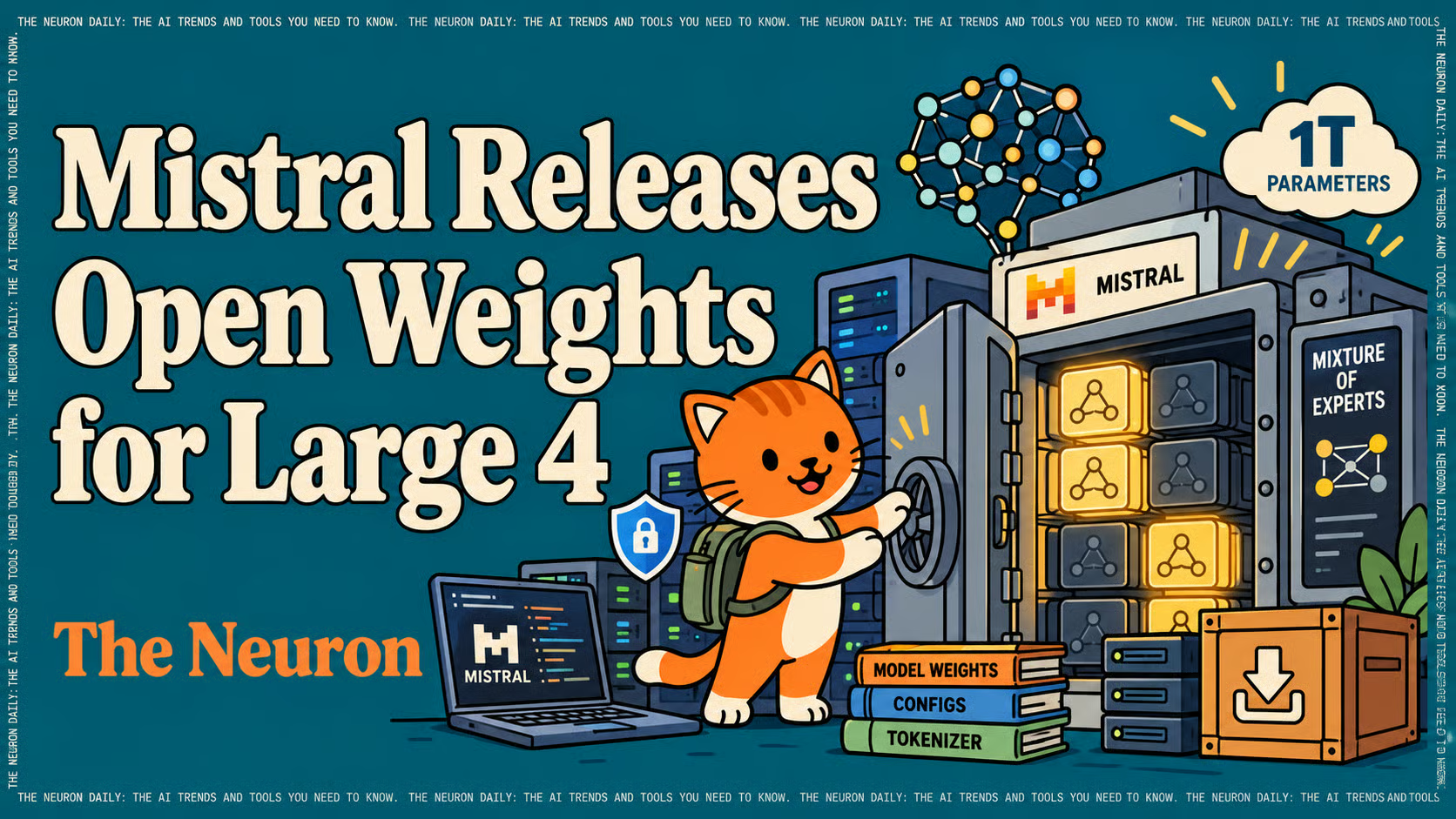
The French AI lab Mistral just made its biggest move yet in the open-weights AI race, releasing the downloadable model weights for Mistral Large 4 — a 1-trillion-parameter model that the company’s own team has affectionately nicknamed Le Chonk — on Hugging Face and through its API. According to The Neuron, the release came three weeks after an October 6 preview, with Mistral spending those additional weeks on reinforcement learning, a training approach that refines model behaviour through reward signals rather than raw data alone.
What Exactly Is a Trillion-Parameter Model?
Before getting into the implications, it helps to understand the architecture. Model weights are the numerical values a neural network learns during training — effectively the brain of the AI. When a company releases these weights publicly, anyone can download and run the model on their own hardware, without ever sending data to an external server. That is the core of what makes an open-weights release strategically significant.
Mistral Large 4 is also a mixture-of-experts (MoE) model, which is an important architectural detail. Despite having 1 trillion total parameters, only around 49 billion of those parameters are active at any given moment. Think of it like a hospital: instead of calling in every specialist simultaneously, the model routes each task to the relevant subset of experts. This makes the model far more computationally tractable than a dense 1-trillion-parameter model would be, though running it still demands serious hardware — Mistral’s recommended configuration splits the model across eight GPUs.
What Large 4 Can Actually Do
The Neuron reports that Mistral Large 4 handles both text and images, supports a 1-million-token context window (large enough to process an entire codebase or lengthy legal document in one pass), and offers three distinct reasoning settings for different task demands. It also runs on Microsoft Foundry.
On benchmarks, Mistral claims the model ties GLM-5.3 on a coding-agent index while using 47% fewer tokens per task — meaning it gets comparable results with significantly lower compute cost. Artificial Analysis had previously called the October 6 preview the strongest model it had seen from outside the United States and China. However, The Neuron is careful to note that Mistral’s newer post-reinforcement-learning numbers are the company’s own and have not yet been independently replicated. That caveat matters when evaluating performance claims.
The Cybersecurity Dimension: A Carefully Split Release
Perhaps the most consequential aspect of this release is how Mistral handled the cybersecurity risk. The company’s own testing suggested that Large 4 could increase attackers’ real-world capabilities, even though the model refused 96.6% of malicious cyber requests on selected benchmarks. The Neuron rightly flags that this figure covers a defined test set — not every conceivable attack vector — and that with public weights now available, no one has yet demonstrated how much of that protection survives modification by a determined adversary.
Mistral’s response was to split the release in two. The general-purpose model is freely downloadable. A more capable cyber variant, built for penetration testing and red-teaming, is being distributed only to vetted partners such as Orange Cyberdefense, with contractual restrictions limiting testing to systems the testers own or are explicitly authorized to probe.
This approach mirrors moves by other major labs: Google limited Gemini 4 Carbon to selected defenders on October 28, and Anthropic expanded its Cyber Verification Program on October 6. The Neuron notes that nothing indicates these moves are coordinated — but the parallel timing is notable.
One attribution that deserves scrutiny: Mistral’s announcement carries a statement from an ENISA spokesperson (ENISA being the EU’s cybersecurity agency) regarding testing of Large 4. However, The Neuron flags that Agence Europe corrected a related report on October 16 to clarify that Large 4 was not named, and that ENISA’s own direct confirmation could not be located. Anyone citing that ENISA endorsement should treat it with appropriate caution until independently verified.
Licensing: Open, But Not Completely Free
The modified MIT license under which Large 4 is released permits internal self-hosting, which is where most enterprise value lies. But anyone wanting to sell the model as a service to third parties needs a separate commercial license. This is notably more restrictive than Mistral Large 3’s Apache 2.0 terms, which placed fewer limits on commercial use. For Indian enterprises or startups looking to build products on top of Large 4 and offer them as a paid service, that licensing distinction is the first document to read before committing engineering resources.
Downloading the weights is cheap. Running the model in production is not. The eight-GPU requirement puts serious self-hosted deployment firmly in the territory of well-resourced data centres, cloud providers, or government compute infrastructure — not a workstation in a startup office.
Why This Matters for Indian Enterprises and Institutions
The strategic pitch Mistral is making is essentially about data sovereignty and control. Banks, government agencies, defence establishments, and healthcare systems that cannot send sensitive data — customer financials, classified documents, patient records — to an external API now have access to a frontier-scale model they can host entirely within their own infrastructure. The Neuron identifies Cisco, Cloudflare, CrowdStrike, and ABN AMRO among entities that offered supportive statements, though these range from active testing to future plans and do not all represent finished deployments.
For Indian public-sector organisations navigating data localisation requirements, or private banks operating under RBI data governance frameworks, the ability to run a model of this calibre on domestic servers is not a minor convenience — it is potentially a compliance-enabling capability. Similar logic applies to BFSI (banking, financial services, and insurance) players who handle Know Your Customer data, or defence and intelligence agencies dealing with classified material.
Mistral also frames Large 4 as part of a broader European AI sovereignty project, pointing to a €3 billion funding round led by Samsung and training infrastructure built around 3,800 Nvidia GPUs housed in European data centres. However, The Neuron adds an important nuance: Microsoft committed billions in July to use part of that same capacity, meaning the sovereignty narrative is more about choosing where the model runs than about severing ties with American technology companies entirely.

The Benchmarks Caveat You Should Not Ignore
The Neuron’s take on this release is pointed and worth quoting directly: “Mistral is betting that control sells, and the partner list suggests some buyers agree. But the pitch rests on Mistral’s own benchmarks and a safety call Mistral made itself.”
That is the crux of the independent-evaluation problem that runs through most open-weights releases. When a lab publishes a model and simultaneously publishes the benchmark results, the figures are accurate reflections of performance on those specific tests — but they are not the same as third-party audits conducted on adversarial or out-of-distribution inputs. The full technical report, once published, is the document that analysts, security researchers, and enterprise procurement teams will need to scrutinise.

What Comes Next
The open-weights frontier is moving fast. With Mistral Large 4 now downloadable, the competitive pressure on other labs to match both capability and openness will intensify. For Indian organisations evaluating AI strategy, the questions to ask are practical ones:
- Do you have the GPU infrastructure to run a model that requires eight cards in parallel?
- Does your use case actually require on-premise deployment, or would a compliant API suffice?
- Have you reviewed the modified MIT license to confirm your intended use falls within its terms without triggering the commercial licensing requirement?
- Are you prepared to wait for independent benchmark replication before making procurement commitments based on Mistral’s own performance numbers?
Mistral Large 4 — Le Chonk — is a genuine milestone in open frontier AI. But as The Neuron makes clear, the technical report is the document to watch, and the safety questions around the cyber variant remain open. The model’s arrival is the beginning of the evaluation process, not the end of it.