OpenAI’s Jalapeño Chip Could End Its Dependency on Nvidia — Here’s What You Need to Know
OpenAI and Broadcom have unveiled Jalapeño, OpenAI's first custom AI inference chip, built in just nine months and already running GPT-5.3-Codex-Spark internally. If its performance-per-watt claims hold up, it could dramatically lower the cost of running ChatGPT and give OpenAI a vertically integrated hardware advantage over rivals still renting Nvidia GPUs.
Every time you ask ChatGPT a question, somewhere in a data centre, a bank of Nvidia GPUs lights up and starts working — at considerable expense to OpenAI. That arrangement has powered the AI boom, but it has also kept OpenAI dependent on a single hardware supplier for the compute that runs its entire product. According to The Neuron’s latest issue, that dependency just got its first serious challenge: a custom silicon chip called Jalapeño.
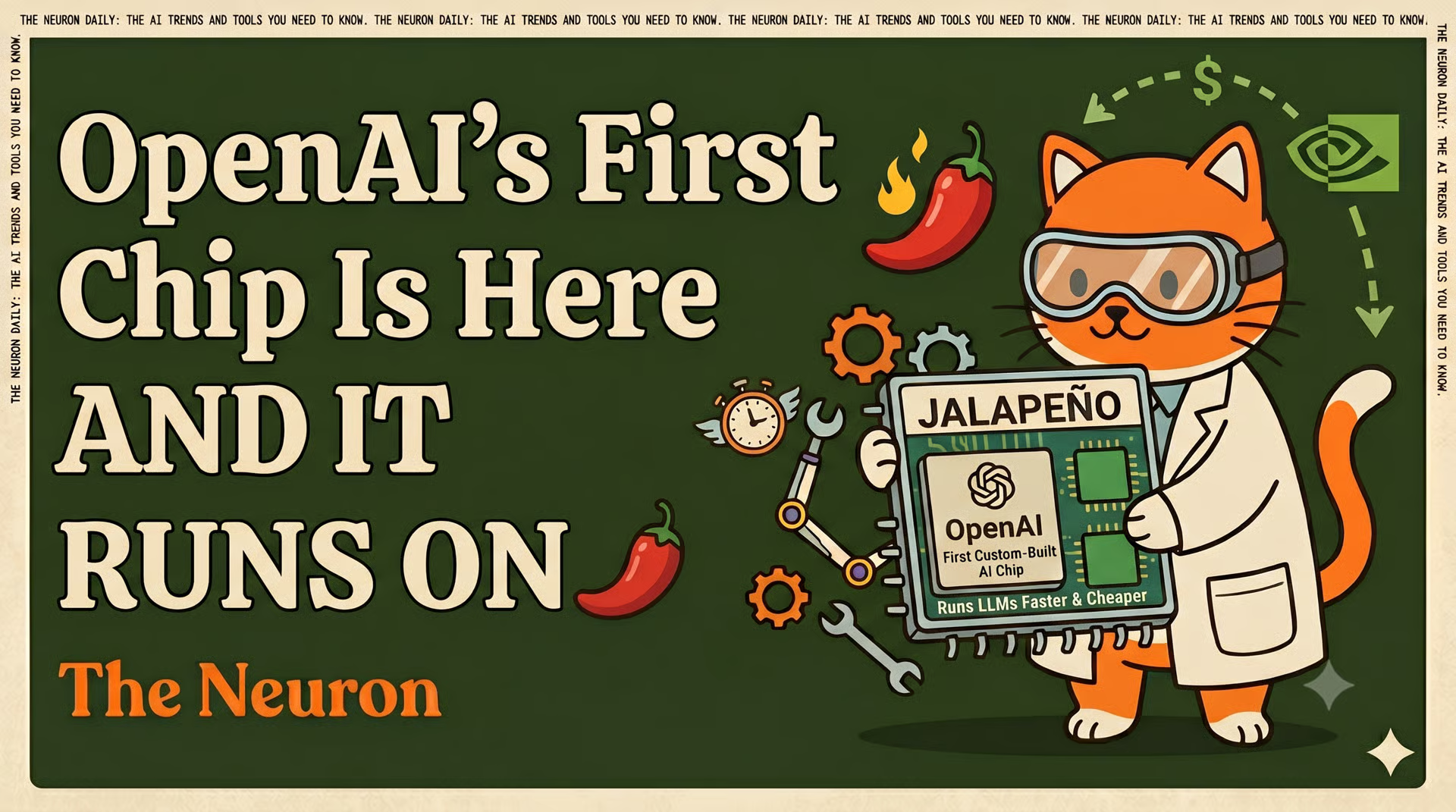
What Is Jalapeño, Exactly?
Jalapeño is OpenAI’s first purpose-built AI chip, developed in partnership with semiconductor giant Broadcom. The two companies unveiled it together, with OpenAI CEO Sam Altman reportedly present when the chip was formally introduced. The name might sound playful, but the engineering ambition behind it is anything but.
The chip is specifically designed as an inference chip — a distinction worth understanding. In AI, there are two major computational tasks: training, which involves teaching a model on vast datasets and is extraordinarily resource-intensive, and inference, which is the real-time process of responding to your prompts. Inference is what happens every single time you use ChatGPT. General-purpose Nvidia GPUs can handle both, but they were never architected around the specific demands of large language model inference. Jalapeño was.
By designing the chip around exactly how ChatGPT thinks — the particular patterns of matrix operations, attention mechanisms, and memory access that define how large language models process tokens — OpenAI can extract far greater efficiency from every watt of electricity consumed. According to The Neuron, early tests indicate Jalapeño beats current state-of-the-art chips on performance per watt, meaning more AI output for less energy cost.
Nine Months from Concept to Silicon
Perhaps the most striking detail in The Neuron’s report is the timeline. Jalapeño went from initial concept to a working chip in just nine months — a pace OpenAI itself describes as potentially the fastest-ever advanced semiconductor development cycle. For context, designing a cutting-edge chip typically takes two to five years from specification to tape-out. Compressing that to under a year, if the claim holds up, would be a significant engineering achievement.
What accelerated the timeline? OpenAI’s own AI models. According to the newsletter, the company used its AI systems to help design the chip itself — a recursive loop that the AI industry has been building toward for years. The robots, as The Neuron’s editors put it, are building themselves now.
The chip is not just a prototype sitting in a lab. OpenAI reports that Jalapeño is already running GPT-5.3-Codex-Spark in its internal facilities. Full commercial deployment is targeted for the end of 2026, and Microsoft has already committed to purchasing 40% of the first production batch — a signal of confidence from OpenAI’s closest commercial partner.

Why This Is a Watershed Moment for OpenAI
To appreciate why Jalapeño matters, you need to understand OpenAI’s current cost structure. Running ChatGPT at scale means paying Nvidia for access to GPUs — hardware that is powerful and in high demand, but expensive and designed as a general-purpose accelerator rather than an LLM-specific one. As ChatGPT’s user base has grown, so has the compute bill.
Custom silicon changes the economics fundamentally. When your chip is designed around your exact workload, you eliminate inefficiency at the hardware level. More queries served per unit of electricity consumed means lower marginal cost per user interaction. Over millions of daily queries, those savings compound rapidly.
There is also a strategic dimension that goes beyond cost. By owning the chip, the model architecture, and the consumer product, OpenAI is assembling what analysts call a vertically integrated AI stack. Apple did something similar in consumer electronics — designing its own processors (the A-series and M-series chips) to optimise performance for its own software, cutting out the margin paid to Intel and gaining competitive advantages that third-party hardware simply could not match. OpenAI appears to be pursuing an analogous strategy in AI infrastructure.
Competitors who continue to rent Nvidia hardware face a structural disadvantage if Jalapeño delivers on its promises. The cost savings OpenAI captures at the infrastructure layer could be passed to users in the form of lower pricing, used to fund more aggressive model development, or simply retained as margin — options that rivals renting commodity GPUs will not have.
The India Angle: What Cheaper Inference Means for You
For users in India, the downstream implications of cheaper inference are meaningful. ChatGPT’s subscription tiers — ChatGPT Pro at roughly ₹1,700 per month, and the more powerful Pro tier at significantly higher price points — are partly a function of the compute cost OpenAI must recoup. As inference becomes cheaper to run, there is at least the potential for more competitive pricing, higher usage limits, or more capable models available at lower tiers.
India is also increasingly relevant to OpenAI’s growth strategy. A more cost-efficient infrastructure layer makes serving price-sensitive markets more viable. If Jalapeño delivers the efficiency gains OpenAI claims, expanding access in markets like India becomes economically easier to justify.
The Caveats Worth Keeping in Mind

The Neuron’s analysis is appropriately measured on one key point: none of the performance claims have been independently verified yet. Broadcom says the chip is faster; OpenAI says it beats current state-of-the-art on performance per watt. But third-party benchmarks have not been published. In semiconductor development, there is a long history of impressive announcement-day metrics that look somewhat different once independent reviewers get access to the hardware.
The nine-month development timeline is also a claim that deserves scrutiny. Advanced chip development at this level involves mask sets, fabrication partnerships, and validation cycles that typically resist compression. Either OpenAI and Broadcom have genuinely found a way to accelerate this process — plausibly, given AI-assisted design workflows — or the nine months refers to a narrower phase of the development cycle than the headline implies. More detail will emerge as deployment approaches.
There is also the question of what Jalapeño does not do. This is an inference chip, not a training chip. OpenAI will still need large clusters of Nvidia (or other third-party) hardware to train future generations of its foundation models. Custom inference silicon reduces one component of compute dependency; it does not eliminate it.
The Bigger Picture
Jalapeño is the most significant infrastructure announcement OpenAI has made to date. It signals that the company is no longer content to be a software layer sitting on top of commodity hardware — it wants to own the full stack from silicon to product. That ambition, if executed, would give OpenAI a durable structural advantage that is far harder for competitors to replicate than a model architecture or a product feature.
For the AI industry broadly, it confirms a trend already visible at Google (with its TPUs), Amazon (with Trainium and Inferentia), and Meta (with its MTIA chips): the largest AI companies are all moving toward custom silicon. The era of every AI lab simply buying Nvidia GPUs is giving way to one where infrastructure differentiation is itself a competitive moat.
As The Neuron puts it: this is OpenAI’s most important infrastructure move yet. The performance claims still need independent validation, and full deployment is months away. But the direction of travel is clear — and for Nvidia’s dominance in AI compute, Jalapeño is the sharpest signal yet that the landscape is shifting.