From iPhone Partners to Courtroom Rivals: Apple’s Lawsuit Against OpenAI Signals a Platform War
Apple has sued OpenAI, io Products, and former Apple employees, alleging that trade secrets including circuit-board manufacturing documents were stolen to accelerate OpenAI's hardware ambitions. The lawsuit transforms what was a high-profile AI partnership into a potential platform war over who controls the interface between consumers and AI.
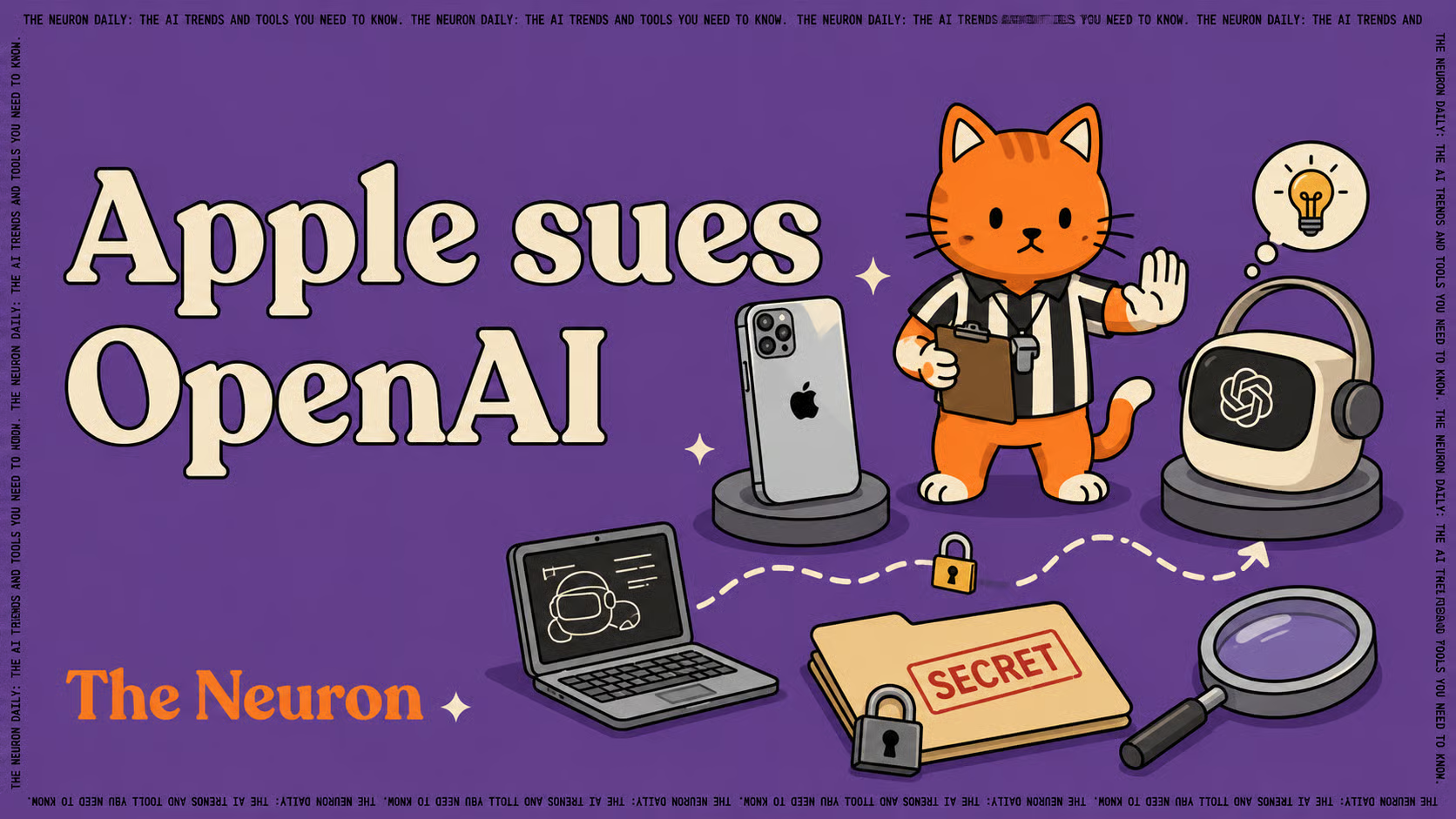
In the compressed timeline of the AI industry, partnerships can curdle into legal battles faster than most product cycles move. That is precisely what happened between Apple and OpenAI. As reported by The Neuron, Apple has filed a lawsuit against OpenAI, io Products — the hardware arm linked to legendary designer Jony Ive — and several former Apple employees, alleging that trade secrets were stolen to accelerate OpenAI’s push into consumer devices.
The two companies went, in The Neuron’s words, from “ChatGPT on your iPhone” to “see you in court” in a remarkably short span of time. To understand why this lawsuit matters far beyond a standard HR dispute, you need to understand what each company stands to lose — and what each is quietly trying to build.
What Apple Is Actually Alleging
The specifics of Apple’s complaint are striking. According to The Neuron’s coverage, the lawsuit names former Apple design VP Tang Tan and former iPhone engineer Chang Liu, along with OpenAI’s newly acquired hardware division. The most dramatic allegation is that Liu exploited an authentication bug after leaving Apple to access confidential files from an Apple-issued laptop — essentially using the company’s own infrastructure as a back door to proprietary information after his employment had ended.
Beyond that single alleged incident, Apple’s complaint goes further. The company claims OpenAI used insider supplier terminology, asked targeted questions about specific components, and received Apple files that included circuit-board manufacturing documents. These are not vague accusations of general knowledge transfer — they describe a specific, allegedly deliberate effort to extract the kind of supply-chain intelligence that Apple has spent decades cultivating and protecting.
OpenAI’s official response was brief. The company stated it has “no interest” in other companies’ trade secrets. As The Neuron pointedly noted, that is “exactly the kind of sentence lawyers write when everyone in the room has suddenly become very interested in discovery.”
The Hardware Ambition at the Center of Everything
To grasp the stakes, you need to zoom out from the legal filings and look at what OpenAI has been building. The company’s next phase is not purely about training smarter language models. It wants to own the interface through which people interact with AI every day — applications, browsers, agents, and eventually dedicated hardware devices.
This is precisely the territory Apple has dominated for nearly two decades. Apple’s competitive moat has never just been software or just been hardware. It is the seamless integration of both: a chip designed in Cupertino, running an operating system built in Cupertino, inside a device manufactured through supply chains that Apple has spent billions of dollars and years of engineering effort to control. Circuit-board manufacturing documents — the kind Apple alleges were passed to OpenAI — sit right at the heart of that moat.
If OpenAI can compress years of hardware learning by accessing Apple’s proprietary supplier relationships and component knowledge, it gains a meaningful shortcut. Apple’s lawsuit is, among other things, an attempt to close that shortcut before it produces a competitive device on store shelves.
The Uncomfortable Irony of Simultaneous Partnership and Litigation

The strangest dimension of this story is the one The Neuron highlights directly: Apple and OpenAI are still partners on Apple Intelligence. The same collaboration that puts ChatGPT functionality on iPhones — one of the most widely distributed AI deployments in the world — is now running in parallel with a lawsuit accusing OpenAI of building its device future on stolen Apple know-how.
This is not just ironic. It reveals a structural tension that was probably always present in the relationship, even when both sides were publicly celebrating their integration. Apple wants AI capabilities it can deliver to its existing user base without ceding control of the platform. OpenAI wants distribution and reach, but only as a stepping stone toward something more independent. The moment OpenAI began seriously developing its own hardware — devices that would not run on Apple’s operating system, would not depend on Apple’s App Store, and would not be subject to Apple’s 30% cut — the interests of the two companies began to diverge in a fundamental way.
The lawsuit is, in this reading, less about the specific files allegedly taken and more about Apple drawing a line. It signals to the entire industry — and to every engineer who might consider leaving Apple for an AI competitor — that proprietary knowledge will be defended aggressively in court.
What This Means for OpenAI’s Hardware Roadmap
OpenAI’s ambitions in consumer hardware are closely tied to the Jony Ive connection. Ive, the designer responsible for the visual identity of the iPhone, iMac, and Apple Watch, has been linked to the io Products venture named in Apple’s suit. The involvement of someone so deeply associated with Apple’s design legacy makes the trade-secret allegations particularly charged.
If Apple can demonstrate in court that the foundation of OpenAI’s hardware effort was built partly on stolen IP, the consequences could extend well beyond financial damages. Courts can issue injunctions that slow or halt product development. Discovery — the legal process of compelling document disclosure — could expose OpenAI’s hardware plans in detail at the worst possible moment for a company trying to make a surprise product launch.
The Neuron frames the possible outcome cleanly: OpenAI’s first real device could launch “as a breakthrough product, a legal exhibit, or both.” In the current climate, all three outcomes remain genuinely plausible.
A Platform War Playing Out in Slow Motion
For Indian tech observers watching this unfold, the implications reach beyond two American companies fighting over documents. The broader pattern — incumbent platform owner versus AI-native challenger trying to build its own hardware layer — is one that will repeat across the industry. Every major AI lab eventually faces the question of whether to remain dependent on existing device ecosystems or to try to own the stack end to end.
Apple charges premium prices for that integration. The iPhone 15 Pro Max, for instance, retails at prices starting around ₹1,60,000 in India. That pricing reflects not just the hardware itself but the years of supply-chain mastery and proprietary manufacturing knowledge that Apple has accumulated. The allegation that OpenAI sought to shortcut that accumulation by accessing Apple’s files is, at its core, a dispute about whether hard-won industrial knowledge can be freely moved when engineers change jobs.
The answer courts give to that question will shape how aggressively AI companies can recruit from established hardware players — and how carefully those hardware players guard their most sensitive supplier relationships going forward.
What Comes Next
The lawsuit is in its early stages. Legal proceedings of this complexity routinely take years to resolve, and settlements are common before any trial begins. But the filing itself is already consequential. It publicly names individuals, describes specific alleged acts, and forces OpenAI into a defensive posture on hardware at a moment when it wants to be on offense.
Watch for three things in the coming months: whether Apple seeks a preliminary injunction to pause io Products’ work, how OpenAI’s hardware timeline shifts in response to legal pressure, and whether the Apple Intelligence partnership quietly cools as the courtroom battle heats up.
As The Neuron put it, this is ultimately a story about two competing visions of who gets to own the interface between humans and AI. The lawsuit is just the opening move.