America’s AI Data Center Revolt: Why the Backlash in America’s Heartland Could Reshape the Entire Industry
Roughly 70% of Americans oppose data centers near their homes, and over 100 moratorium proposals are circulating — a bipartisan revolt that The Neuron identifies as the AI industry's most serious political crisis. Reporter Jasmine Sun's on-the-ground findings reveal that the backlash is not a messaging failure but a product problem: AI is scaling infrastructure before earning genuine community trust or solving its fundamental technological limitations.
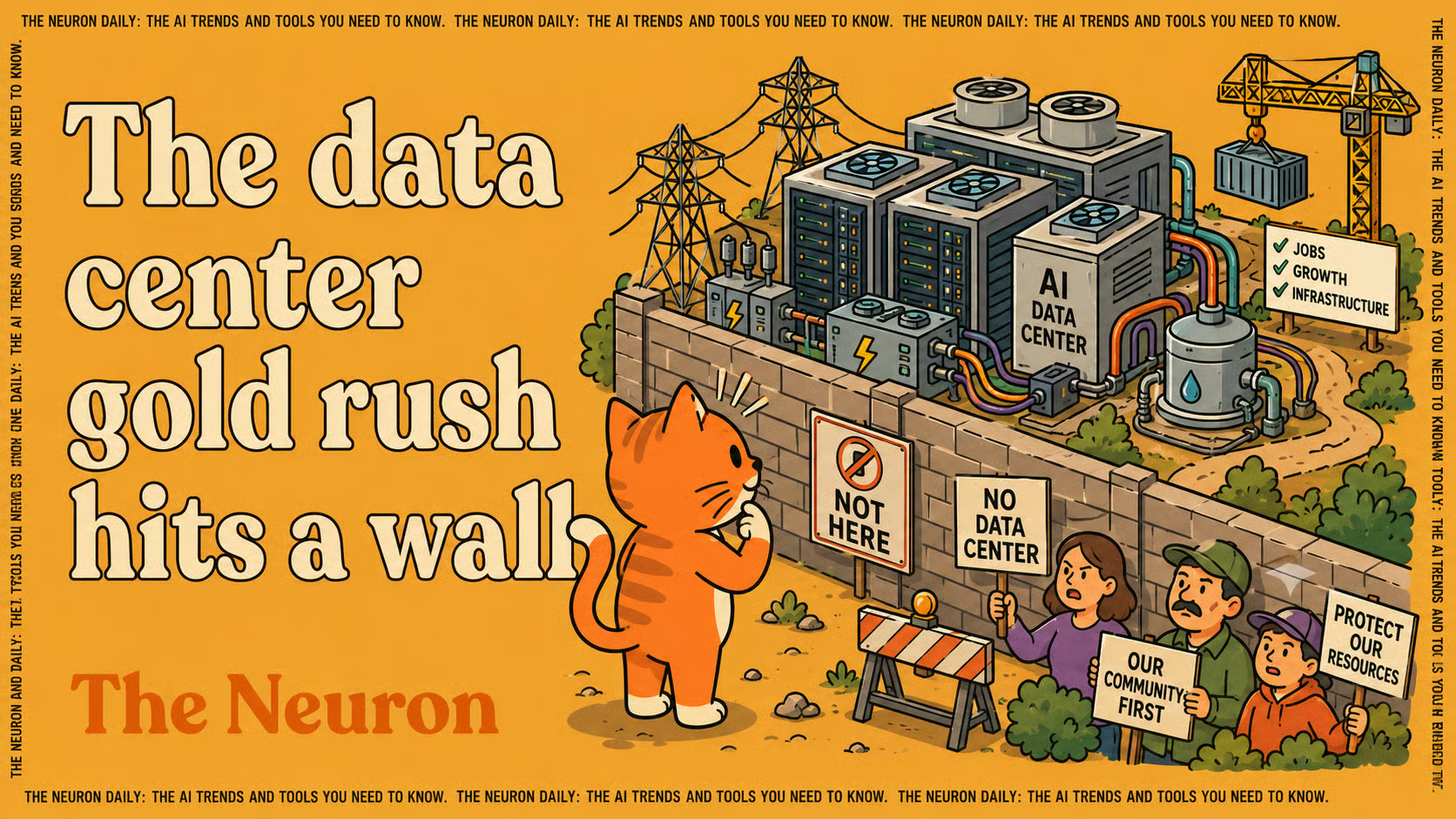
You might use ChatGPT every day — for drafting emails, debugging code, or just answering random questions at midnight. But according to a growing and surprisingly unified slice of the American public, that daily convenience does not mean your town owes the AI industry its land, its water, its power grid, or its political goodwill. That tension is no longer a fringe concern. It is, as The Neuron reported in its August 7, 2026 issue, arguably the year’s biggest AI story.
Bipartisan Backlash: A Rare Moment of American Unity
Political consensus in the United States is hard to find. Yet reporter Jasmine Sun, after a 10-day, four-site reporting trip across Wisconsin and Michigan, found exactly that — on the subject of data centers. According to The Neuron’s coverage of Sun’s findings (also discussed on The Ezra Klein Show), roughly 70% of surveyed residents oppose having a data center built nearby, and more than 100 moratorium proposals are currently circulating across the country.
Left, right, rural, suburban — it does not seem to matter. The opposition cuts across traditional political lines in a way that almost nothing else does right now. That alone should make the AI industry pay very close attention.
What Are People Actually Complaining About?
The grievances are concrete and local, not abstract or ideological. Sun’s on-the-ground reporting identified several recurring themes that communities raise when a data center proposal lands in their backyard.

The Deeper Problem: AI Has No Local Constituency
One of the sharpest observations in The Neuron’s coverage of Sun’s reporting is this: AI lacks a constituency in the way that other major infrastructure investments have historically had one. Housing developments have future residents advocating for them. Auto plants bring union workers who fight for them. Renewable energy projects have environmental advocates. AI data centers? They serve a diffuse, global user base that experiences the benefits as invisible utility — a chatbot response, a faster search result — not as something that transforms a town’s economy or identity in a positive, felt way.
This absence of a local champion means there is no political counterweight to the very organised, very motivated opposition. And that asymmetry is a serious structural problem for the industry’s growth plans.
The newsletter also highlights a fear that goes beyond economics: what Sun describes as a “permanent underclass” dynamic. Residents are being asked to supply land, water, and power — and absorb the disruption — for infrastructure that may ultimately make them economically disposable. The AI systems being built in their backyards could automate the very jobs their communities depend on. Accepting the data center is, in this framing, consenting to your own redundancy.
This Is Kitchen-Table Politics Now
With US midterm elections approaching, The Neuron notes that AI has become kitchen-table politics: electricity bills, farmland values, job prospects, and the fundamental democratic question of whether a town can say no to a powerful corporation. Daily ChatGPT users can simultaneously enjoy the product and reject the idea that their enjoyment creates an obligation for their community to subsidise the infrastructure behind it.
That is a crucial distinction the industry has been slow to grasp. Liking an app is not the same as consenting to industrial-scale transformation of your neighbourhood.
Can Better Deals Break the Deadlock?
Sun does not argue that moratoriums are the answer in the long run. The Neuron’s coverage makes clear that simply blocking data centers locally will not make them disappear — it will push them to other states, overseas, or into jurisdictions with fewer democratic guardrails. And that carries its own serious risks.
The more productive path, Sun suggests, involves transparent deal-making that genuinely shares the upside. Her reporting points to examples where a developer might invest substantially in cleaning contaminated land and reviving shuttered factories — creating real, lasting community benefit — in exchange for approval. The key word is transparently: no NDAs, no opaque negotiations, no promises that residents have no way to verify or enforce.

The Product Problem the Industry Won’t Name
The sharpest insight in The Neuron’s coverage comes from Jasmine Sun’s framing of industry responses to community opposition. When residents and local politicians push back, the AI industry tends to treat it as a communications problem — a failure of marketing, of messaging, of public education about the wonders of AI.
Sun’s counter-argument is more uncomfortable: it is a product problem. AI currently feels like a toy or a productivity boost to most people, not like trillions of dollars worth of essential infrastructure that communities should sacrifice for. We are scaling physical infrastructure at an extraordinary rate before the underlying technology has solved fundamental issues — alignment, hallucinations, memory, continual learning, and energy efficiency.
Building more data centers does not fix those problems. It compounds the unsustainability of the current trajectory.
The Question Every Politician Must Now Answer
As The Neuron frames it, the political question that AI has generated is now unavoidable for candidates at every level: Who pays for AI, who gets to decide where it is built, and who gets the benefits?
For the AI industry — including the companies scaling aggressively in India and globally — this American revolt carries a clear warning. Infrastructure expansion without genuine community consent, transparent economic sharing, and credible accountability is not just a PR problem. It is a political and operational risk that could throttle the entire buildout.
The data center revolt is not a fringe reaction from technophobic NIMBYs. It is a structurally coherent response to a genuine imbalance of costs and benefits. And until the industry treats it as a product problem rather than a messaging problem, the 100-plus moratoriums currently circulating are unlikely to be the last.