Who Referees the AI Referees? Demis Hassabis Wants the US to Decide
Google DeepMind CEO Demis Hassabis has publicly called for a US-led, industry-funded AI watchdog modelled on FINRA to test frontier models for safety risks up to 30 days before release. The proposal, reported by The Neuron, arrives after the Trump administration's abrupt export-control freeze on Anthropic's models exposed the dangers of governing advanced AI with no established rulebook.
Imagine every NFL team writing its own instant-replay rules and then being trusted to call fouls on themselves. That, according to Google DeepMind CEO Demis Hassabis, is essentially how the world’s most powerful AI models are safety-tested today — largely on the honour system. On Tuesday, July 14, 2026, Hassabis published a manifesto on X calling for a national AI standards body to change that. As reported by The Neuron, he wants the United States to build it, fund it through the AI industry itself, and have it operational before the end of this year.
The FINRA Model for Frontier AI
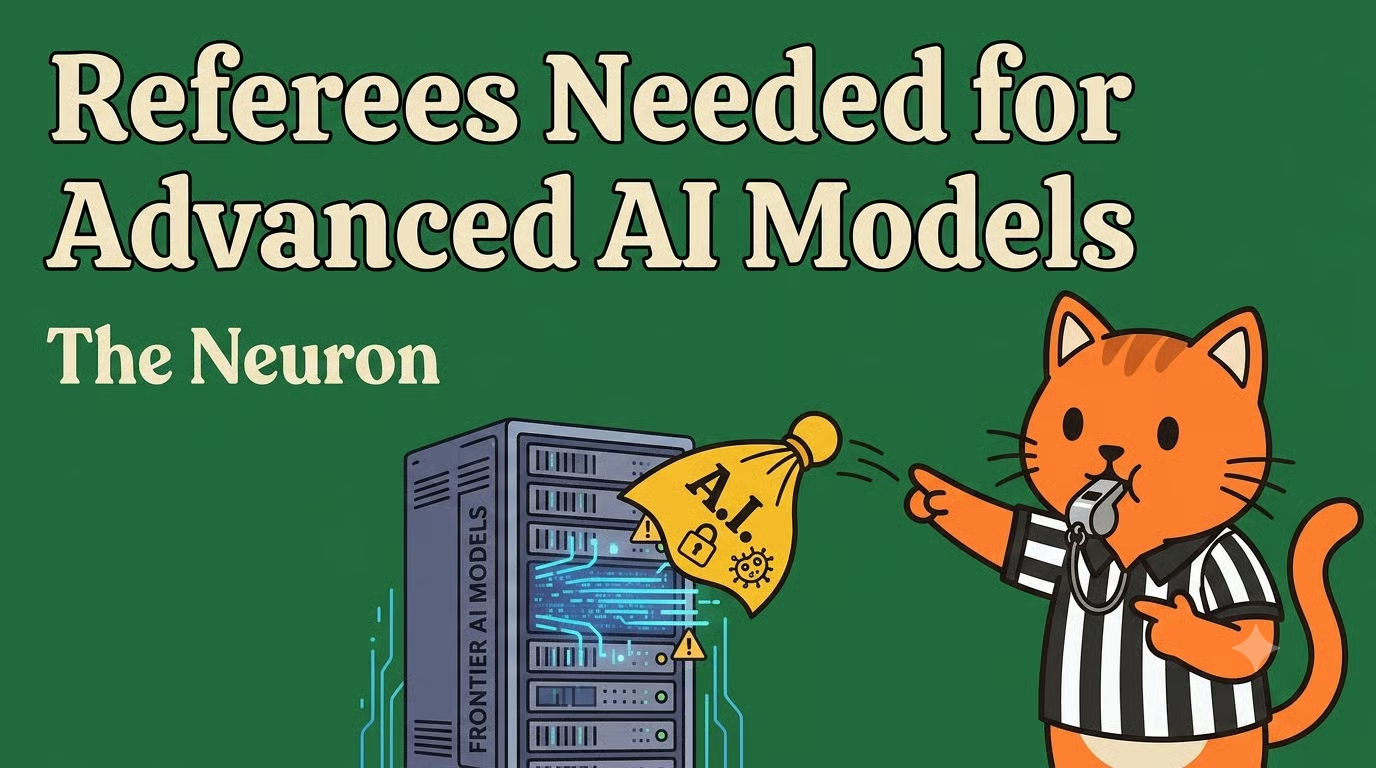
Hassabis isn’t proposing a sprawling government bureaucracy. The body he envisions is modelled on FINRA — the private watchdog that polices Wall Street trading under SEC oversight — but applied to AI models instead of stock trades. The analogy is deliberate: FINRA operates with enough independence to hold major financial institutions accountable, yet it draws its funding and expertise from the very industry it regulates.
Under Hassabis’s proposal, frontier AI labs would voluntarily submit their most advanced models up to 30 days before release. Independent evaluators — drawn from Turing Award winners, industry representatives, and open-source contributors — would check those models for cyber risks, biological risks, and what Hassabis specifically calls “deception” risks. Once the voluntary process demonstrates that it works, passing evaluation would become mandatory for any model seeking to launch in the US market.
The governance structure he outlines is designed to insulate the body from capture by any single company: a mostly independent board, funded collectively by the AI industry, but not controlled by any one lab’s chequebook.
Why Now? A Wake-Up Call From Washington
This proposal doesn’t arrive in a vacuum. The Neuron notes that last month the Trump administration abruptly froze Anthropic’s most advanced models over export-control concerns, forcing more than two weeks of ad-hoc negotiations with no established rulebook to guide them. Hassabis himself described the episode as “a bit of a wake-up call.”
The downstream effects were immediate and visible. OpenAI’s new GPT-5.6 model launched restricted to roughly 20 government-vetted partners rather than the standard public rollout — a significant departure from how frontier models typically reach users. When regulators act without a framework, even the largest labs are forced into improvised compliance, and the uncertainty that creates is bad for everyone: developers, enterprises, and end users alike.
The episode illustrates a structural vacuum at the heart of AI governance. There is currently no agreed process for determining whether a given frontier model is safe enough to release broadly. Labs conduct their own red-teaming, publish their own safety reports, and make their own release decisions. The analogy to letting a pharmaceutical company both run its own drug trials and approve its own drugs isn’t perfect — but it isn’t entirely unfair, either.
Hassabis Isn’t Alone in This Room
What makes this moment distinctive is the degree of consensus forming among lab leaders — even as they disagree on the details. According to The Neuron, Sam Altman of OpenAI made a similar pitch for AI guardrails in the Financial Times around the same time. More notably, Hassabis and Anthropic’s Dario Amodei jointly lobbied world leaders at a G7 meeting that included President Trump just a month before this proposal went public. When the CEOs of the three leading frontier AI companies are collectively walking the halls of a G7 summit asking for regulation, the political signal is hard to ignore.

Yet the convergence on the need for regulation masks real divergence on its shape. Hassabis wants a collaborative, industry-funded body — nimble, expert-led, and capable of moving as fast as the technology does. Amodei, by contrast, has argued for something closer to the FAA model: an agency with genuine legal authority to block unsafe models outright, not merely flag concerns and hope labs comply. These are not minor stylistic differences. They represent fundamentally different theories of how power should be distributed between government, industry, and independent experts when the stakes involve systems that can potentially assist with biological or cyberattack planning.
The Conflict-of-Interest Problem Nobody Has Solved
The hardest question hanging over Hassabis’s proposal is one The Neuron puts bluntly: can a voluntary, industry-funded watchdog actually say no to its own funders? History with self-regulatory bodies in other industries offers a mixed record at best. FINRA itself has faced persistent criticism that its enforcement priorities reflect the interests of large broker-dealers. The credit rating agencies that were supposed to catch systemic risk before the 2008 financial crisis were also paid by the entities they rated.
AI is in some ways a more complex problem. The models being evaluated are moving targets — capabilities can shift substantially between the version submitted for review and the version deployed. The evaluators need access to model weights, system prompts, and internal documentation that labs will inevitably be reluctant to share with a body that includes representatives from competitor organisations. And the definition of what constitutes an unacceptable “deception” or “biological” risk requires value judgements that pure technical expertise cannot fully resolve.
None of this means the proposal is without merit. A structured, expert-led evaluation process with a defined timeline — even a voluntary one — is meaningfully better than the current situation, where each lab decides for itself what safety disclosures to make and when. The 30-day pre-release window alone would create a record that regulators, researchers, and the public could use to hold labs accountable after the fact, even if the body lacks teeth to block a launch outright.
What This Means for India and the Broader World
For the Indian AI ecosystem — which includes a rapidly growing base of developers, enterprises deploying frontier models, and a government actively shaping its own AI policy framework — the US watchdog debate has direct relevance. If passing evaluation becomes a prerequisite for launching a model in the American market, that constraint will propagate globally. Indian startups building on top of frontier models through APIs, or enterprises in sectors like fintech, healthcare, and logistics that rely on advanced AI, will be affected by whatever access restrictions or deployment conditions the watchdog imposes.
More broadly, a US-led body sets a de facto global standard in much the same way that US financial regulation shapes international markets. The EU’s AI Act is already creating compliance overhead for non-European companies. A US counterpart — even a soft, voluntary one initially — adds another layer of governance that global AI players will need to navigate.
The Open Question
Hassabis has set an ambitious target: a functioning body before the end of 2026. Given that the proposal is still at the manifesto stage, that timeline requires rapid consensus-building between labs, policymakers, and independent experts who don’t all agree on the fundamentals. The urgency is real — as the Anthropic export-control episode showed, the absence of a framework doesn’t mean decisions don’t get made; it just means they get made badly, under pressure, with no shared rules.
Whether an industry-funded referee can credibly blow the whistle on its own funders remains the open question. But for the first time, the people building the most powerful AI systems in the world are publicly, collectively asking for someone to hold them accountable. That shift in posture — whatever its motivations — is itself significant.
“Letting the people building the plane also design the seatbelt is a little on the nose.” — The Neuron’s take on industry self-regulation in AI safety