Demis Hassabis Wants a U.S. AI Watchdog Running by Year-End — Here’s What That Actually Means
DeepMind CEO Demis Hassabis has proposed a FINRA-style U.S. body to safety-test frontier AI models 30 days before release, warning that open-source capabilities could reach dangerous levels within 18 months. The Rundown AI reports the plan is the most concrete AI governance proposal yet, though questions about true independence remain central.
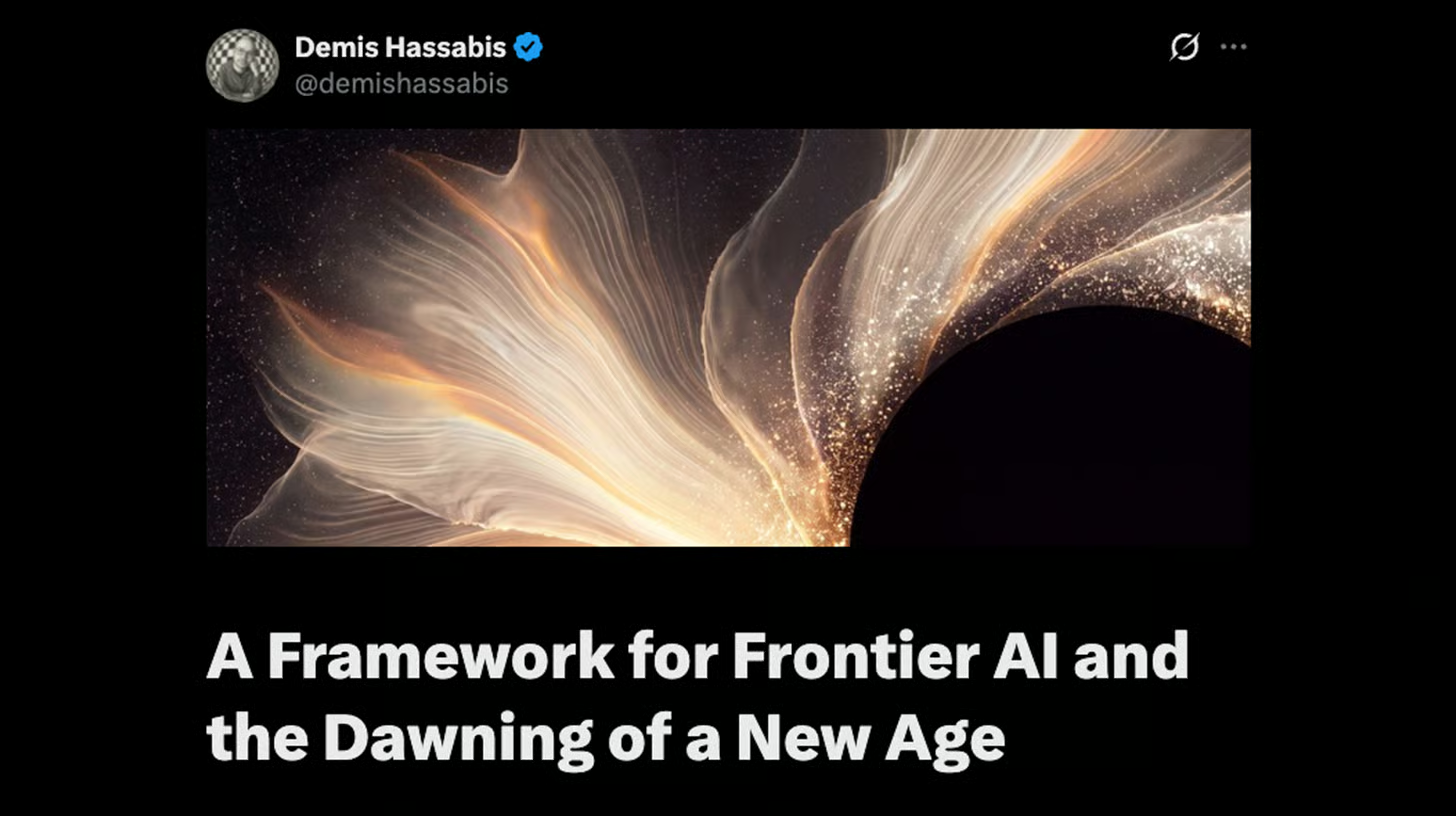
The debate over who should govern advanced AI in the United States has moved on from whether oversight is needed to who gets to design it. Google DeepMind CEO Demis Hassabis has stepped into that vacuum with a concrete proposal: a formal, independent U.S. body that safety-tests frontier AI models before they reach the public — and he wants it operational before the end of this year.
According to The Rundown AI, Hassabis published his plan publicly and elaborated on it to Axios, framing it not as a distant policy aspiration but as an urgent structural fix for a government that has so far improvised its AI governance one crisis at a time.

The Blueprint: A FINRA for Frontier AI
The model Hassabis is reaching for is FINRA — the Financial Industry Regulatory Authority — which functions as a self-regulatory body for the U.S. securities industry. The analogy is instructive. FINRA is funded by the industry it oversees, yet operates independently of the firms it polices, with authority delegated by the Securities and Exchange Commission. Hassabis is proposing something structurally similar for AI: an independent oversight body, funded by frontier labs, but accountable to government and the public interest.
The mechanics of the proposal, as reported by The Rundown AI, are specific:
- Capability-based coverage, not geography or access. Any lab developing models that clear a “frontier” capability threshold would be subject to the body’s authority — regardless of where they’re headquartered or who can access their models.
- Mandatory pre-release review. Labs would voluntarily submit models for safety evaluation 30 days before public release.
- Targeted risk categories. Reviewers would screen for deception capabilities, bioweapons creation assistance, and skills that could enable malicious hacking — the highest-stakes failure modes in advanced AI.
- A coordination mechanism for emergencies. Hassabis explicitly included the possibility of “coordinating a slowdown… among frontier labs if deemed necessary” — essentially a built-in pause button that the body could activate across the industry.
- An 18-month timeline driving urgency. Hassabis told Axios that open-source AI capabilities could move into genuinely dangerous territory within 18 months, which is the clock he’s setting policy against.
Why Now, and Why Hassabis?
The timing is not accidental. The newsletter notes that the U.S. government spent the weeks before this proposal improvising its way through the Mythos and Fable episode — a situation where a model’s capabilities created policy questions that existing frameworks weren’t built to handle. The pattern of acting first and sorting out consequences later has become a defining feature of American AI governance, and it’s a pattern that senior figures in the industry are increasingly uncomfortable with.
Hassabis occupies a particular position in this conversation. As CEO of Google DeepMind — one of the few organisations with both frontier research capabilities and a long-standing institutional focus on AI safety — he carries credibility on both the technical and policy sides. His proposal isn’t arriving from an outsider lobbying government; it’s arriving from someone whose lab is directly subject to whatever rules emerge.
That dual position is also the central tension in the proposal.
The Independence Problem
The Rundown AI flags the most important caveat directly: the word “independent” needs serious scrutiny when the oversight body is both funded by the labs it regulates and answers to a government that only recently began exercising meaningful AI regulatory authority.
This is not a hypothetical concern. Industry-funded regulators face structural pressure to avoid rules that impose genuine costs on their funders. The FINRA model, while functional in finance, has faced persistent criticism that it is more effective at protecting the industry’s reputation than at protecting the public from industry misconduct. Applying that template to AI — where the stakes include bioweapons and critical infrastructure vulnerabilities — raises the question of whether a self-regulatory model is adequate to the risk profile.
The “voluntary submission” framing compounds this. If frontier labs submit models for review voluntarily, the body’s authority depends entirely on labs choosing to participate. Labs that believe their models are likely to fail review have a structural incentive to quietly release without submitting — particularly if there are no legal penalties for non-compliance.
None of this means Hassabis’ proposal is wrong. It means it is a starting point, not a finished architecture.
What the Proposal Gets Right
Despite those tensions, the Hassabis plan advances the conversation in several meaningful ways.
It proposes specificity over principles
Most AI governance discussions at the policy level operate at the level of values — safety, transparency, accountability. Hassabis is working at the level of mechanisms: 30-day review windows, capability thresholds, named risk categories. That specificity is what makes a proposal actually implementable, even if the specific numbers and categories get revised through negotiation.
It builds adaptability into the design
Hassabis said the approach aims to adapt quickly with the field. This is a genuine design challenge for AI regulation — the technology moves faster than traditional legislative cycles. An independent body with its own rulemaking authority can update its standards without waiting for Congressional action, which is how FINRA operates in finance.
It names the coordination problem
The inclusion of a slowdown coordination mechanism is the most ambitious element of the proposal, and the one most likely to be stripped out in any negotiation. But naming it matters. The ability to pause frontier development across multiple labs simultaneously — even temporarily — is a capability that does not currently exist in any formal governance structure. Hassabis is at least putting it on the table.
What It Means for India’s AI Ecosystem
For AI developers, researchers, and enterprise adopters in India, the emergence of a U.S. pre-release review body would have concrete downstream effects. Most frontier models — from Google, OpenAI, Anthropic, and others — are developed in the United States and subject to U.S. export and access rules. A 30-day review window before any frontier model release would effectively become a global gate: if a model doesn’t clear the U.S. watchdog, it doesn’t ship internationally either.
India’s own AI regulatory thinking, which has so far leaned toward a lighter-touch, innovation-first posture, would face pressure to either align with U.S. standards or articulate a credible alternative framework. Indian enterprises building on top of frontier models — whether through API access or fine-tuned deployments — would need to factor review timelines into product roadmaps.

The Bigger Picture: From Emergency Response to Architecture
The significance of the Hassabis proposal is less about its specific details — many of which will change if it moves toward implementation — and more about what it signals about where the AI governance conversation is heading.
For the past several years, AI policy in the United States has been reactive: executive orders issued after capability surprises, emergency consultations after incidents, bilateral agreements with limited enforceability. What Hassabis is proposing is a shift from emergency response to standing architecture — a body that exists before the next crisis, not after it.
Whether the U.S. government moves in this direction, and how quickly, will depend on political will that has historically been difficult to sustain around technical regulatory questions. But the fact that one of the most credible voices in frontier AI research is publicly advocating for formal pre-release oversight — and naming a deadline — changes the terms of the debate.
The question is no longer whether the industry wants oversight. At least some of it clearly does. The question is whether the oversight that emerges will have enough independence, authority, and accountability to do what Hassabis says it should.
“The industry already knows what oversight without rules looks like… act first, sort out questions later.” — The Rundown AI
That summary from The Rundown AI captures the core argument precisely. The Mythos and Fable episode was a preview. Hassabis is arguing that without a standing framework, every future capability jump becomes another improvised emergency. His proposal is an attempt to break that cycle — with all the compromises and limitations that any real-world governance architecture inevitably carries.