NVIDIA, Microsoft, and Meta Draw a Line in Washington: Keep Open-Weight AI Free
Over 20 major tech companies including NVIDIA, Microsoft, and Meta have urged Washington to protect open-weight AI from premature regulatory restrictions. The coalition argues open models lower costs, boost competition, and give businesses data sovereignty — while OpenAI, Anthropic, and Google notably stayed off the letter.
The most consequential AI policy fight of 2026 may not be about safety benchmarks or compute thresholds. It is about something far more fundamental: who gets to own, run, and modify the intelligence that powers the next decade of software. And according to The Neuron’s reporting on a major joint letter published this week, more than 20 of the world’s most influential technology companies have picked a side.

What the Coalition Is Asking For
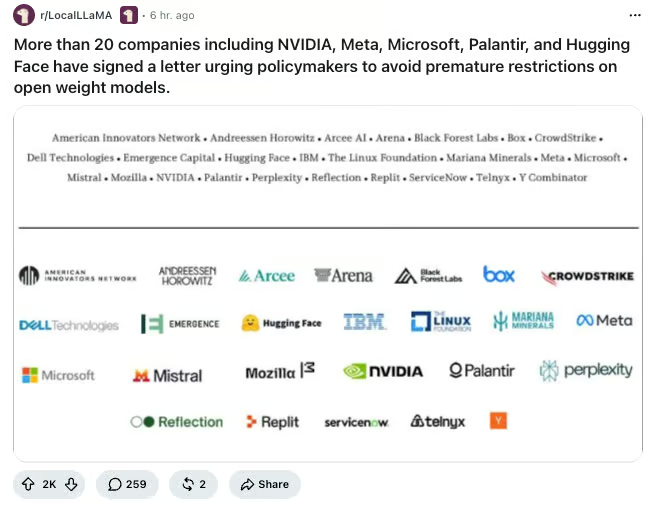
A group of more than 20 companies and organizations — including NVIDIA, Microsoft, Meta, IBM, Palantir, Hugging Face, Mistral, Mozilla, and Y Combinator — published a joint letter urging Washington to protect open-weight AI models. The letter, reported by The Neuron, calls on policymakers to avoid what it describes as “premature restrictions” that could weaken competition or push AI development to other countries.
Open-weight models, for context, are AI systems whose core files can be downloaded, inspected, modified, and run on a company’s own hardware. The newsletter frames this neatly: think of it as buying the machinery outright instead of repeatedly paying to use someone else’s factory. You control the inputs, the outputs, the data, and the costs.

The coalition’s arguments to Washington break down into four main points. First, open models allow businesses to choose cheaper, specialized AI for routine tasks while reserving expensive frontier models for genuinely complex problems. Second, openness gives customers greater control over their data, infrastructure, and accumulated institutional knowledge. Third, treating model distillation — the process of using one AI’s outputs to improve another — as automatically equivalent to intellectual property theft would be an overreach that stifles innovation. Fourth, the threat of misuse is not unique to open models; closed systems can also be hacked, misused, or fail in ways that are invisible to the public.
The coalition did acknowledge the genuine risk: once model weights are released, modified copies are difficult to trace or recall. But the counter-argument is equally compelling. More researchers examining a model means more eyes on its vulnerabilities, which can surface weaknesses faster than any internal red-teaming process at a closed lab.
The Business Logic Behind the Principle
It would be naive to read this letter purely as a civic act. The Neuron’s analysis makes the business model behind the principle explicit: most of the signatories make money when many AI models run in many places. NVIDIA sells the chips those models run on. Microsoft sells the cloud infrastructure and enterprise software that wraps around them. Hugging Face and Mistral are built entirely on the open-weight ecosystem. Y Combinator-backed startups thrive in a world where the cost of building an AI-powered product is low and the playing field is not pre-tilted toward a handful of incumbents.
Notably absent from the signatory list: OpenAI, Anthropic, and Google. These are the three companies whose premium frontier models are accessed almost exclusively through controlled APIs and subscription services. Their business model depends, at least in part, on the idea that the best AI is something you rent rather than own. The Neuron’s framing is sharp here — the signatory list is essentially every major US tech company that benefits from a wide-open AI ecosystem, arrayed against the labs whose revenue depends on keeping the gate.
This does not make either side wrong on the merits. But it does mean you should weigh the arguments with that context in mind.
Why This Matters for Indian Businesses and Startups
For the Indian technology ecosystem, the stakes in this Washington debate are surprisingly direct. Indian enterprises and startups are among the most active users of open-weight models — both because of cost sensitivity and because of the desire to keep sensitive data on-premise rather than routing it through US-based APIs.
If Washington moves to restrict open-weight model releases, Indian companies could find themselves dependent on a small number of US-based API providers for access to frontier AI. That creates a single point of failure, a potential geopolitical leverage point, and a cost structure that favors large enterprises over scrappy startups. Conversely, a regulatory environment that protects open-weight development keeps the global innovation floor lower and more accessible.
The coalition’s argument that open models create more demand for chips, clouds, security tools, and enterprise software is also relevant here. India’s growing data center and cloud infrastructure sector stands to benefit from a world where AI deployment is distributed rather than centralized.
The Cable Bundle Analogy
The Neuron draws an analogy that is worth sitting with: this battle will determine whether AI develops more like the open internet or like a new cable bundle controlled by a handful of providers. The open internet, for all its chaos and risk, enabled an explosion of value creation that no single gatekeeper could have planned or permitted. Cable, by contrast, was a world of rent-seeking, bundling, and captive audiences who paid because switching was too painful.
The closed-AI-as-cable-bundle scenario is not hypothetical. If a small number of labs control access to the most capable models, they can price, restrict, and bundle that access in ways that serve their shareholders rather than their users. The open-weight alternative is messier and carries real security risks, but it preserves optionality for the rest of the world.
Neither outcome is inevitable. Washington’s actual regulatory choices will be shaped by lobbying, by security incidents, and by whether policymakers develop enough technical fluency to distinguish between regulating dangerous capabilities and simply entrenching incumbents.
What Policymakers Need to Get Right
The Neuron’s coverage is careful not to declare a winner in this debate, and that caution is warranted. The coalition’s letter is persuasive on the benefits of openness, but it does not fully resolve the hardest question: what happens when an open-weight model is fine-tuned for genuinely dangerous purposes and the weights are already widely distributed?
The answer Washington eventually lands on needs to thread a narrow needle. Regulate demonstrably dangerous uses and capabilities without handing today’s frontier labs a permanent regulatory moat. Require transparency and safety evaluations without making the compliance burden so heavy that only the largest companies can afford to publish models. Treat model distillation with nuance rather than reflexively classifying it as theft.
That is a genuinely difficult set of tradeoffs. The coalition letter is the opening argument in what will be a long policy process. Indian policymakers, developers, and enterprise technology buyers should watch it closely — because the rules written in Washington will shape the global AI supply chain for years to come.
The Bottom Line
More than 20 major technology companies, including NVIDIA, Microsoft, and Meta, have formally asked Washington to keep open-weight AI accessible and free from premature restriction. Their arguments are grounded in real benefits: lower costs, more competition, greater data sovereignty, and faster security research. Their business interests also align neatly with those arguments, which does not invalidate them but does explain the urgency.
The companies that stayed silent — OpenAI, Anthropic, Google — have their own defensible reasons for preferring a more controlled environment. The honest answer is that both models carry risks, and the policy challenge is to contain the risks of each without simply picking a winner in a commercial competition dressed up as a safety debate.