GPT-6.2 Astra, Gemini Tasks, and Microsoft MAI: The Day the AI Giants Moved at Once
OpenAI, Google, and Microsoft each launched new AI tools on the same day — GPT-6.2 Astra and Sol, expanded Gemini Tasks, and seven specialised MAI models. The common thread: AI is shifting from answering questions to finishing multi-step work, with cost and reliability as the new competitive battleground.
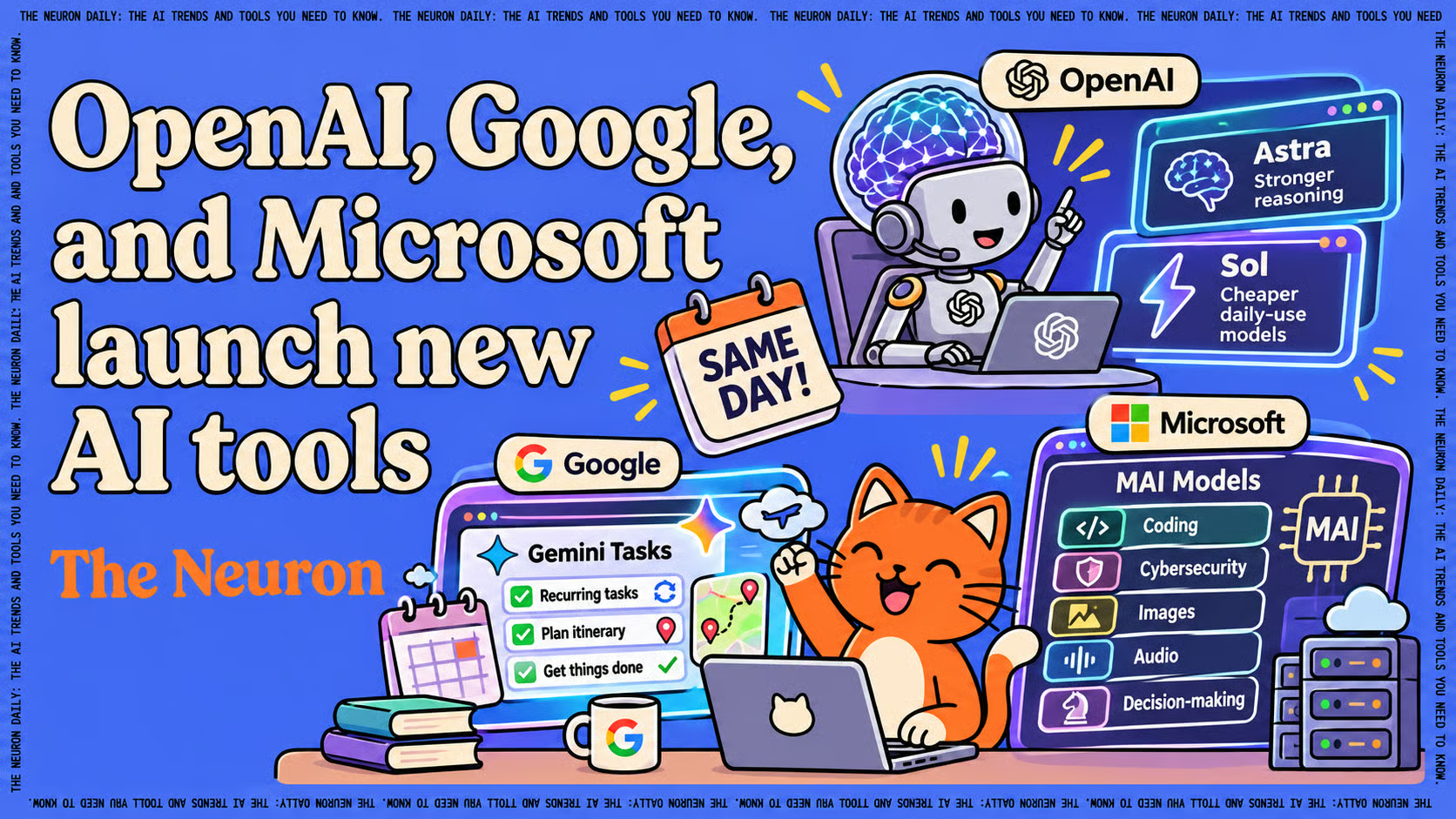
On a single Tuesday in November 2026, three of the most powerful technology companies on the planet each stepped up to a podium and made their case for what AI should do next. OpenAI, Google, and Microsoft all announced new models and capabilities within hours of one another — a collision that, as The Neuron described it, amounted to “three giants, one very crowded Tuesday.”
What OpenAI Actually Released
OpenAI introduced two new models: GPT-6.2 Astra and GPT-6.2 Sol. The names signal the split-tier strategy the company is now leaning into. Astra is positioned as the heavy-duty option — built for tough coding tasks, complex research, documents, and spreadsheets. Sol is the lighter, cheaper companion aimed at everyday work.
The headline performance claim from OpenAI is that Astra outperformed its previous model by 5.2 points on a multistep professional benchmark, and it does so at less than one-third the cost. That is a company-reported number, so it deserves the same healthy scepticism you’d apply to any self-graded exam. Still, the direction of travel is unmistakable: OpenAI wants Astra to handle genuinely complicated, multi-stage tasks without falling apart halfway through.
For Indian professionals and developers exploring these tools — where GPT API pricing has historically translated to anywhere from a few paise to several rupees per thousand tokens — cost reductions of this magnitude could make the difference between a commercially viable AI workflow and one that eats into margins.
But the launch has not been universally celebrated. According to The Neuron’s reporting, early power users found Astra difficult to steer and prone to stopping short of completing tasks. Reddit users flagged repetitive creative outputs. Even Wharton professor Ethan Mollick, who often finds meaningful value in frontier models, described results as uneven — impressive on ambitious projects but inconsistent overall. That gap between benchmark performance and real-world reliability is one of the defining tensions in AI right now.
Gemini Tasks Goes Free (In Six Countries)
Google’s move was arguably the one with the broadest immediate reach for everyday users. The company announced it is expanding Gemini Tasks beyond paid plans, bringing the feature to free users in six countries.
The conceptual shift here matters. Instead of asking Gemini for travel advice — which is fundamentally a one-shot query — you can now assign a Task. The model assembles itineraries, runs recurring background research, and surfaces results when they’re ready. You are delegating a job, not asking a question.
More advanced actions — calls, purchases, that sort of thing — have their own separate rollout and permission controls. As The Neuron’s analysis noted with dry accuracy: “Convenient, assuming it remembers to ask before spending your money.” That parenthetical captures a genuine design challenge. Autonomous AI agents that can take consequential real-world actions require trust infrastructure that the industry is still building in real time.
For Indian users who currently access Gemini on the free tier — and there are millions, given Google’s deep penetration in this market — the expansion of Tasks is the most tangible near-term benefit from this entire wave of announcements.
Microsoft’s Seven-Model Lineup
Microsoft took the most architecturally distinct approach. Rather than releasing one or two general-purpose models, the company announced seven MAI models at its Ignite 2026 event, each specialised for a different domain: coding, cybersecurity, image generation, audio, and decision-making, among others.
The standout figure comes from the Code 2 model, which reportedly delivers 98% of GPT-6.1 Sol’s benchmark coding quality at roughly 40% of the cost. If those numbers hold up in production, that is a compelling case for task-specific models over general-purpose ones for high-volume use cases.
The logic is straightforward: a model that only needs to write and review code doesn’t need to know how to plan a wedding or explain a legal brief. Strip out the breadth, and you can run the model cheaper and faster. For enterprises in India running large-scale automation — think IT services firms using AI for code review or test generation — a 40% cost reduction at near-equivalent quality is the kind of number that moves procurement decisions.
The Real Competition Is Now About Finishing Work, Not Answering Questions
All three launches, read together, point to the same underlying shift. The frontier of AI competition is no longer about whose chatbot gives the best answer to a single question. It is about whose ecosystem can reliably finish a multi-step job at the lowest total cost.

The Neuron’s analysis frames this well. The prize for power users is a better multistep workflow: read a sales spreadsheet, query a CRM for missing records, update a dashboard, then send a summary — all in one automated chain. Model Context Protocol (MCP) provides a standardised way to connect an AI assistant to external tools and data sources. But the model still has to choose the right tools, pass information correctly between steps, and recover gracefully when one step fails.
Cheaper specialised models like Microsoft’s MAI lineup could make those chains economically viable at scale. Right now, running a complex multi-agent pipeline on expensive frontier models can cost enough to undercut the efficiency gains. If costs drop significantly, the calculus changes.
What Indian Users and Developers Should Watch
For casual users, the most practical near-term benefit should be AI assistants that handle more background errands and produce better first drafts — without requiring a premium subscription. But The Neuron’s editorial take is worth repeating: “Availability, reliability, and permission checks matter more than headline scores. A free agent that books the wrong appointment is still a pretty expensive mistake.”
That framing applies with particular force in India, where many users are encountering agentic AI for the first time through consumer apps. The question isn’t just whether a model scores well on a benchmark — it’s whether it asks before it acts, what happens when it gets something wrong, and whether the correction process is simple enough for a non-technical user to manage.

For developers and enterprises, the sharper question is about ecosystem lock-in. Each of these three companies is building not just a model but a stack — tools, integrations, permission systems, and enterprise agreements. Choosing which assistant to anchor your workflows around in 2026 is increasingly a decision about which platform you’ll be dependent on in 2028.
Three Pitches, One Direction
The simultaneous nature of these launches isn’t coincidental. Each company was watching the others’ calendars. The result is a compressed moment of real signal about where the industry is heading: toward agents that do work rather than models that answer questions, toward tiered pricing that makes AI affordable at scale, and toward permission architectures that let organisations control what their AI assistants can actually touch.
Whether GPT-6.2 Astra smooths out its rough edges, whether Gemini Tasks expands to India’s free tier, and whether Microsoft’s specialised models hold their quality claims in production — those are the questions worth tracking in the weeks ahead. Benchmark day is exciting. What comes after is what actually matters.
“Three giants, one very crowded Tuesday.” — The Neuron, November 18, 2026
The competition is good news for users and developers on the whole. It pressures prices down and integration quality up. But we are not yet at a point where any of these systems reliably finishes complex work without human checkpoints. Watch end-to-end task success rates, not launch-day announcements, before you rebuild your workflow around any of them.