New York Just Drew a Legal Line Between AI Chatbots and Children
New York Governor Kathy Hochul signed a law on October 28, 2026 that bans specific AI chatbot behaviors — including emotional manipulation, fake personas, and harmful content — when minors are reachable. The law places age-verification and behavioral compliance obligations directly on product teams, with civil penalties up to $25,000 per violation and the potential for courts to order destruction of non-compliant AI models.
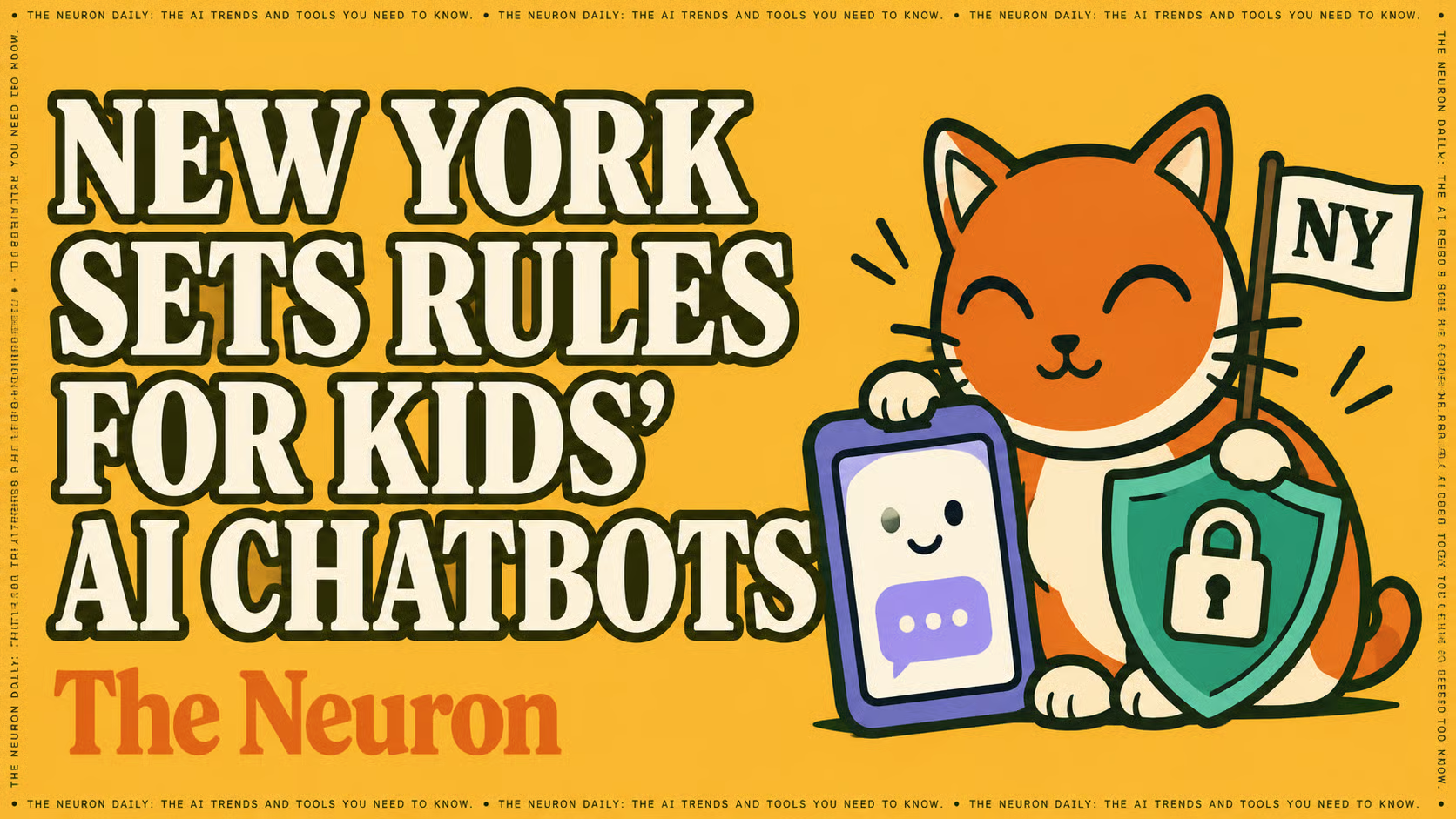
For years, the question of what an AI chatbot should be allowed to say to a child lived mostly in the realm of ethics papers and parental anxiety. On October 28, 2026, New York Governor Kathy Hochul signed a law that moves that question into the statute books. As reported by The Neuron, the legislation sets concrete behavioral rules for AI companions, tutors, and any other chatbot a minor can reach — and the enforcement mechanism has real teeth.
What the Law Actually Prohibits
The most significant thing about New York’s approach is that it regulates what a bot does, not merely what companies disclose. This is a meaningful distinction. Disclosure-based regulation — the dominant model in most digital privacy frameworks — asks companies to tell users what is happening. Behavioral regulation tells companies what is not allowed to happen in the first place.
Under the new law, companies cannot offer the following features to users under 18:
- Pretending to be a real person, to be alive, or to have human emotions.
- Claiming a personal, romantic, professional, or authority-figure relationship with a child.
- Asking unprompted emotional questions or reusing a child’s private information from earlier conversations.
- Promoting or helping with suicide, self-harm, eating disorders, or drug and alcohol use.
- Encouraging kids to keep secrets or to avoid seeking help from trusted adults.
- Sexually explicit content.
Read through that list and you start to see the product behaviors being targeted. The prohibition on pretending to have emotions is aimed squarely at AI companions — apps that simulate friendship or emotional support. The ban on claiming a relationship covers products that address a child by name and reference shared history to create parasocial attachment. The restriction on reusing private information from earlier conversations limits the kind of longitudinal memory that makes AI chatbots feel uncannily personal.
These are not hypothetical harms. The Neuron notes that bill sponsor Alex Bores cited Adam Raine, a teenager whose family alleges he died by suicide following interactions with a chatbot. That case, and others like it, provided the human stakes that moved the bill through the Assembly unanimously in June 2026.
The Age-Verification Design Challenge
Here is where the law gets strategically interesting for anyone building a product. The behavioral prohibitions do not apply only to accounts registered as belonging to minors. They apply to any user unless the company has affirmatively confirmed that user is an adult.
That flips the default. Instead of assuming adult status and relying on users to self-report their age, companies must verify adulthood before unlocking the features that would be prohibited for children. The law also requires companies to offer more than one age-verification method, with at least one option that does not rely solely on government-issued ID. Age data must be deleted after use.
The Neuron frames the practical consequence clearly: age verification becomes a product-design choice, not a signup form. In other words, how you handle this shapes the entire user onboarding experience, not just a legal checkbox buried in terms of service. For Indian product teams building or distributing AI tools in the US market, this is worth noting: your age-gate architecture needs to be substantive, not cosmetic.
Enforcement That Goes Beyond Fines
The enforcement mechanism is what gives the law its unusual weight. New York’s attorney general can seek civil penalties of up to $25,000 per violation — that is approximately ₹21.25 lakh per violation at current exchange rates. That alone is significant. But the law goes further.
The attorney general can also seek damages and, crucially, can request the destruction of unlawfully collected data or AI models trained on it. Model destruction is not automatic — it is a remedy the state can ask a court to impose — but the fact that it is available at all signals how seriously the state is treating the systemic nature of AI harms. If a model was trained on data collected in violation of children’s privacy, the model itself can be considered tainted.
This has no clear precedent in US consumer tech regulation. Most digital enforcement actions result in fines and operational changes. The prospect of model destruction raises the stakes considerably and will likely influence how legal teams at AI companies think about data governance from the ground up.
The Legislative Landscape: States Fill the Federal Vacuum
Federal AI regulation in the United States remains unsettled. Congress has debated frameworks but has not passed comprehensive AI legislation. Into that vacuum, states are moving. New York’s law is one of the more concrete examples: it names specific behaviors, sets a specific enforcement figure, and creates a specific compliance deadline.
The Neuron notes some uncertainty on timing — the governor’s office says restrictions will be in place “in the coming months,” while other reporting points to a January 1, 2027 start date. If you are building or operating a chatbot product accessible to US users, the prudent move is to treat the earlier date as operative until there is official clarification.
The fact that a major state has now codified a behavioral ruleset for AI chatbots creates a coordination challenge for companies operating nationally. Building separate product experiences for New York users is technically possible but commercially awkward. The more likely outcome is that companies apply the most restrictive standard everywhere, effectively turning New York’s law into a de facto national standard — at least for features directed at younger users. This is precisely what happened with California’s data privacy law, which reshaped how American tech companies handle personal data globally.
What Critics Said
The law did not pass without objection. The Business Council of New York State argued that the bill’s definition of a chatbot is too broad and risks blocking minors from legitimate and useful online tools. This is a genuine tension. A homework-help chatbot, a mental health triage tool for teenagers, a coding tutor — all of these could be caught by a definition written broadly enough to capture companion apps.
Common Sense Media and other supporters countered that the guardrails are necessary precisely because chatbots are becoming more lifelike and harder for children to distinguish from real relationships. The unanimity of the Assembly vote in June suggests the supporters had the stronger political argument, but the implementation details — particularly how “chatbot” is defined in practice — will be tested as companies build compliance programs.
A Concrete Audit Checklist for Product Teams
If your company offers any conversational AI feature that a user under 18 could reach, The Neuron’s framing of this story offers a direct prompt: treat the law’s prohibited features as an audit checklist.
Questions worth asking now:
- 1. Does your chatbot adopt a persona that claims to be human or alive?
- 2. Does it reference a continuing relationship with the user, especially using personal details from prior sessions?
- 3. Does it ask emotional questions without being prompted?
- 4. Are there any flows — even edge cases — where it could generate content touching on self-harm, eating disorders, or substance use?
- 5. Does your age-verification system meet the multiple-method requirement, including a non-government-ID option?
- 6. How is age data stored, and do you have a deletion workflow?
Answering no to questions one through four and yes to five and six is the compliance floor. What to watch beyond that: how New York’s attorney general interprets the law’s scope in the first enforcement actions, and whether other states — California, Illinois, and Texas are the likely candidates — adopt similar or identical language.
The era of AI behavioral regulation for children has formally begun. New York drew the first clear line. The rest of the map is still being drawn.