DeepSeek’s Flash Model Beats Opus 5 on Coding — And Its Web Search Costs 85% Less Than Rivals
DeepSeek released V4.1-Flash-1017, a free MIT-licensed model that outscores Claude Opus 5 on a coding benchmark, alongside web Search and Fetch tools priced 85% below rivals. The release intensifies pressure on closed-model pricing while raising data-security and geopolitical considerations developers cannot ignore.
On Saturday, October 18, DeepSeek quietly dropped two things at once: an updated model called V4.1-Flash-1017, and public access to its own web Search and Fetch tools for AI agents. As reported by The Neuron, you can think of it as a new brain plus a pair of eyes — both priced like a clearance sale. For developers in India and around the world building on top of AI infrastructure, this release deserves serious attention.
The Brain: A Free-to-Download Model That Edged Past Claude Opus 5 on Coding
The model update is a minor revision to DeepSeek’s cheaper “Flash” tier, but the benchmark numbers are striking. DeepSeek reports that V4.1-Flash-1017 scored 77.0 on DeepSWE v1.1, a coding-agent benchmark, compared to 74.0 for Claude Opus 5 and 73.0 for GPT-5.6 Sol. That puts a free, downloadable, mid-tier model ahead of two of the most prominent closed frontier models on a task that matters enormously to software teams.
The weights are released under an MIT license, meaning anyone can download the model, run it locally, or build a paid commercial service on top of it. That is a meaningful distinction — it puts a pricing ceiling on every cloud provider who wants to offer this model, because competing hosts on platforms like OpenRouter can simply run the same weights.
Before you declare a new king of AI, the fine print matters. DeepSeek ran these benchmarks itself, and on other evaluations the picture shifts. Claude Opus 5 scores 56.3 on Humanity’s Last Exam versus DeepSeek’s 42.6, and 51.8 on Terminal-Bench 4.0 versus 42.3. The right read here is that V4.1-Flash is an exceptional-value coder, not a general-purpose model that beats everything. For routine coding tasks, agent loops, and bulk automation work, though, its performance-to-price ratio is difficult to argue with.
The Price Is the Point
DeepSeek charges ₹12.75 per million input tokens and ₹51 per million output tokens at off-peak rates (at approximately ₹85 per USD, based on $0.15 and $0.60 respectively). To put that in context, The Neuron cites an Artificial Analysis finding from August that running the earlier Flash model through an entire test suite cost roughly 3 cents (about ₹2.55), compared to $1.86 (about ₹158) for GPT-5.6 Sol and $3.15 (about ₹268) for Claude Fable 5. Three cents for a full test run. As the newsletter dryly notes, a single sticky note costs more.
This pricing structure has structural implications that analysts cited by IBTimes describe as a challenge to closed labs’ premium pricing models. When open weights exist and any cloud can host them, the floor on what a provider can charge gets set by the cost of compute, not by the model’s exclusivity. The top closed models remain safe on the hardest reasoning tasks, but the squeeze lands squarely on bulk work — exactly the category where most enterprise usage actually lives.
The Eyes: Web Search and Fetch at 85% Below Market Rate
An AI model cannot browse the internet on its own. It needs tools. DeepSeek’s new Search and Fetch tools give agents exactly that capability. Search returns ranked results for a query; Fetch opens a single page and returns its full text as Markdown, ready for a model to process.
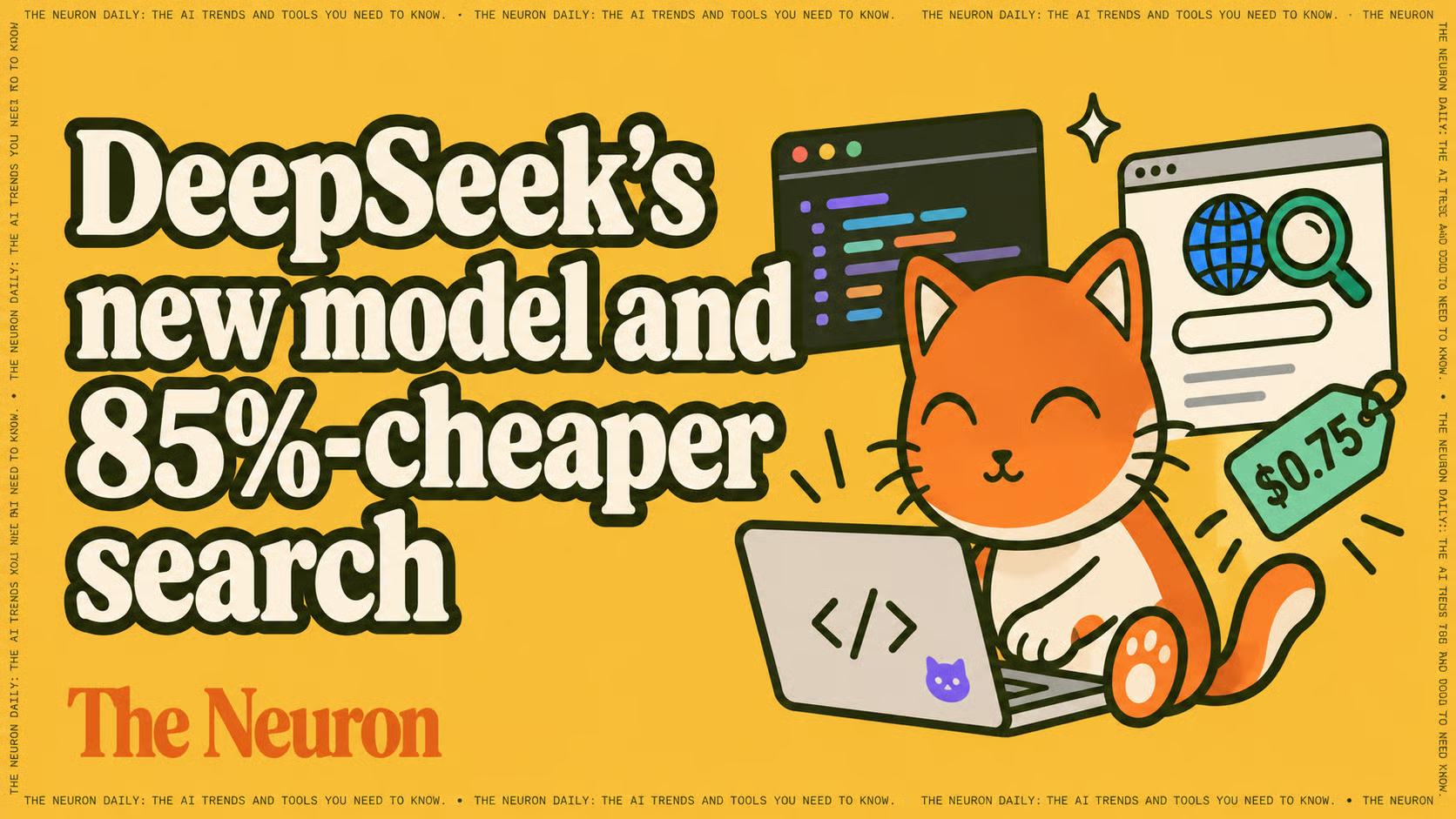
The pricing on these tools is where the competitive disruption becomes even clearer. DeepSeek charges $0.75 per 1,000 successful requests (about ₹64). The Neuron cites a pricing roundup that lists rivals including Brave, Tavily, and Perplexity at $5 per 1,000 and above — that is an 85% gap. Failed and empty calls are free. Calls made through DeepSeek Harness, Claude Code, or Codex are free until billing begins on November 1, Beijing time.
For Indian developers and startups building agent-based products — think automated research tools, competitive intelligence pipelines, customer support bots that need live web data — this pricing difference compounds rapidly at scale. An agent making thousands of search calls per day would see costs drop dramatically compared to existing alternatives.

What This Does to the Competitive Landscape
The immediate effect is a price signal. No rival has cut prices yet in response to this release, so what The Neuron describes as a “structural challenge” remains a forecast rather than a confirmed market shift. But the logic is sound: when open weights cap the model tier and sub-dollar-per-thousand pricing caps the search-tool tier, premium closed-model providers face questions about where their moat actually lies.
The answer, for now, is on the hardest benchmarks. Humanity’s Last Exam and Terminal-Bench 4.0 still favor Opus 5 meaningfully. For teams that need frontier-level reasoning on complex, open-ended problems, the case for paying a premium holds. For teams running high-volume coding agents, log analysis, document processing, or web research pipelines, the calculus has shifted.
OpenRouter already lists roughly a dozen providers hosting DeepSeek models, which illustrates how quickly open weights commoditize even capable models.
The Geopolitical Layer You Cannot Ignore
DeepSeek does not launch in a vacuum, and this release carries the usual geopolitical undertow.
In September 2026, the NSA, FBI, and CISA issued a joint advisory claiming that DeepSeek and Alibaba used distillation — training a model on another model’s outputs — at industrial scale. Beijing pushed back and hinted at retaliation. Separately, IDC data shows Nvidia’s share of China’s AI chip market fell to 34% in early 2026, while Huawei’s rose to 28%.
Perhaps most relevant to interpreting this specific release: on Friday, China proposed export controls on 23 AI items, including model weights for systems with 2 trillion or more parameters or a top-10 global ranking. The draft reportedly names no specific models, but Bloomberg and the AP note that Kimi K3 and Qwen3.8-Max exceed the size threshold. DeepSeek shipped open weights for a mid-size model and a pay-per-call API — sitting on the safe side of that proposed line. Whether that is deliberate strategy or coincidence, The Neuron notes, is impossible to determine from the outside.
Practical Guidance for Teams Evaluating This Now
If you are evaluating DeepSeek’s new tools for production use, a few considerations are worth keeping in mind.
- Search and Fetch run on DeepSeek’s servers. Several governments restrict DeepSeek on official devices over data security concerns. Public-web research is a reasonable use case. Confidential business data, customer PII, or proprietary code should stay out of these calls. Check your IT policy before integrating.
- The free window closes November 1. If you want to test the Search and Fetch tools at zero cost through supported integrations, that window is short.
- The benchmark caveat is real. DeepSeek self-reported the 77.0 score on DeepSWE v1.1. Independent reproduction of that number would substantially strengthen the case for deploying it on coding-critical workflows.
The Bigger Pattern
What DeepSeek’s Saturday release illustrates is a pattern that has been building throughout 2026: the commoditization of capable AI is accelerating faster than the frontier is moving. Open weights compress model pricing. Sub-dollar API tools compress the agentic infrastructure layer. The value question for every team building on AI shifts away from “which model is smartest” and toward “which combination of model, tools, and infrastructure best fits my actual workload at the cost I can sustain.”
For India’s rapidly growing developer and startup ecosystem, where cost sensitivity shapes infrastructure decisions more acutely than in some Western markets, DeepSeek’s pricing moves are not just interesting news — they are a genuine shift in what is economically viable to build. An agent-powered product that would have been expensive to run at scale last quarter may now be buildable at a fraction of the cost.
Two dates to watch: November 1, when real billing begins on Search and Fetch, and whenever an independent lab publishes its own DeepSeek V4.1-Flash-1017 coding benchmark run.