Amazon and Google Are the Quiet Winners of Anthropic’s Record IPO
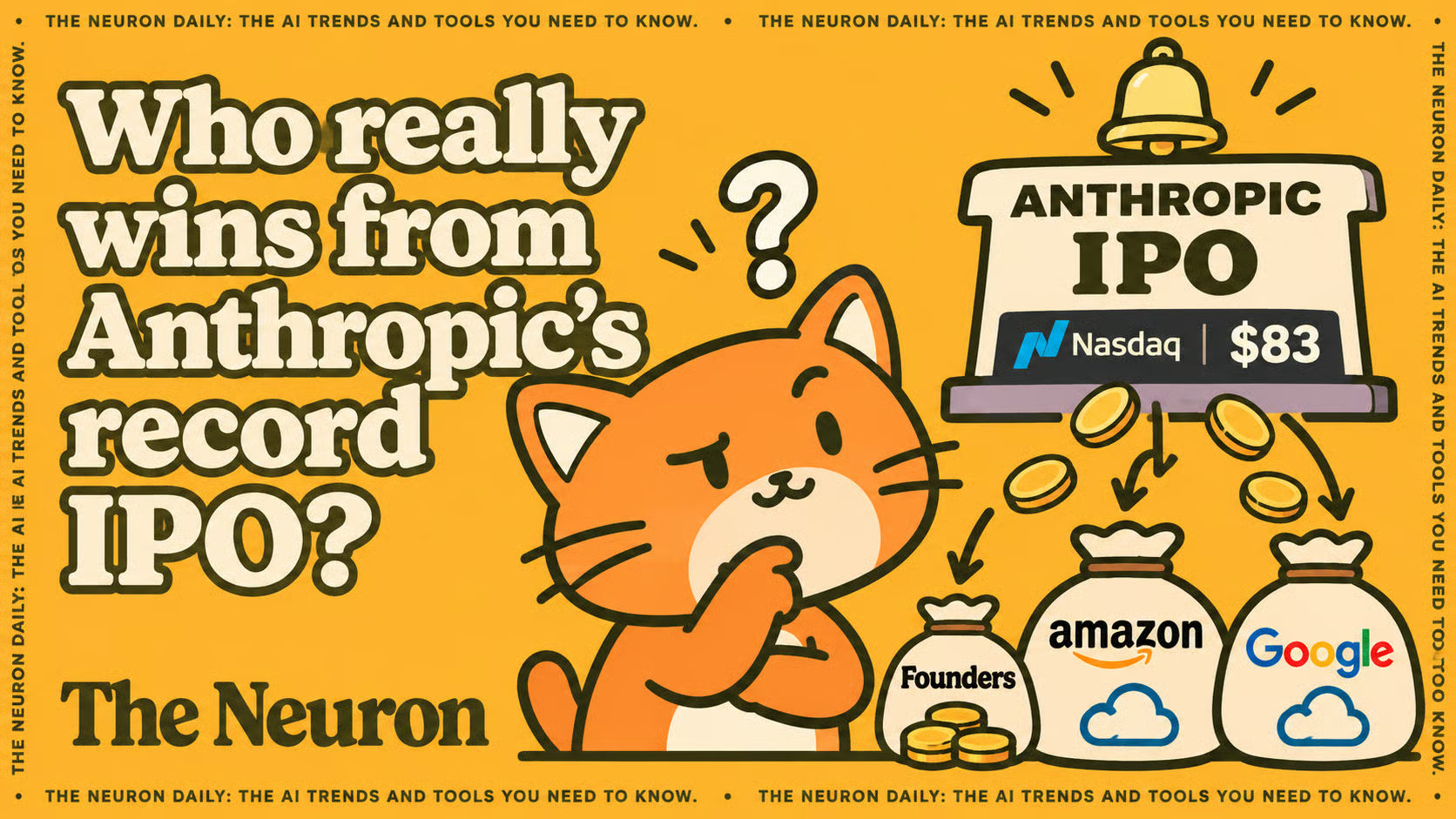
Anthropic's Nasdaq IPO created enormous paydays for its seven founders and venture backers, but Amazon and Google — as both equity holders and cloud infrastructure providers — may be the structural winners. The newsletter highlights how a $110 billion compute commitment to Amazon and hundreds of billions in disclosed equity stakes mean the AI boom is amplifying existing tech-giant concentration rather than disrupting it.
When Anthropic began trading on Nasdaq, the headlines focused on a dramatic opening — shares priced at $83 each, a valuation that placed the maker of Claude among the most valuable AI companies ever to go public. According to The Neuron’s reporting on the event, each of Anthropic’s seven founders sold roughly $280 million in shares at the IPO price, before fees and taxes. That is a life-altering sum by any measure. At today’s exchange rates, $280 million is roughly ₹23,800 crore — more than the annual revenue of many mid-sized Indian conglomerates.
But if you follow the money past the founders, the picture becomes more complicated, and far more revealing about how power is actually distributed inside the AI industry.
The Founders’ Windfall Is Only Part of the Story
The cash payout from share sales is striking, but it represents only a fraction of the founders’ total wealth created by the listing. As The Neuron notes, each founder still held roughly $20 billion in Anthropic shares at the IPO price — paper wealth that will rise or fall with the stock over the coming years. The $280 million figure, as large as it sounds, is essentially a small liquidity event against a much larger stake that remains locked up.
The founders also pledged 80% of their personal equity to philanthropy, though The Neuron flags that those pledges are not legally binding. That distinction matters. Philanthropic intentions are not the same as legally enforceable obligations, and history suggests that headline-grabbing giving pledges sometimes outlast the original motivation.
Amazon and Google: Investors and Infrastructure Providers at Once
Here is where the story gets structurally interesting. Amazon and Google were among Anthropic’s largest outside investors long before this IPO, and their disclosed holdings at the offering price were enormous. According to The Neuron, citing SEC filings, Amazon’s disclosed stake was worth roughly $161 billion at the offering price, and Google’s was worth roughly $147 billion. Combined, the two companies held stakes worth more than $300 billion in a single AI competitor.
But ownership is only one of the two ways these giants benefit. Both companies also supply Anthropic’s computing power — the cloud infrastructure that trains Claude and runs every API call. So when Anthropic grows, Amazon Web Services and Google Cloud capture revenue from that growth too. The Neuron describes this dynamic pointedly: your investor is also your landlord.
The landlord metaphor becomes even more apt when you look at the contractual commitments Anthropic made at listing. According to SEC filings cited by The Neuron, Anthropic committed to spend at least $110 billion with Amazon from May 2026 through April 2036, generally regardless of usage. That is not a flexible procurement relationship — it is a decade-long, largely unconditional revenue guarantee flowing from an AI startup back to one of its own largest shareholders. In Indian terms, ₹9,35,000 crore committed to a single vendor over ten years.
The shares that Amazon and Google hold are nonvoting, as The Neuron notes, which means ownership does not translate directly into governance control. Anthropic’s founders retain decision-making authority. But the financial dependency runs deep in both directions: Anthropic needs the capital and the cloud, and the cloud providers need Anthropic’s spend commitments and equity appreciation.
Venture Capital’s Outsized Returns
Beyond the tech giants, venture investors collected returns that illustrate how timing determines everything in private markets. The Neuron highlights three firms in particular.
Menlo Ventures invested more than $1 billion and reportedly held a stake worth above $20 billion at a $1.5 trillion valuation — a return multiple that most funds never achieve in an entire decade of investing. Lightspeed invested over $3 billion and held an even larger stake. Spark Capital invested in 2023, when Anthropic’s entire valuation stood at just $4.5 billion. Buying in at $4.5 billion and watching the company list at a valuation orders of magnitude higher is precisely the outcome every early-stage venture fund spends years trying to engineer.
The underwriting banks did not leave empty-handed either. Underwriters earned $550 million in fees from the transaction, according to SEC filings cited by The Neuron. That figure alone exceeds the annual technology budget of most large enterprises.
Who Is Not at the Table
The Neuron draws attention to a question that the financial headlines tend to skip: what about the people whose working lives AI is most likely to reshape?
AI policy researcher Molly Kinder, cited in the newsletter from the Roosevelt Institute, raises a concern that goes beyond the usual IPO analysis. The workers whose jobs AI could disrupt are not positioned to share in the wealth that disruption creates. She argues for giving workers more say in how AI is deployed and for creating mechanisms — including ownership stakes — that let workers participate in the gains rather than simply absorb the losses.
This is a structural critique that applies well beyond Anthropic. The pattern of AI wealth concentration is visible across the industry: capital flows to investors, infrastructure providers, and founders, while the productivity gains flow to enterprise customers, and the displacement costs are borne by workers who had no seat at any of these tables. Cheaper software subscriptions are not an adequate substitute for a share of the equity.
The IPO Wave Still Building
Anthropics’s listing may be the opening act of a larger wave. The Neuron notes that OpenAI has filed confidential IPO paperwork, while Nscale has filed publicly. Canva and Lambda have been linked to 2027 listings, and Databricks has indicated it will eventually go public without committing to a date. Each of these events will generate its own version of the same question: who actually captures the value?
The pattern established by Anthropic suggests the answer will often be: the same companies that were already large. Amazon and Google positioned themselves as both funders and suppliers before the AI boom became obvious, and that positioning is now worth hundreds of billions of dollars in disclosed equity alone. Venture firms that wrote checks in 2022 and 2023, when the numbers were smaller and the risk felt higher, are collecting multiples that justify years of patient capital.
What to Watch Going Forward
The Neuron frames the public benefit question carefully: the investor payoff is visible, but the public benefit still has to be delivered. That is the right framing. An IPO converts private wealth into liquid wealth — it does not automatically produce affordable tools, scientific breakthroughs, or a more competitive market landscape.
Watch whether Anthropic’s public-company status creates meaningful pressure to price Claude competitively for smaller businesses and individual developers in markets like India, where the ₹7,000-per-month price points of premium AI subscriptions already exclude large segments of the professional population. Watch whether the $110 billion Amazon commitment shapes Anthropic’s infrastructure decisions in ways that limit its ability to diversify or negotiate. And watch whether any of the forthcoming AI IPOs experiment with employee ownership structures that give workers a direct stake in the outcomes they are helping to build.
The Anthropic IPO is a landmark moment for the AI industry. But a landmark moment and a broadly shared moment are not the same thing — and the difference is worth tracking carefully.