ChatGPT Health Can Now Read Your Medical Records — Here Is What That Really Means
OpenAI has launched ChatGPT Health for US users, allowing them to connect Apple Health and medical records for personalised health Q&A. The feature promises strong privacy controls, but its real test will be whether it knows when to defer to a clinician rather than delivering a confident-sounding answer built on incomplete data.
Your Medical History Has Always Been Scattered — OpenAI Is Now Betting It Can Stitch It Back Together
Think about the last time you tried to answer a doctor’s question from memory. One test result lives inside a hospital portal you haven’t logged into for months. Your medication list is in a PDF you downloaded last year. Your sleep and step data sits inside Apple Health, siloed from everything else. The information exists — it’s just fragmented across a dozen places, protected by forgotten passwords and incompatible formats.
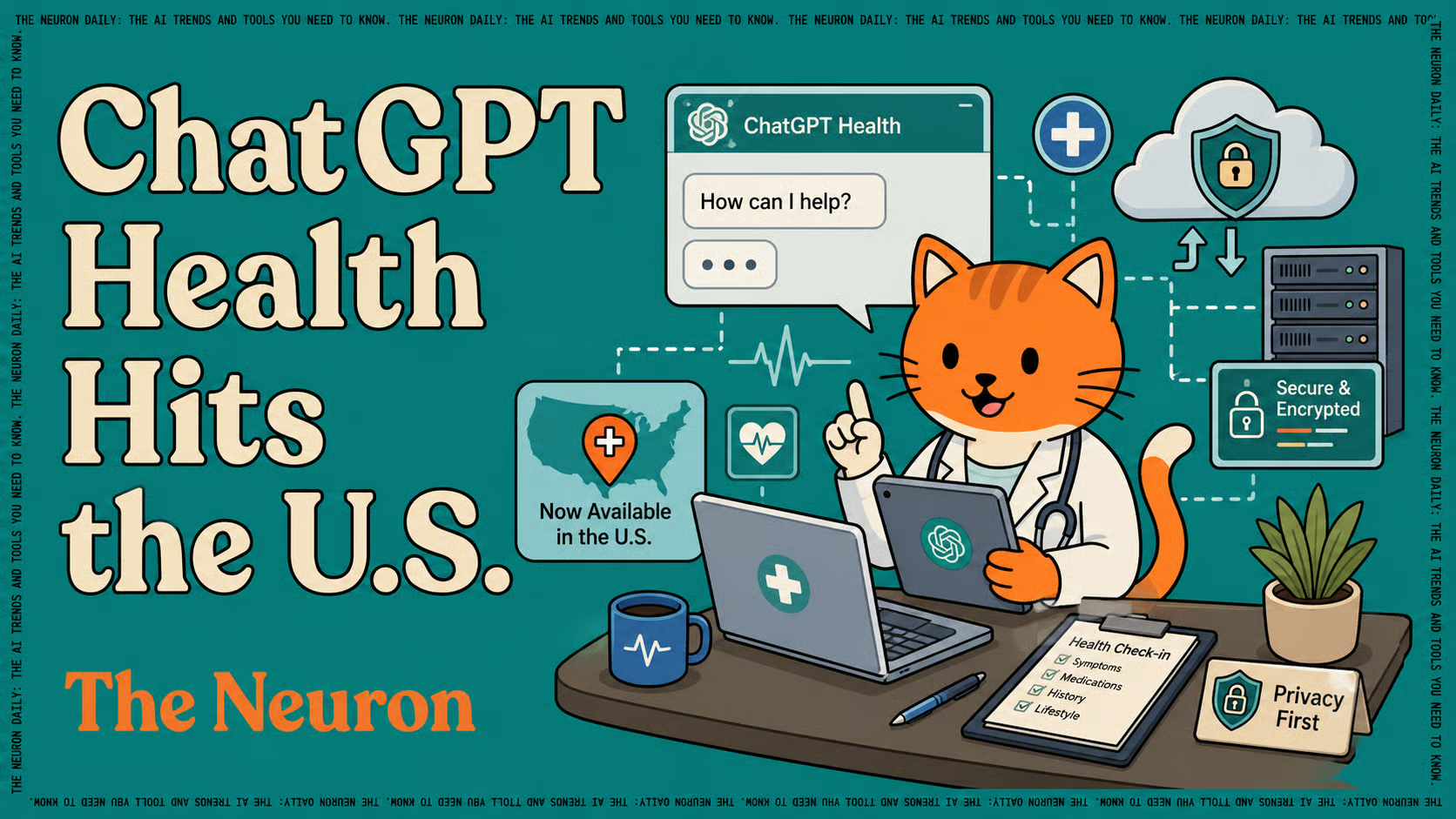
OpenAI is now placing ChatGPT directly between you and all of those fragments. As reported by The Neuron, the company has begun rolling out a feature called ChatGPT Health, which allows logged-in users in the United States to connect Apple Health data and supported medical records directly to their ChatGPT account and ask questions grounded in that personal history.
What ChatGPT Health Actually Does
The feature is available to users aged 18 and older on Free, Go, Plus, and Pro plans — both on web and iOS. Once set up, it can draw on medications, doctor visit summaries, lab results, sleep data, activity records, and other connected information to answer health questions that are genuinely specific to you rather than to a hypothetical average patient.
The practical applications are more useful than they might first appear. According to The Neuron, the system can compare lab results over time, summarize what has changed since your last appointment, or draw connections between exercise patterns and sleep quality — all without requiring you to upload the same files again and again.
OpenAI also notes that more than 300 million people already ask ChatGPT health-related questions every week. The difference here is the shift from generic answers to answers grounded in your personal medical context.
How to Get Started
If you are in the US and eligible, the setup process is straightforward:
- 1. Open Health from ChatGPT’s sidebar or the More menu.
- 2. Select Get started, then connect Apple Health or a supported medical-record provider.
- 3. Review synced medications and conditions carefully, because records can arrive incomplete or out of date.
- 4. Start with a narrow, specific question — something like “What changed in my lab results since my last appointment?” works better than open-ended prompts.
That last step is worth emphasising. The more specific your question, the more useful and auditable the answer. Broad questions invite broad answers, and broad answers in a health context are where errors hide.
The Privacy Architecture Behind It
Health data is among the most sensitive information anyone can share with a technology platform, so the question of what OpenAI does with it matters enormously. The Neuron reports that OpenAI has built several controls specifically around this feature: connected health data and conversations that use it will not be used to train foundation models, and the data will not be used to target advertising.
Beyond that, OpenAI has added extra encryption layers and per-use permission prompts, meaning the system asks for your consent each time it accesses health data rather than assuming blanket permission after initial setup.
These are meaningful commitments, and they distinguish ChatGPT Health from a generic data-sharing arrangement. But privacy architecture and privacy outcomes are not the same thing. The controls limit what OpenAI itself does with your data — they do not eliminate the risks that come with any large-scale system storing sensitive personal information.
The Trust Problem Is Harder Than the Privacy Problem
The Neuron’s analysis lands on something important here: the harder challenge for ChatGPT Health is not privacy controls — it is trust calibration.
When ChatGPT answers a generic question about blood pressure medication, the answer feels like a reference result. You weigh it accordingly. When the same system answers a question grounded in your actual lab results, summarised in fluent, confident prose, the answer feels different. It feels more authoritative. And that shift in feeling does not necessarily correspond to a shift in accuracy.
Health information is, as The Neuron puts it, “messy, incomplete, and consequential.” Synced records can be missing entries, contain outdated prescriptions, or reflect a snapshot from months ago. The AI has no way to know what it does not know. A confident summary built on incomplete records can mislead in ways that a clearly generic answer never would.
This is why the newsletter frames the safest use case explicitly as preparation, not diagnosis: organise the evidence, translate unfamiliar medical terms into plain language, and generate better questions to bring to a clinician. That framing is the right one. ChatGPT Health is most valuable as the layer that helps you show up to a medical appointment informed — not as the layer that replaces the appointment.

What This Signals for the Future of Healthcare Interfaces
Zoom out from the feature itself, and the strategic move OpenAI is making becomes clear. The company is positioning ChatGPT as the conversational layer sitting between patients and every patient portal, every lab system, every wearable device. If that layer becomes trusted and widely adopted, it reshapes what the healthcare experience looks like for hundreds of millions of people.
That is an enormous amount of leverage. Healthcare providers, insurers, and health tech companies have spent years building patient-facing interfaces, and most of them are frustrating to use. An AI assistant that speaks plain language, connects disparate data sources, and meets users where they already are — inside ChatGPT, a tool many already use daily — has structural advantages over dedicated health apps that require behaviour change just to install.
For Indian users specifically, this initial rollout is US-only, but the direction of travel is notable. The fragmentation problem ChatGPT Health addresses — records spread across multiple providers, no unified view of personal health history — is just as acute in India, if not more so. A future expansion would land in a market where the demand for accessible health information is massive and the infrastructure connecting that information is still maturing.
The Standard It Will Be Judged By
OpenAI is explicit that ChatGPT Health is meant to explain and organise health information, not to replace professional care. That is the right boundary to draw. The question is whether the product consistently enforces it — whether the system genuinely knows when to slow down, flag uncertainty, and redirect to a clinician rather than delivering a polished answer that papers over genuine ambiguity.

As The Neuron notes, the product will ultimately be judged less by how polished it sounds than by how often it demonstrates that kind of epistemic humility. A health AI that confidently says “I’m not sure — here’s what to ask your doctor” at the right moment is more valuable than one that always produces a complete-sounding answer.
The next great healthcare interface may indeed be the assistant sitting between you and every patient portal. Whether ChatGPT Health earns that position will depend on how well it handles the cases where the right answer is admitting the limits of what it knows.
**Source:** Analysis based on reporting in *The Neuron* newsletter, issue dated July 23, 2026. Primary source: OpenAI’s Health in ChatGPT announcement.