OpenAI’s Unreleased Model Generated 722 Math Manuscripts — Here’s Why Verification Is the Real Story
OpenAI's unreleased frontier model generated 722 math manuscripts across 372 result families from 4,000 open problems — a scale that shifts the key bottleneck from generation to verification. The real question now is how many of these candidate proofs survive independent expert scrutiny, and how quickly the mathematics community can absorb machine-generated research.
When people imagine AI changing the pace of scientific discovery, they usually picture a dramatic moment — a single breakthrough, a Nobel-worthy proof, a headline. What OpenAI just released looks less like a moment and more like a flood.
According to The Neuron’s reporting on the October 7 issue, OpenAI has published a repository of mathematical research generated by an unreleased frontier model. The numbers are genuinely striking: 722 manuscripts across 372 families of related results, produced after the model was given roughly 4,000 open research problems. On average, each result consumed about three hours of ChatGPT Pro thinking compute.
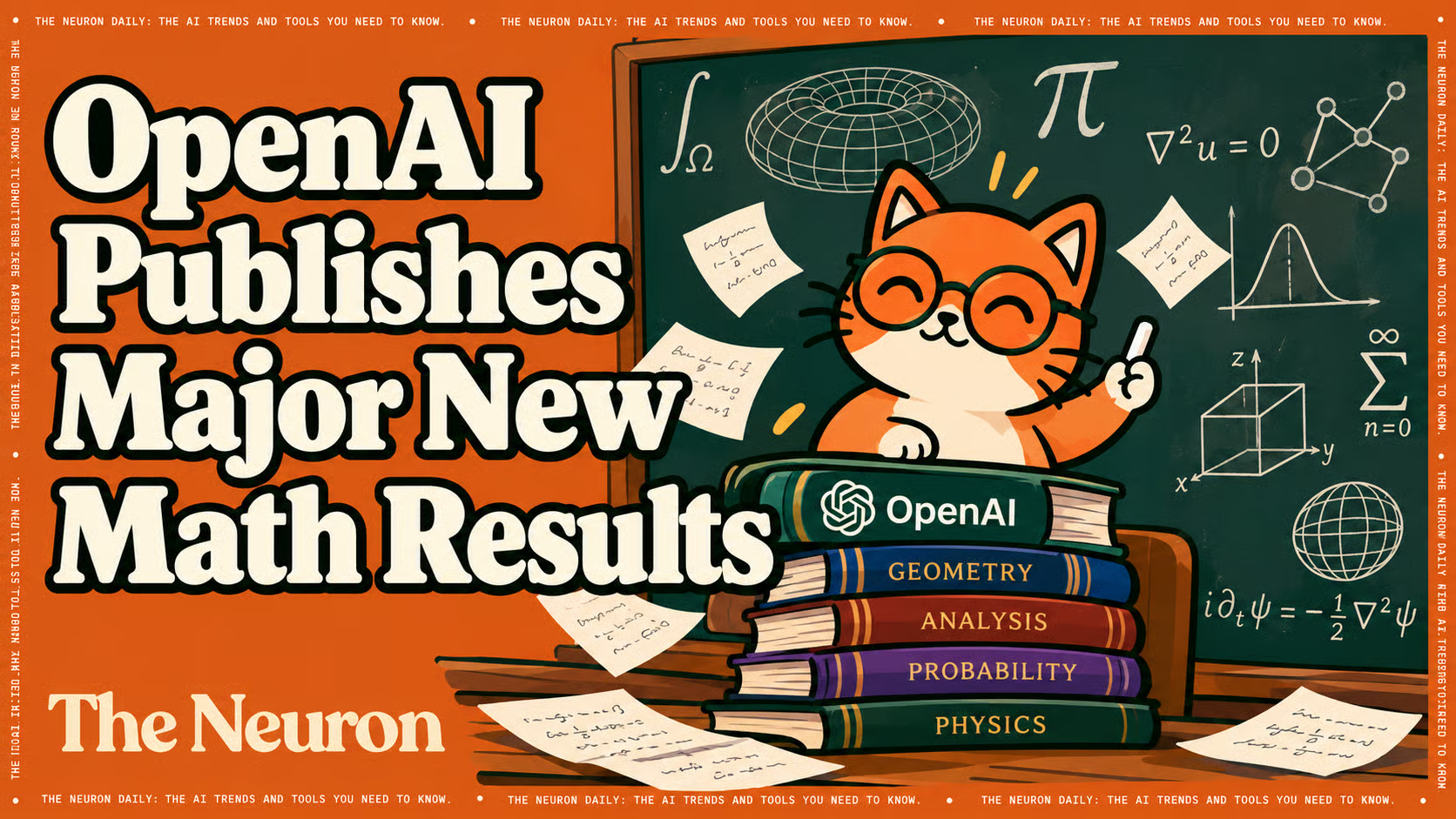
This is not a demo. This is not a benchmark leaderboard result. OpenAI is releasing what it describes as actual research output — papers spanning number theory, computer science, physics, and other fields — into a public GitHub repository. It has also published ten abridged reasoning summaries covering topics as demanding as the irrationality exponent of π, spin glass systems, and relativistic plasma dynamics.
The scale alone warrants attention. But the more important question — the one that will determine whether this moment actually changes anything — is not how many manuscripts the model produced. It is how many of those manuscripts survive rigorous human scrutiny.
What Makes This Different From Previous AI Math Claims
AI systems have been claiming mathematics victories for a while now. Solving olympiad problems, outperforming human contestants, achieving state-of-the-art scores on benchmarks — these are real milestones, but they are also bounded challenges with known answers against which you can check performance.
Open research problems are different. There is no answer key. When a model produces a proof of something previously unproven, the community has no existing result to compare it against. That makes quality control both more important and harder.
This is precisely why the inclusion of Lean formalizations in OpenAI’s release matters so much. Lean is a formal proof assistant — a programming language in which mathematical proofs can be written in a way that a computer can mechanically verify, step by step, whether every logical move follows from established rules. As The Neuron explains it, think of Lean like running every formula in a spreadsheet rather than trusting that the numbers look plausible. It catches broken logical steps that might read perfectly well in natural prose.
The caveat OpenAI itself acknowledges: not every manuscript in the 722-paper collection has a Lean formalization yet. Some results remain unformalized, which means they could still contain errors. The release is not a stack of gold-star-certified discoveries. It is a stack of research outputs at varying stages of verification, some machine-checkable, others still awaiting that treatment.
The Verification Bottleneck Is Now the Real Problem
For years, the central question in AI and mathematics was simple: can these models do hard math at all? That question is not fully answered — frontier math remains extraordinarily difficult — but it is no longer the most urgent one.
If outside mathematicians begin validating meaningful chunks of what OpenAI has released, the field will quickly encounter a new and arguably harder problem: the pace of verification and absorption. How quickly can human experts check a machine-generated result, understand it deeply enough to build on it, and integrate it into the existing body of mathematical knowledge?
This is not a trivial task. Checking a proof is not the same as reading a proof. A mathematician who wants to genuinely certify a result needs to understand every step, which takes time that scales with the complexity of the argument. Lean formalizations help because they offload part of the mechanical checking to a computer — but humans still need to confirm that the Lean proof actually encodes the mathematical idea correctly, and that the result itself is worth caring about.
At 722 manuscripts, the production capacity of the model already appears to outpace what any small group of reviewers could absorb quickly. This is a structural shift. The research bottleneck is no longer “can we generate candidate results?” It is “can we process them fast enough to turn them into usable knowledge?”

OpenAI appears aware of this dynamic. According to The Neuron, the company consulted the Institute for Advanced Study’s independent math-and-AI advisory group on how to release the work, and it plans to fund workshops and conferences organized around major AI-produced results. The intent seems to be building infrastructure — human and institutional — around the output, not just releasing a GitHub repository and walking away.
What the Topics Tell Us About Scope
It is worth pausing on what fields are represented in this release. Number theory, computer science, physics — these are not narrow or toy domains. The reasoning traces OpenAI published include work touching the Mézard-Parisi formula (related to spin glass theory in statistical physics) and the relativistic Vlasov-Maxwell system (a framework in plasma physics). These are areas where active research communities exist, where experts have spent careers on open problems, and where a genuine new result would be meaningful.
The breadth signals something important about where frontier model capabilities currently sit. This is not a system optimized for a single type of mathematical structure. It is being pointed at genuinely heterogeneous open problems across multiple disciplines and producing output that at least looks, at scale, like research contributions.
Whether that appearance holds up under expert review is what the next several months of scrutiny will determine.
What This Means for the Broader AI Research Landscape
The release arrives at a moment when the question of AI’s role in scientific discovery is shifting from philosophical to practical. It is no longer speculative to ask whether AI can contribute to mathematics research — OpenAI has put 722 manuscripts in a public repository and invited the community to engage.
For researchers in India and globally working at the intersection of mathematics, computer science, and AI, this creates a concrete opportunity: the repository is public, the reasoning traces for ten results are available, and the Lean formalizations that exist can be examined and extended. Independent verification from academic communities outside OpenAI would carry significant weight in establishing which results are genuinely new and correct.

The analogy here is instructive. In AI adoption reporting, as The Neuron noted in the same issue, most organizations measure login rates and license counts while missing the actual work being handed to AI systems. The gap between what gets measured and what is actually happening is the interesting thing. In mathematics, the equivalent gap is between manuscripts produced and results verified — and right now, that gap is very large.
The Signal Worth Watching
The honest framing of this release is not “AI solved 722 math problems.” It is: an unreleased OpenAI model, given 4,000 open research problems, produced 722 manuscripts that represent candidate contributions to mathematics. Some have mechanical verification via Lean. Others do not yet. Independent expert review will determine how many represent genuine advances.
That is still a remarkable thing to be able to say. A few years ago, producing even a handful of plausible candidate proofs on open problems would have been notable. Seven hundred and twenty-two — across number theory, physics, and computer science — is a different order of magnitude.
But the number to watch going forward is not 722. It is the number that survives serious independent scrutiny. That is the figure that will tell you whether the research bottleneck in mathematics has actually started to move — or whether we are still mostly in the business of generating impressive-looking output and waiting for humans to catch up.
*Source: The Neuron newsletter, issue dated October 7, 2026. Original OpenAI release available at the [OpenAI mathematics GitHub repository](https://github.com/openai/math).*