Alibaba’s 2.4 Trillion Parameter Qwen3.8 Could Reshape the Open-Weight AI Race
Alibaba has previewed Qwen3.8-Max, a 2.4 trillion parameter AI model with a promise of open-weight release, positioning it as a potential frontier-level alternative to closed US models. Independent benchmarks are still pending, but the move signals China's growing two-track strategy of building powerful models while making them freely accessible to developers worldwide.
The Latest Flexing Move in the Global AI Race
There is a pattern forming at the cutting edge of AI development: announce something enormous, promise to open-source it, and drop a preview before the industry has finished absorbing the last release. Alibaba is now playing that game at a scale that is genuinely hard to ignore.
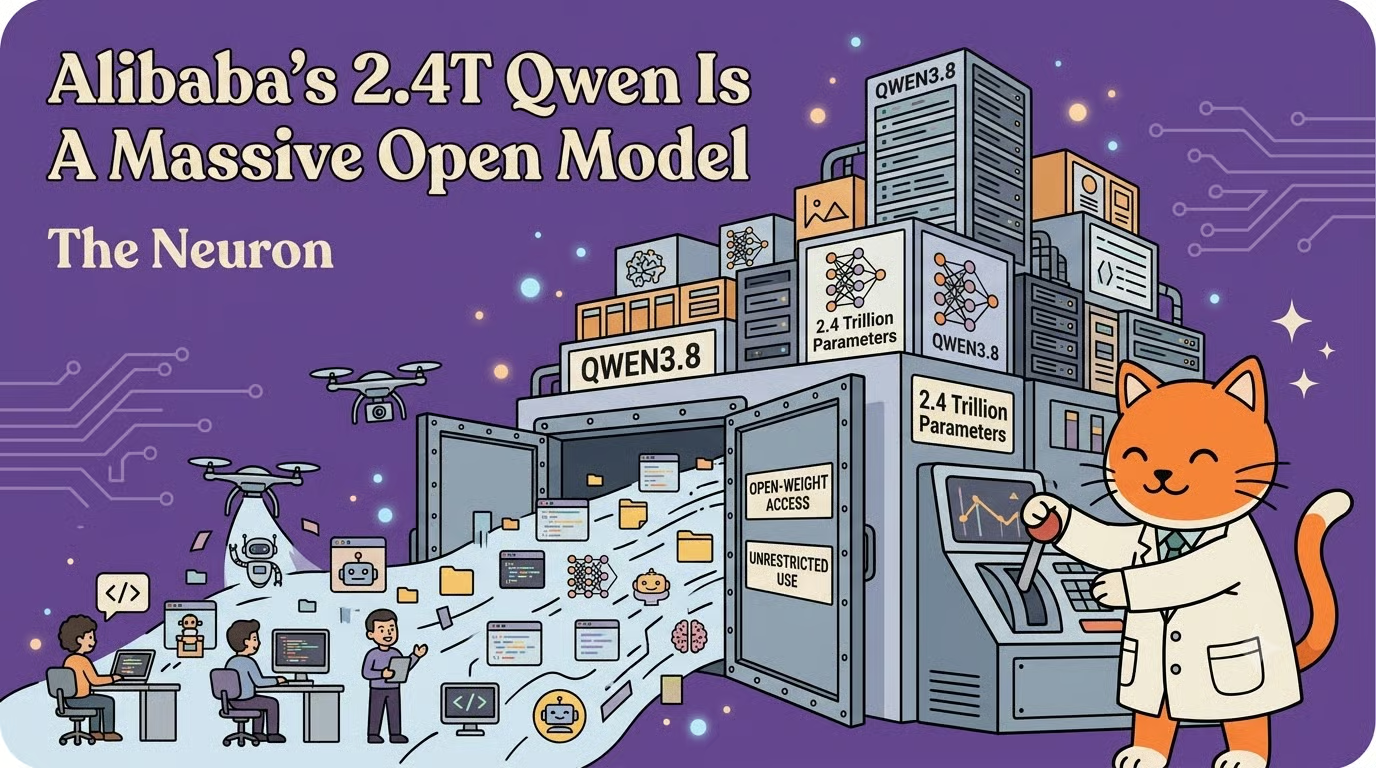
According to The Neuron, Alibaba’s Qwen team has previewed Qwen3.8-Max, a model built on a staggering 2.4 trillion parameters. The company has promised to eventually release it as open-weight software — meaning developers around the world, including in India, could download and run it independently rather than routing everything through a corporate API. If that promise holds, it could be one of the most significant open model releases in recent memory.
What 2.4 Trillion Parameters Actually Means
The word “parameters” gets thrown around constantly in AI coverage, often without much explanation. Here is the short version: parameters are the numerical values a model adjusts during training to learn patterns in data. Think of them as the knobs and dials the system fine-tunes until it can predict language, solve problems, and reason through tasks with reasonable accuracy.
More parameters can — though do not automatically — translate into a more capable model. A larger parameter count gives the model more room to encode nuance, handle edge cases, and generalise across diverse tasks. The current generation of top-tier models from OpenAI, Anthropic, and Google are estimated to operate in the hundreds of billions to low trillions of parameters range, though most companies keep exact numbers private.
At 2.4 trillion, Qwen3.8-Max would sit at the extreme upper end of anything publicly disclosed. That scale alone makes it worth watching. But as The Neuron rightly notes, size alone does not guarantee better answers, lower costs, or faster performance. The real question is what those parameters actually do in practice.
What Has Been Announced — And What Has Not
The Neuron’s reporting lays out the current state of play clearly. Qwen3.8-Max-Preview is already accessible through Alibaba’s Token Plan, Qoder, and QoderWork platforms. Alibaba has described it as one of today’s strongest models and claimed it trails only Claude Fable 5 in capability rankings.
Here is the critical caveat: Alibaba has not yet published independent benchmarks supporting those performance claims. Right now, the boldest comparisons are coming from Alibaba itself — which is not exactly a neutral referee. Independent evaluations from researchers, third-party benchmark organisations, and developer communities will be essential before those claims carry real weight.
For Indian developers and enterprises evaluating their AI stack, this is an important distinction. A self-reported ranking from a company previewing its own flagship product deserves healthy scepticism until external validation arrives.
The Open-Weight Promise and Why It Matters
The more consequential part of this announcement may not be the parameter count — it is Alibaba’s stated intention to release the model as open-weight software.
Open-weight release means that once the full model is out, developers can download the model weights, inspect them, modify them, fine-tune them on custom datasets, and deploy them on private infrastructure. No subscription fees. No API rate limits. No single company sitting between your data and your model.
For Indian businesses, this carries particular significance. A company handling sensitive financial, medical, or legal data faces real risk when processing that data through a third-party API hosted in another country. Running a comparable frontier-scale model on your own servers — or on Indian cloud infrastructure — removes that dependency almost entirely.
The alternative, as The Neuron frames it, is choosing between paying premium prices for a tightly managed US model or operating a comparable Chinese model on your own infrastructure. Neither option is without trade-offs, but the existence of a genuine choice is itself a shift in the market.

China’s Two-Track AI Strategy
Alibaba’s move does not exist in isolation. As The Neuron observes, China’s open-model strategy has effectively turned every major release into two simultaneous competitions.
The first competition is capability: which model produces the most accurate, useful, and sophisticated outputs across a wide range of tasks? The second competition is accessibility: which model can be made cheap enough, efficient enough, and easy enough to deploy that developers actually adopt it over incumbents?
DeepSeek’s earlier releases demonstrated that the second competition can matter just as much as the first. A model that scores slightly lower on benchmarks but runs efficiently on affordable hardware, carries no usage fees, and can be customised freely will often win in practice over a theoretically superior model locked behind a paywall.
Qwen3.8 appears to be targeting both tracks simultaneously. If the benchmarks hold up under independent scrutiny, and if Alibaba follows through on the open-weight release, it could give the developer ecosystem a new reference point for what frontier-scale AI looks like outside of closed corporate systems.
The Practical Challenge: Can You Actually Run This Thing?
There is an awkward question hovering over the entire Qwen3.8 announcement that The Neuron raises directly: can ordinary companies afford to run a 2.4 trillion parameter model efficiently?
Running models at this scale typically requires significant GPU infrastructure — the kind that costs tens of thousands of dollars (roughly ₹8.5 lakh to ₹85 lakh or more) per month at enterprise scale, even when using cloud providers. Quantisation techniques and model compression can reduce those requirements substantially, and the open-weight ecosystem has become remarkably resourceful at making large models more accessible. But until Alibaba releases the weights and developers actually attempt real-world deployments, the infrastructure requirements remain an open question.
For Indian startups and mid-sized enterprises, this is not a trivial concern. Access to the weights is only meaningful if the compute required to use them is within reach.

What to Watch for in the Coming Weeks
The Neuron positions the next few weeks as decisive for understanding whether Qwen3.8 represents a genuine breakthrough or simply the largest line on an AI résumé. Several things will clarify the picture rapidly.
- Independent benchmark results from academic institutions, AI research labs, and developer communities will either confirm or complicate Alibaba’s self-reported performance claims.
- The open-weight release timeline will reveal whether Alibaba’s promise is imminent or aspirational. A long delay between preview and open release would reduce the near-term impact significantly.
- Quantisation and efficiency reports from early adopters will show whether the model can be practically deployed at costs accessible to companies without hyperscale budgets.
- Regulatory and geopolitical signals will also matter. Enterprises with compliance obligations may face scrutiny over deploying Chinese-origin model weights, regardless of technical performance.
The Bigger Picture for India’s AI Ecosystem
India is one of the world’s most active markets for AI adoption, and the open-versus-closed model debate has concrete implications for Indian developers, startups, and enterprises. Every credible open-weight frontier model that enters the ecosystem expands the realistic options available to teams that cannot afford or do not want to depend on proprietary US-based APIs.
The Qwen family of models from Alibaba has already demonstrated genuine capability in previous iterations. If Qwen3.8-Max delivers on even a substantial portion of its stated promise, it adds a new and meaningful option to a landscape that has largely been shaped by a handful of Western incumbents.
The open-versus-closed debate is getting much less theoretical. The next question is whether the weights, when they arrive, can do what the preview is claiming.
“The next few weeks will show whether Qwen3.8 created a breakthrough, or simply the largest résumé line in AI.” — The Neuron