OpenAI’s DevDay 2026: Dots, an Agent OS, and the Bid to Become Your Digital Front Door
OpenAI's DevDay 2026 introduced Dots — an always-on agent with its own cloud computer, 4,000+ plugins, and multi-project memory — alongside 20+ platform launches designed to turn ChatGPT into an agent operating system. The bigger ambition, as reported by The Neuron, is for ChatGPT to become the authenticated, permissioned front door for all software interactions, functioning like an Apple ID, App Store, and AI budget rolled into one.
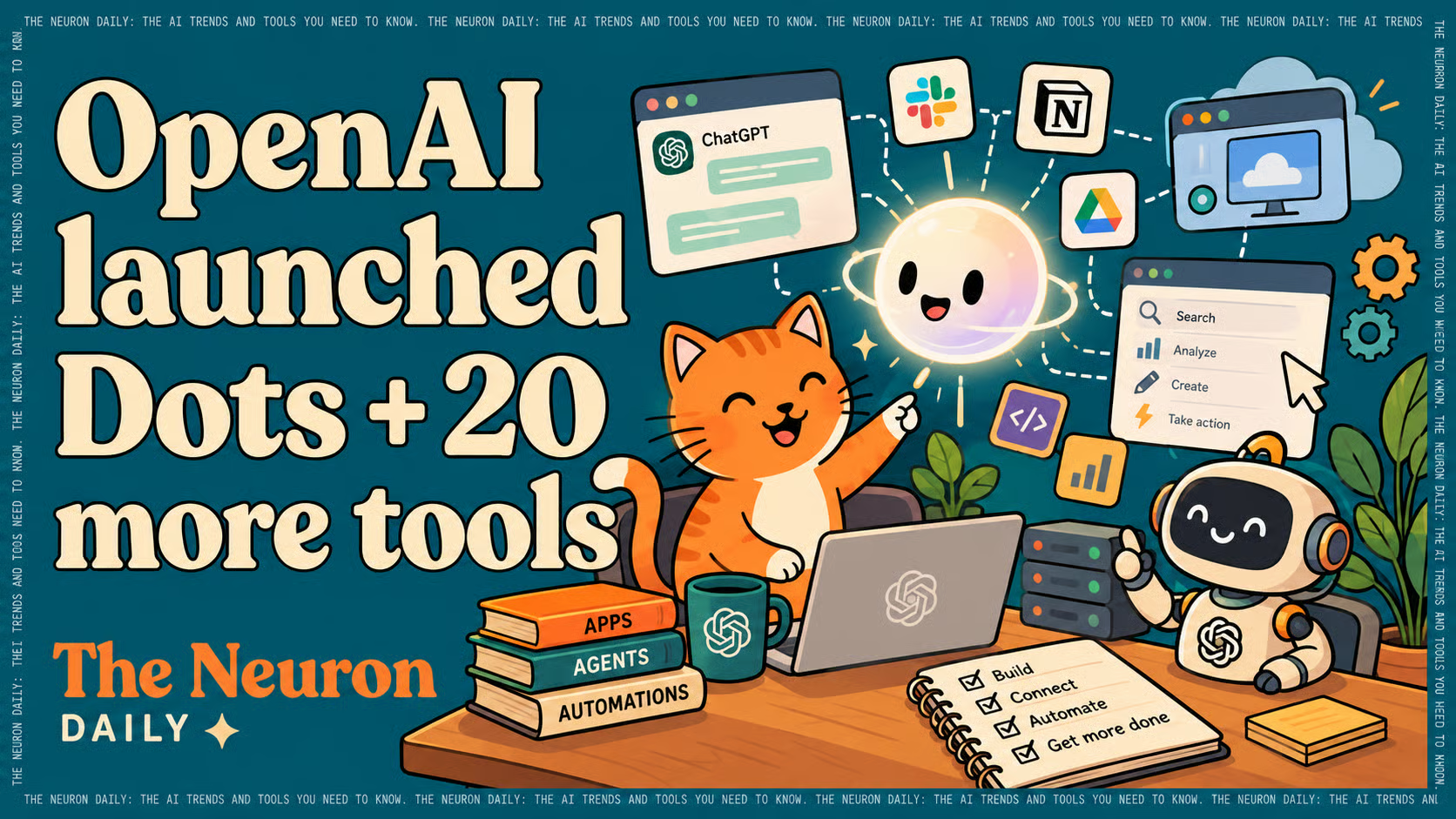
OpenAI’s annual developer conference — DevDay 2026 — landed with more than 20 product launches packed into a single announcement cycle. According to The Neuron’s coverage of the event, the centerpiece is a new always-on agent called Dots, but the broader picture is even more ambitious: OpenAI is assembling the pieces of what can reasonably be called an agent operating system, one designed to make ChatGPT the primary interface through which people and businesses get things done on a computer.
What OpenAI Actually Announced
The full DevDay list reads like a platform buildout rather than a feature drop. Alongside Dots, OpenAI introduced a new model called GPT-6.1 Sol, hosted computer use via the Agents API, Plugin Extensions, Sign in with ChatGPT, an OpenAI Marketplace, new Codex cloud environments, and Private Safety Processing. That is a dense surface area, and understanding why it matters requires zooming out from any single launch.
The throughline, as The Neuron framed it, is this: you state the outcome you want, and the agent chooses tools and models, moves information between them, and asks for your approval only when something is sensitive. Less time hunting across browser tabs, more time getting results.
Dots: The Clearest Expression of the Bet

Dots is the product that best illustrates where OpenAI is trying to go. The Neuron describes it as an always-on agent equipped with its own cloud computer and browser, access to more than 4,000 plugins, and the ability to manage multiple ongoing projects simultaneously. It is OpenAI’s direct competitor to Meta’s Muse for Small Business and xAI’s Grok-bot.
The distinction from a regular chatbot is meaningful. A chatbot answers a question and stops. A Dot can hold a goal in memory, notice when circumstances change, keep working in the background, and return to you only when human judgment is actually needed. Think of it as the difference between asking an assistant a question and delegating an outcome to one.
The concrete use cases are exactly the kinds of tasks that eat up working hours without requiring creativity: invoicing, software debugging, scheduling, research, purchasing, and cross-team coordination. If a Dot can handle those reliably without constant supervision, the value proposition for both individual subscribers and enterprise customers becomes substantial.
More Autonomy, More Guardrails
OpenAI is pairing greater autonomy with explicit safety mechanisms. Dots ships with approval gates — moments where the agent pauses and waits for human sign-off before taking consequential actions. Alongside this, OpenAI introduced Private Safety Processing, a system that allows automated safety review to happen without creating a new pathway for OpenAI personnel to read protected customer content. For enterprise deployments in regulated industries — healthcare, legal, financial services — that distinction between automated review and human access to data matters considerably.
The Platform Layers Underneath
Dots is the visible product, but the real infrastructure story is in the supporting launches.
- The Agents API gives developers a hosted browser environment that agents can click and type through — hosted computer use, in other words, without developers having to manage the underlying infrastructure.
- Plugin Extensions allow third-party apps to expose panels, forms, viewers, settings, and actions directly inside ChatGPT, tightening the integration between outside software and the agent layer.
- Sign in with ChatGPT lets participating apps draw on a user’s existing Plus or Pro subscription allowance without requiring separate API keys or model billing. For Indian developers and startups building on top of ChatGPT, this reduces the friction of monetisation and authentication simultaneously.
- The OpenAI Marketplace gives enterprise software vendors a new distribution channel, including the possibility of approved products qualifying against existing OpenAI procurement commitments — a meaningful shortcut for large organisations already in OpenAI’s ecosystem.
- GPT-6.1 Sol is positioned as a cost-efficient model that gets close to GPT-4o-class agentic performance at significantly lower cost, with caching making repeated context progressively cheaper.
On the caching point, The Neuron quoted a commentator from their DevDay watch party summarising the significance in five words: “that’s what makes agents doable.” The logic is straightforward — if an agent holds your context across many interactions, you are not paying frontier-model prices to re-establish that context every single time. Agents become economically viable at scale only when repeated context is cheap.
The Apple ID Analogy — and Why It Is the Real Story
The individual launches are significant, but The Neuron identifies the truly ambitious part of the strategy clearly: OpenAI wants your ChatGPT subscription to function as the Apple ID plus App Store plus AI budget for everything else you do online.
This is a meaningful platform ambition. Apple’s App Store became the distribution layer for mobile software, capturing value from every transaction and every developer relationship. OpenAI appears to be making a comparable structural bet — that ChatGPT, not the browser or the operating system, will become the front door through which people interact with software, data, and services.
The Neuron put it this way during their DevDay commentary: “the browser is being consumed by the agent window.”
In practice, this means that once a Dot holds your permissions, your identity, your preferred tools, and your context, it becomes an action aggregator. You stop navigating between applications and start delegating outcomes. The Neuron introduced the concept of a “polyagentamorous” future — where several specialist agents handle specific domains (coding, scheduling, research, finance) while sitting under a primary chief-of-staff agent that coordinates them.
What This Means for Developers and Businesses in India
For Indian developers, the Agents API and Plugin Extensions open practical integration paths without the overhead of standing up custom infrastructure. The Sign in with ChatGPT feature, in particular, removes the API key and billing complexity that has historically been a friction point for smaller studios building AI-native products.
For businesses, the OpenAI Marketplace creates a new distribution surface — especially relevant for SaaS companies already selling to enterprise customers with OpenAI procurement relationships. If your product can qualify against an existing OpenAI commitment, the sales cycle shortens considerably.
GPT-6.1 Sol’s lower cost structure is also worth noting for Indian startups operating on tighter margins. While The Neuron does not publish the exact pricing per token, the directional signal is that agentic workflows become more affordable as caching compounds and model costs trend downward.
The Central Question OpenAI Still Has to Answer
The Neuron frames the real test simply: will people hand Dots meaningful work and walk away? That question has two audiences. Early adopters and developers will experiment regardless. The harder audience is mainstream users — people who have never thought carefully about how a chatbot differs from an agent, and who will adopt this mode of computing only if it reliably delivers on outcomes without requiring active management.
Every major tech platform shift has had this same adoption hurdle. Smartphones required trust that a glass slab could replace a physical keyboard. Cloud storage required trust that your files were safer on someone else’s server than on your own hard drive. Autonomous agents require trust that a Dot invoicing a client or booking travel on your behalf will not make a costly mistake.
OpenAI’s answer — approval gates, Private Safety Processing, explicit human-in-the-loop moments — is the right structural response. Whether it is sufficient to earn that trust at scale is the question DevDay 2026 raised but did not yet fully answer.
“The agent stuff is table stakes. Everybody’s got a Muse or a Dot or a Grokbot. The wild part is OpenAI wants your ChatGPT subscription to become the Apple ID + App Store + AI budget for everything else.” — The Neuron
That is the frame worth holding onto as this platform matures. The competition in agentic AI is already crowded. The differentiated play is whether OpenAI can make ChatGPT structurally indispensable — not just useful, but the authenticated, permissioned, context-holding layer that everything else plugs into.