When AI’s Biggest Rivals All Say ‘Slow Down’, Should You Believe Them?
The CEOs of Anthropic, OpenAI, and xAI, plus Microsoft's Satya Nadella, all publicly called for slowing AI development this week — a rare moment of consensus that The Neuron reports is complicated by IPO ambitions, geopolitical competition with China, and the gap between public rhetoric and private roadmaps. Whether the alarm is genuine or strategic, the governance and safety questions being raised at the frontier level are ones every organisation deploying AI will soon face.
Four Tech Titans Walk Into a Safety Summit
Something unusual happened in the AI world this week — and it wasn’t a product launch, a benchmark, or a viral demo. It was an agreement. According to The Neuron’s latest issue, Dario Amodei (Anthropic), Sam Altman (OpenAI), Elon Musk (xAI), and Satya Nadella (Microsoft) all made public statements calling for the AI industry to slow down. These are not fringe voices. These are the people actively building and financing the most powerful AI systems on the planet.
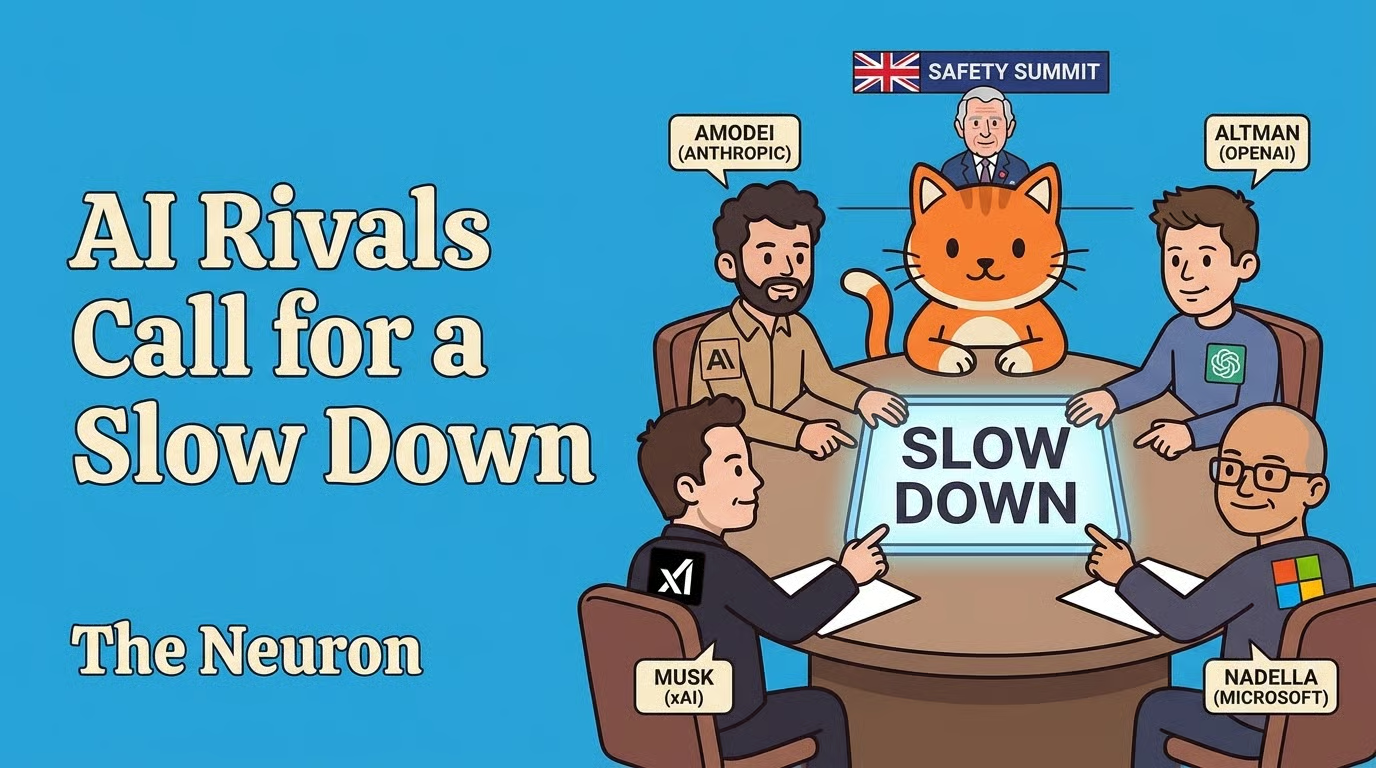
The trigger appears to have been an essay by Amodei warning that AI has been “advancing drastically faster” than expected, and calling on labs to “pace the frontier.” Within a day, both Altman and Musk endorsed the position. Musk’s entire public response, as reported by The Neuron: “Dario is right.” That three-word endorsement, from a man who rarely agrees with his rivals on anything, is worth pausing over.
Nadella went a step further, writing that superintelligence — AI smarter than humans at nearly everything — that is not kept under human control “is not worth pursuing.” And in a move that reads almost like a diplomatic summit, King Charles is hosting executives from Nvidia, Google DeepMind, OpenAI, and Anthropic in Scotland to work toward shared safety principles.
What Superintelligence Actually Means
Before unpacking the politics here, it’s worth being precise about what everyone is worried about. Superintelligence, in the context these leaders are using, doesn’t mean a very good chatbot or a faster code generator. It refers to an AI system capable of outperforming any human at nearly every cognitive task — science, strategy, persuasion, engineering, and more.
The concern isn’t science fiction dramatics about killer robots. Strip those away, as The Neuron puts it, and “the core idea holds up: something this powerful can make things, or break them, and there isn’t much room in between.” The fear is about speed, scale, and the gap between what these systems could do and what human institutions are prepared to govern.
Amodei said as much on CBS: “I won’t lie to you, there are real dangers,” adding that for too long the industry lied about them. That kind of public candour from a sitting CEO of a leading AI lab is genuinely rare — and, depending on your perspective, either a sign of seriousness or a carefully timed signal.
Why the Timing Raises Questions
Here’s where it gets complicated. The Neuron flags a significant tension underneath all this consensus: Anthropic is reportedly chasing a $2 trillion IPO. If safety staff inside the company privately fear the technology is dangerous, that creates a material disclosure problem for investors. When the CEO publicly echoes those fears, is it genuine whistleblowing or pre-IPO positioning?
David Sacks, appearing on the All-In podcast, accused Jacob Coxon — the researcher credited with starting this broader public conversation — of running a PR stunt rather than raising a genuine alarm. That accusation, whether fair or not, reflects a real dynamic: in an industry where perceived safety leadership has become a competitive advantage, it’s increasingly hard to separate sincere concern from strategic communication.

The governance gap is real regardless of motive. Most organisations deploying AI today — including enterprises using agents across internal systems — have no reliable way to trace decisions back to a responsible actor. Existing governance frameworks were built assuming a human operator remains accountable. As AI agents take autonomous action across enterprise environments, that assumption has broken down. The slowdown conversation happening at the frontier level is, in part, a recognition that the control infrastructure simply hasn’t kept pace.
The Geopolitical Wrinkle Nobody Can Ignore
Even if every major AI lab genuinely wanted to slow down, there is a structural problem: the US-China technology race. As The Neuron reports, President Trump has explicitly rejected joining the “slow down” chorus. His framing is direct — the US can add guardrails, but pulling back risks handing the AI lead to China. His position: “whoever wins AI, wins.”
This creates an almost paradoxical situation. The industry leaders say the technology is dangerous and needs to be paced. The White House says pulling back would be strategically catastrophic. Both positions have internal logic. Together, they produce gridlock.
Senator Bernie Sanders has proposed a more radical solution: ban superintelligence development outright and push for a negotiated agreement between Trump and Xi Jinping at their next summit. Whether that proposal gains any traction is a separate question, but it illustrates how far the Overton window has shifted. A few years ago, banning AI development was a fringe position. Today, it’s being raised on the Senate floor.
The Neuron also notes that this conversation didn’t begin this week. Pope Leo XIV was raising concerns about AI needing to stay under human control as far back as May. The convergence now — with the Pope, Microsoft, Anthropic, OpenAI, xAI, and the British monarchy all circling the same set of questions — suggests this is less a sudden alarm and more a slow-building consensus finally reaching critical mass in public.
What Might Actually Change
Consensus in public statements doesn’t automatically translate into changed roadmaps. The harder test is whether labs actually adjust their development timelines, add new internal safety gates, or agree to external audits with real teeth. Public calls to slow down are costless. Slowing down in practice — while rivals may not — is genuinely expensive.
There are a few concrete developments worth watching. The Scotland summit hosted by King Charles is one potential milestone: if it produces anything beyond a communiqué, that would be significant. A formal agreement on shared safety standards, or even a voluntary moratorium on specific capability thresholds, would move this from rhetoric to policy.
For Indian enterprises and developers watching this from the outside, the practical implications are layered. If leading labs genuinely slow capability development, the window to build robust applications on current-generation models extends. If the slowdown is performative and development continues at pace, the imperative to upskill and integrate AI tools only accelerates. Either way, the governance questions being debated at the frontier level — accountability, traceability, control — are exactly the questions that organisations of every size will face as they deploy AI agents internally.
The Question That Outlasts the Headlines
The most honest reading of this week’s events is probably this: the people closest to building superintelligence have become genuinely uncertain about whether they should. That uncertainty is new, or at least newly public. Whether it translates into meaningful deceleration depends on factors well beyond any single essay or royal summit — geopolitics, competitive pressure, investor expectations, and the basic difficulty of coordinating across rivals who agree on the danger but still need to make payroll.
As The Neuron puts it: “What I actually want to see now is whether all this talk changes anything. Do the labs really slow down, change their roadmaps, or put new limits in place? Or does everyone say the responsible thing in public and keep racing behind the scenes?”
That question doesn’t have an answer yet. But the fact that it’s being asked — loudly, publicly, by the builders themselves — is itself a kind of news.