Why AI Data Centers Are Making Your Next MacBook or iPad Cost More
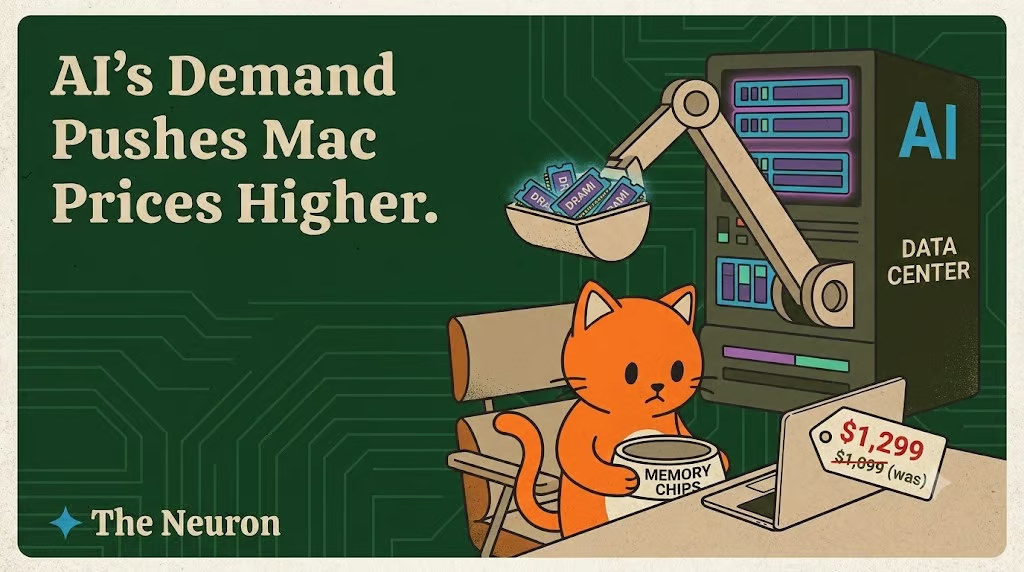
AI data center demand for DRAM chips has caused memory prices to more than double since October 2025, forcing Apple to raise MacBook and iPad prices by $100–$400. The shortage, expected to last through 2027, marks the first time AI infrastructure costs have translated directly into consumer hardware price hikes.
The cost of building and running AI at scale has always seemed like an abstract corporate problem — hyperscale data centers, billion-dollar GPU clusters, quarterly losses measured in the billions. But as of late June 2026, that cost has landed directly in your pocket. According to The Neuron’s newsletter, Apple has raised prices across its entire Mac and iPad lineup by anywhere from $100 to $400 (roughly ₹8,500 to ₹34,000), and the culprit is not trade tariffs or inflation — it is the voracious appetite of AI data centers for the same memory chips that power your laptop.
The Numbers You Need to Know
The price increases Apple announced are sweeping and immediate. The Neuron reported the following changes:
- MacBook Neo: $699, up from $599 (approximately ₹59,400 to ₹50,900 previously)
- 13-inch MacBook Air: $1,299, up from $1,099 (approximately ₹1,10,400 to ₹93,400 previously)
- 13-inch MacBook Pro 1TB: $1,999, up from $1,699 (approximately ₹1,69,900 to ₹1,44,400 previously)
- Base iPad: $449, up from $349 (approximately ₹38,200 to ₹29,700 previously)
- iPad Air (11-inch): $749, up from $599 (approximately ₹63,700 to ₹50,900 previously)
- Vision Pro: $3,699, up from $3,499 (approximately ₹3,14,400 to ₹2,97,400 previously)
Apple’s own statement, as cited by The Neuron, was stark: the company said it has “never seen a component price increase this much, this quickly.” The market reacted accordingly — Apple shares fell 6% on the day of the announcement, their worst single-day performance in four months.
What Is Actually Driving This?
The specific component at the heart of this crisis is DRAM — dynamic random-access memory, the chip responsible for how fast your computer processes tasks in real time. Every AI data center being built globally requires enormous quantities of high-bandwidth DRAM to power the large language models, inference engines, and training clusters that underpin tools like ChatGPT, Gemini, and Claude.
The scale of this buildout has been extraordinary. According to The Neuron, memory prices have more than doubled since October 2025. Analysts project a further 30–40% climb over the course of this year. Micron, one of the world’s largest memory manufacturers, expects the shortage to persist through at least 2027.
Think of it as a supply chain squeeze in slow motion. The global memory chip market is controlled by three companies — Samsung, SK Hynix, and Micron. These firms are currently having what The Neuron describes as “their best stretch ever,” because demand from AI data center operators is essentially unlimited in the short term, and they can charge accordingly. Consumer device makers like Apple, which also need DRAM for laptops and tablets, are competing for a shrinking pool of available supply — and losing on price.
This Is the First Time AI’s Cost Has Landed on Consumers Directly
For years, the cost of AI infrastructure was someone else’s problem. OpenAI burning billions per quarter, Microsoft absorbing enormous capital expenditure for Azure AI infrastructure, Google pouring money into TPU clusters — these were numbers that appeared in earnings calls, not on shopping receipts.
That dynamic has now fundamentally changed. As The Neuron puts it, this is “the first time AI’s cost has landed directly in your wallet as a consumer: not as a subscription fee or a service charge, but as a straight-up sticker shock on hardware you already rely on.”
And it may not stop with Macs and iPads. The Neuron also reports that analysts expect iPhone prices to increase later this year as well, with Pro models potentially climbing by around $200 (approximately ₹17,000) — a significant jump for a product that already sits at the premium end of the smartphone market.

Why the Shortage Won’t Clear Quickly
The uncomfortable reality of semiconductor supply chains is that they move slowly. Building a new DRAM fabrication facility — a “fab” — takes years and costs billions of dollars. Unlike software, you cannot patch a chip shortage with an update. Samsung, SK Hynix, and Micron are all expanding capacity, but that capacity will not come online quickly enough to relieve pressure in 2026 or even much of 2027.
Micron has explicitly stated it expects the shortage to last through 2027 at minimum. In the meantime, AI data center buildout shows no sign of slowing. Every major technology company — Google, Microsoft, Amazon, Meta — has announced aggressive AI infrastructure spending for 2026 and beyond. Each of those data centers needs memory chips. Each memory chip ordered for a server rack is one fewer available for a consumer laptop.
For Indian consumers, this creates a compounded challenge. Apple products in India already carry significant import duties and local taxes on top of their US dollar base prices. When the US base price rises by $100–$400, the Indian retail price typically increases by a proportionally larger rupee amount once the full landed cost is calculated. A MacBook Air that was already a stretch purchase becomes even more of one.
The Leadership Transition That Adds Uncertainty
The timing of this crisis intersects with a major leadership change at Apple. Tim Cook is stepping down as CEO on September 1, 2026, with John Ternus set to take over. As The Neuron observes, Ternus is “inheriting the memory crisis as a welcome gift” — meaning the new CEO’s opening months will be defined in part by navigating a supply chain problem Apple cannot solve unilaterally.
How Ternus handles the shortage — whether through longer-term supply agreements with memory manufacturers, product redesigns that reduce DRAM dependency, or simply passing costs to consumers as Cook’s team has already begun doing — will be one of the defining strategic questions of his early tenure.
What This Means for the Broader Tech Market
Apple is not alone in this bind. The DRAM shortage affects every device that runs on modern memory — gaming consoles, Android smartphones, Windows laptops, and enterprise servers. Apple has simply been the most visible and most direct in communicating the price impact to consumers.
The broader implication, as The Neuron frames it, is that we are entering “a weird new era where your phone, laptop, and gaming console all cost more because AI companies need the same chips.” This is a structural shift, not a temporary blip. Until new fabrication capacity comes online at scale, consumer electronics manufacturers will be competing with some of the best-funded technology companies in history for a finite pool of memory supply.

What Should You Do?
If you have been considering an upgrade to your MacBook, iPad, or iPhone, the situation offers little comfort. The Neuron’s analysis is direct: “If you’ve been on the fence about upgrading your gear, the window may have officially closed. Don’t wait for a sale that isn’t coming.”
For Indian buyers specifically, it is worth monitoring whether Apple India adjusts its local prices in lockstep with US changes, or absorbs some of the increase temporarily for competitive reasons. Historically, Apple India prices have tracked US price shifts, though the timing can lag by weeks. If you are in a position to purchase at current Indian retail prices before any formal revision, that may represent the better value window.
More broadly, this story is a reminder that AI’s costs are no longer contained within the technology industry’s own balance sheets. The infrastructure buildout powering the AI tools millions of people use every day is now reshaping the prices of the everyday consumer electronics those same people depend on. The data center and the laptop shelf have turned out to be connected in ways that most consumers never anticipated.
The AI economy, it turns out, has a hardware bill. And right now, you are helping pay it.