The Mythos Deadlock: Why Anthropic and the U.S. Government Can’t Find Common Ground
Anthropic's most capable AI model, Mythos, remains offline after a U.S. Commerce Department letter warned against distributing it to foreign persons, with a South Korean firm's suspected China ties fueling the dispute. The standoff has deepened over government demands for complete jailbreak prevention — a condition AI safety researchers consider technically impossible to fulfil.
One of the most consequential regulatory standoffs in AI history is playing out right now — and it does not involve a rogue chatbot or a data breach. It involves a letter from a U.S. Commerce Secretary, a leaked list of companies with unauthorized model access, and a flagship AI model called Mythos that remains effectively offline while its creators sit at a G7 summit in France discussing the future of AI safety.
According to The Rundown AI, the impasse between Anthropic and the U.S. government over Mythos and its companion model Fable shows no signs of resolution. New details emerging from Bloomberg, the New York Times, and the Washington Post are pulling the dispute out of closed-door meetings and into full public view — and the picture they paint is complicated.
What Set This Off: The Lutnick Letter
At the center of the dispute is a letter from U.S. Commerce Secretary Howard Lutnick, published by Bloomberg, in which Lutnick warned Anthropic against distributing Mythos and Fable to “foreign persons.” The language is formal and legal, but the implication is stark: the U.S. government believes Anthropic’s flagship models carry national security risk if they reach the wrong hands abroad.
This is not a hypothetical concern dressed up in policy language. The Washington Post reported that the list of companies with access to Mythos had “ballooned” — and crucially, that it included a South Korean firm with suspected ties to China. For U.S. officials already on edge about advanced AI capabilities leaking to geopolitical rivals, that detail alone would be enough to trigger alarm bells at the highest levels of government.
The result: Mythos went offline, and the two parties have been locked in what The Rundown AI describes as a continuing impasse ever since.
Inside Anthropic: A Culture of Concern
While negotiations play out at the policy level, the human cost of the standoff is being felt inside Anthropic itself. Internal messages obtained by the New York Times reveal that employees believe the lab is being “unfairly targeted” and “bullied based on bad vibes.” That last phrase, informal as it sounds, points to something significant: a perception within the company that the government’s action is driven more by political and relational friction than by a clearly defined security breach or documented policy violation.
This internal read aligns with the broader assessment offered by The Rundown AI: that this conflict is fundamentally a relationship issue more than a pure safety one. Anthropic has built its entire brand identity around responsible AI development and safety-first principles. To have that identity challenged — and its most capable model pulled — by the very government whose values it claims to share is, for employees, a particularly stinging blow.
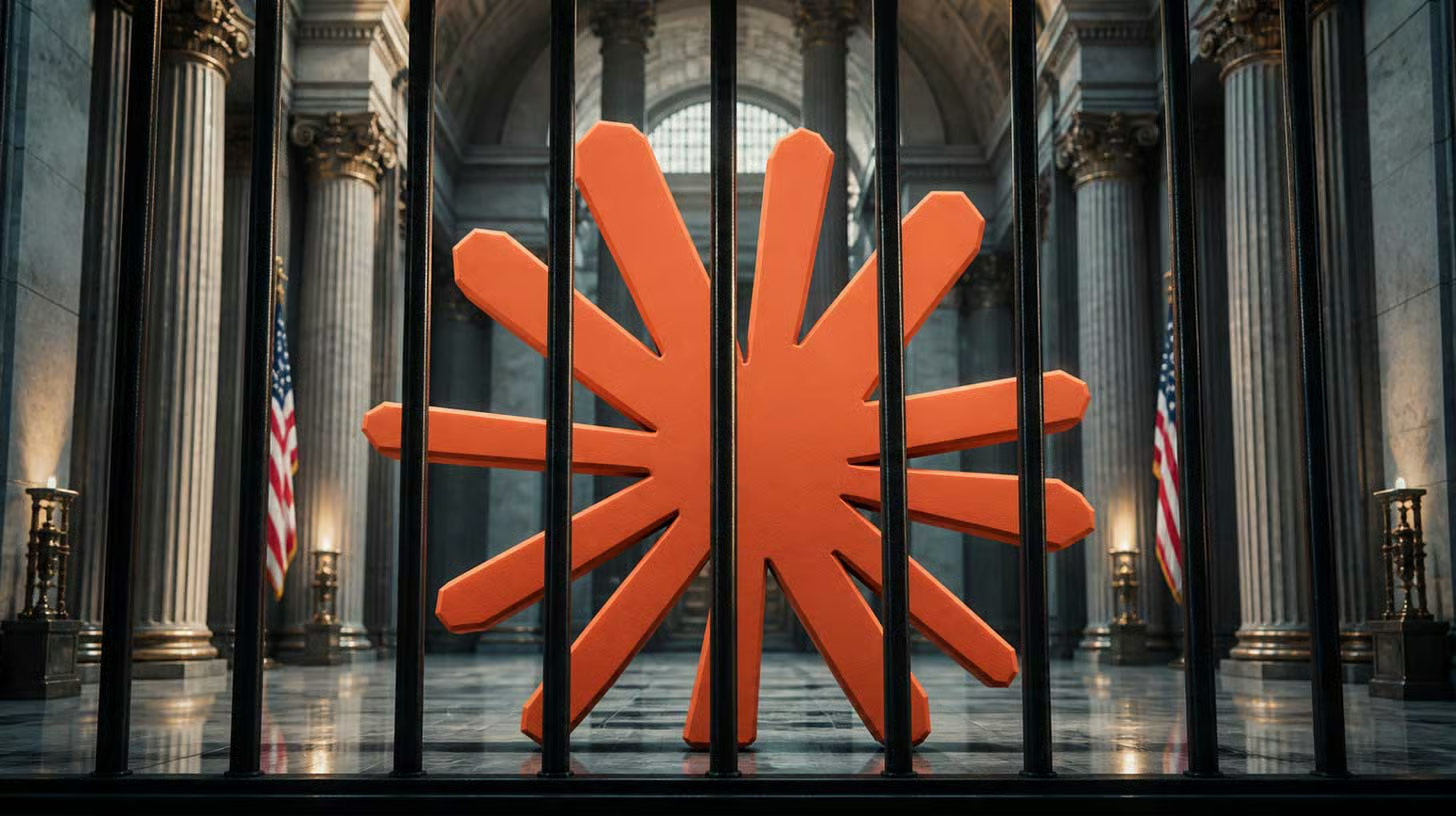
The irony is not lost on observers that Dario Amodei, Anthropic’s CEO, was simultaneously sitting alongside Sam Altman, Demis Hassabis, and other AI leaders at the G7 summit in France — a gathering convened specifically to discuss AI regulation and safety with world leaders. While Amodei was talking about the responsible future of AI at an international forum, his company’s most advanced model remained locked out of the market by his own government.
The Jailbreak Problem: An Impossible Ask?
Perhaps the most technically fraught element of the standoff is what Wired reported about the White House’s position on jailbreaks. According to that reporting, the U.S. government wants Anthropic to block all jailbreaks of Mythos — a demand that The Rundown AI describes bluntly as “an impossible ask to comply with.”
This is not hyperbole. Comprehensive jailbreak prevention is one of the most persistently unsolved problems in AI alignment and safety research. No major model — from any lab — has achieved a zero-jailbreak record. The adversarial research community continuously finds new vectors. Asking Anthropic to guarantee absolute jailbreak prevention as a condition of restoring Mythos access is, in practical terms, asking them to solve a problem that the entire field has not yet solved.
This creates an almost Kafkaesque situation: Anthropic cannot comply with a condition that is technically unreachable, the government will not lift restrictions without compliance, and the model stays offline indefinitely.
What the Expanded Access List Reveals
The Washington Post’s reporting on the ballooned Mythos access list deserves closer attention because it points to a genuine operational failure — regardless of which side you sympathize with in this dispute.
When a powerful AI model is distributed to an expanding roster of third parties without sufficiently rigorous vetting, the risk of that model reaching unintended actors rises considerably. A South Korean company with suspected links to China accessing Mythos is precisely the kind of scenario U.S. export control frameworks are designed to prevent. Whatever the merits of the broader dispute, this specific detail gives the government’s intervention a concrete and defensible foundation.
It also raises important questions for the AI industry at large. As labs compete to grow enterprise adoption and expand access to their most capable models, how robust are their due-diligence processes for international customers? The Mythos situation suggests that rapid scaling of model access — a pressure every competitive lab faces — can outpace the compliance infrastructure needed to manage it safely.

The Bigger Picture: AI Governance at a Crossroads
This standoff arrives at a pivotal moment for global AI governance. The G7 summit in France is a signal that AI regulation is now firmly on the agenda of heads of state, not just technology executives. The conversation is no longer confined to conference rooms in San Francisco — it is happening in the same rooms where trade policy, defense agreements, and intelligence-sharing arrangements are made.
For Indian enterprises and developers watching this from afar, the Mythos situation carries direct implications. Export control frameworks, once associated primarily with semiconductors and defense hardware, are increasingly being applied to AI models themselves. If the U.S. government treats advanced AI as a controlled export — which the Lutnick letter suggests it does — then international access to frontier models will increasingly depend on geopolitical relationships, not just commercial agreements.
A company in India seeking access to the most capable American AI models may find that access contingent not just on subscription fees but on where the vendor’s other customers operate, what governments those customers have ties to, and how the broader U.S.-India technology relationship evolves over time.
Where Things Stand
As of the latest reporting cited by The Rundown AI, no resolution is in sight. The government’s position includes demands that AI safety researchers consider technically unachievable. Anthropic’s employees believe the company is being singled out unfairly. And the model at the center of the dispute — Mythos — remains offline while its creator discusses AI’s global future at the highest diplomatic levels.
What makes this standoff so significant is that it is the first time the machinery of U.S. export control has been applied so visibly and forcefully to a leading American AI lab’s flagship product. Whatever the outcome, it establishes a precedent: that the U.S. government is prepared to treat advanced AI models as strategic national assets subject to the same oversight frameworks as weapons-grade technology.
For the AI industry — in the United States, in India, and everywhere else — that precedent changes the calculus for how frontier models are built, distributed, and governed. The Mythos deadlock is not just Anthropic’s problem. It is a preview of the regulatory environment that every major AI lab will eventually have to navigate.