ChatGPT Becomes a Desktop Super-App: What GPT-5.6 and the Codex Rebrand Mean for You
OpenAI launched GPT-5.6 in three tiers — Sol, Terra, and Luna — while folding Codex into a rebuilt ChatGPT desktop app designed as a persistent, multi-tool work agent. The move is generating excitement over new capabilities but frustration over a confusing interface, with the core challenge being AI memory reliability rather than model power.
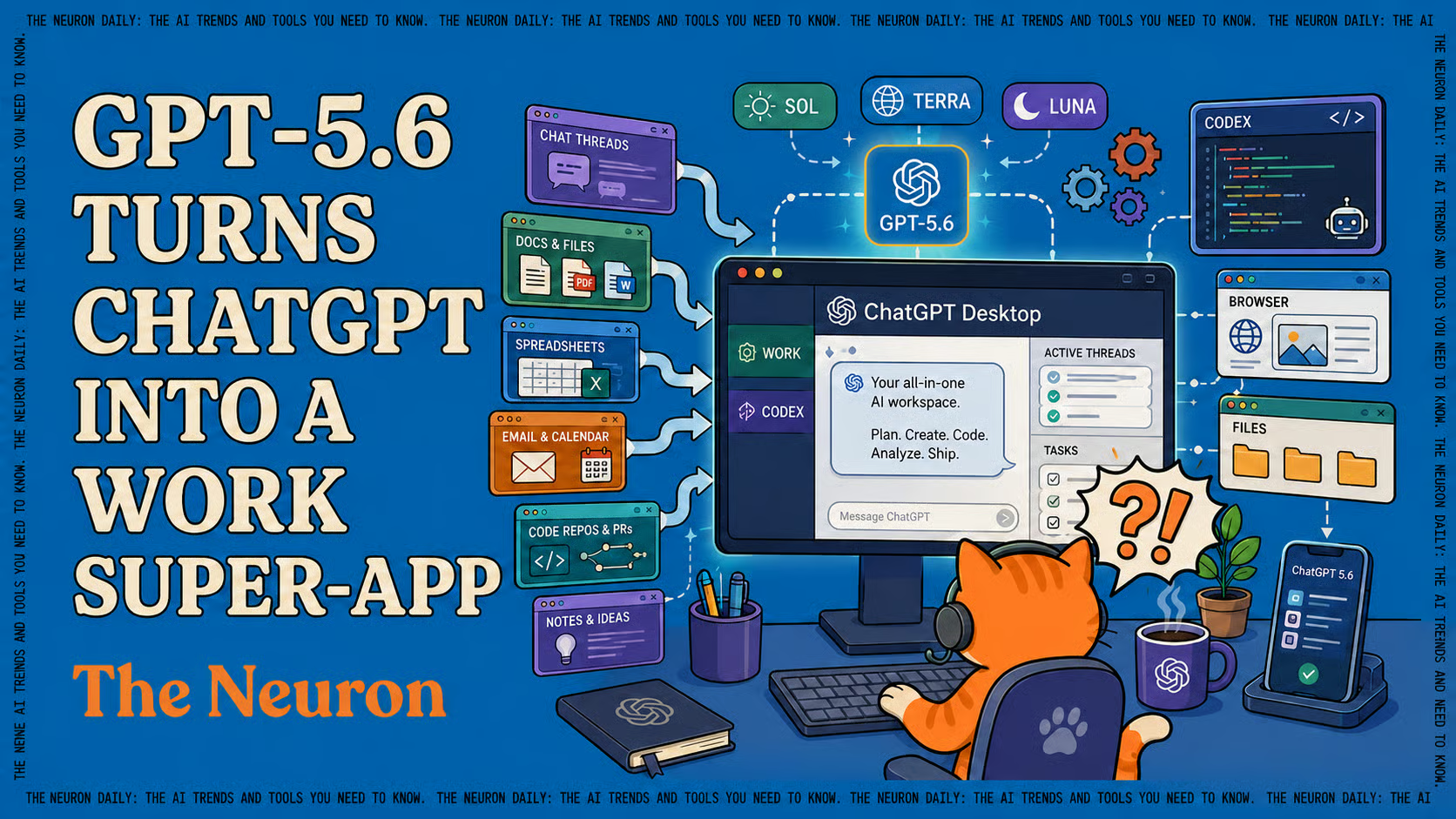
If you opened the ChatGPT desktop app on July 9, 2026, you likely found something unfamiliar staring back at you — a new model family, a restructured interface, and a product vision that has quietly but dramatically shifted. According to The Neuron, OpenAI officially launched GPT-5.6 and simultaneously rebuilt ChatGPT around a concept called “ChatGPT for Work,” positioning the app not just as a chat assistant but as a persistent, cross-session, multi-tool work agent.
This is one of the more consequential — and most quietly controversial — product moves OpenAI has made in recent memory. Let’s break down what actually changed, why it’s creating noise in the developer community, and what it signals about where AI tools are heading.
GPT-5.6: Three Models, One Unified Family
GPT-5.6 does not arrive as a single model. The Neuron reports it comes in three tiers — Sol, Terra, and Luna — each targeting a different use case and price point. Think of them as most powerful, balanced, and affordable, respectively.
Sol is the flagship. It includes an “Ultra” mode that coordinates multiple agents simultaneously for harder, multi-step jobs. Notably, The Neuron highlights that Sol reportedly helped post-train Luna — meaning the most capable model in the family was used to improve the most cost-efficient one. That is a meaningful architectural signal: OpenAI is explicitly building a tiered ecosystem where models train and complement each other.
Early reactions from practitioners are largely positive on capability. Tibo Sottiaux called Sol OpenAI’s best model yet across coding, difficult context, strategy, and site building. However, Jun Song described Sol as strong but incremental, and Simon Willison, despite praising the capability, documented what he called a “dizzying matrix” of three models, multiple effort settings, prices, tool-calling configurations, and multi-agent options. Even seasoned observers like Willison and Ethan Mollick — who follow the AI space as closely as anyone — expressed genuine confusion about the differences between ChatGPT for Work and Codex. That should serve as a red flag for OpenAI’s product communication team.
Codex Is Gone — Sort Of
The headline that sparked the most debate is not the new models themselves but the branding decision underneath them. Codex, OpenAI’s agentic coding tool that had been building significant brand equity over several months, has been folded into the unified ChatGPT desktop app. Simultaneously, OpenAI is sunsetting Atlas — its standalone desktop browser experiment — and migrating those browser features into the app and a Chrome sidebar.
The Neuron was among the first to confirm this rebrand, and the publication notes the community reaction has been pointed. Engineers who had adopted Codex specifically because of its focused, purpose-built experience now find themselves inside a broader super-app with more modes and a more complex UI to navigate. Theo, signüll, Corbin Braun, and Daniel Lockyer all captured this frustration publicly. The argument, as The Neuron frames it, is that early Codex users liked the focused tool — and they got something very different.
On the other side, Sriram Krishnan argued that this super-app direction is simply where the market is heading. And there is logic to that. ChatGPT reportedly has roughly one billion weekly active users. When you have that kind of distribution, consolidating under one brand is a defensible business decision — even if it costs you some developer goodwill in the short term.
What ChatGPT for Work Actually Does
Setting aside the branding debate, the functional scope of what OpenAI is building is worth taking seriously. The new ChatGPT for Work can browse the web, use connected apps, edit files, operate your computer directly, schedule tasks, and generate slides, spreadsheets, documents, and sites. Work is designed to continue across chats, files, browsers, and devices — the idea being a persistent work context rather than a series of disconnected conversations.
This is a meaningful shift in ambition. ChatGPT is no longer being positioned as a chat interface you visit to ask questions. It is being positioned as an always-available work layer that sits across your digital environment — including a floating chat window and a Chrome sidebar for in-browser use.
For Indian professionals and teams increasingly using AI tools to manage research, writing, coding, and scheduling workflows, this kind of persistent, multi-tool agent represents a qualitative upgrade from what a chat assistant offered even twelve months ago.
The Real Problem: Memory, Not Menus
The Neuron makes a sharp observation buried in the analysis that deserves to be pulled out: the UX problem with the super-app is fundamentally a memory problem. Users are confused about where their chat threads went after the update. Old conversations are hard to surface. The interface feels disorganized.
But the disorganization is a symptom of something deeper. Until AI memory is reliable enough to replace hundreds of scattered chat threads with a single, continuously updated context — one that surfaces the right project, decision, or file at the right moment — every super-app will feel like someone shuffled all the papers on your desk without telling you. The organizational metaphor is apt: the vision is sound, but the execution depends on a memory layer that does not yet exist at the reliability level the product demands.
The newsletter’s prescription is elegant: what users actually want is one chat — a persistent thread that remembers everything important about their projects, tools, and decisions, that can surface information proactively, and that travels with them across devices and contexts. That is clearly what OpenAI is building toward. The gap between that vision and today’s reality is what is generating the frustration.
Competitive Context: Why This Timing Matters
OpenAI is not launching into a vacuum. The Neuron flags that Grok has a new coding model, Meta recently released a new coding model (Muse Spark 1.1, with a one-million-token context window), and Gemini 3.5 is reportedly arriving around July 17, 2026. Pricing pressure is intensifying — Sol is reportedly priced at roughly one-third the cost of Fable, and competitors are expected to come in cheaper still.
The publication’s read on the competitive landscape is direct: this is Anthropic’s game to lose. With multiple frontier players converging on similar capability levels, the differentiator will increasingly be the product experience — how well the tool fits into a professional’s actual workflow, how reliable the memory layer is, and how intuitive the model selection feels.

For users in India evaluating which AI platform to invest time in learning, the Sol/Terra/Luna tiering matters practically. If Sol is positioned at roughly one-third the cost of the top-tier Fable model from Anthropic, the pricing calculus for heavy professional use becomes more accessible — though exact INR pricing has not been confirmed in the newsletter.
How to Get Started With the New ChatGPT
If you want to explore the updated app, The Neuron’s guidance is straightforward:
- Update or download the ChatGPT desktop app to get the new model family.
- Choose between ChatGPT for Work (general work tasks) and ChatGPT Codex (coding-specific work) based on your immediate need.
- Select Sol, Terra, or Luna depending on the complexity of the task — and raise the effort level when the job demands it.
- Use the floating chat window for quick, ambient access without switching context.

The caveat the newsletter offers is honest: where exactly your previous chat threads now live is, in their words, “confusing as all get out.” Give the product team time to iron out the navigation before you rely on it for mission-critical work.
The Bigger Picture
What OpenAI is attempting with this release is a platform pivot — from conversational assistant to persistent work infrastructure. The GPT-5.6 family provides the model horsepower. The ChatGPT for Work redesign provides the product surface. The absorption of Codex and the sunsetting of Atlas consolidate the experience under one roof.
Whether that roof feels like a well-organized office or a chaotic open floor plan depends almost entirely on how quickly OpenAI can make the memory layer trustworthy. Until then, the super-app will remain a compelling vision that occasionally loses your files.