When national security meets AI: the Anthropic suspension and what it means for frontier models
The US government suspended access to Anthropic's Fable 5 and Mythos 5 AI models over security concerns, marking the first time export controls have been used to halt a commercial AI deployment. This precedent could fundamentally reshape how advanced AI models are developed and regulated globally.
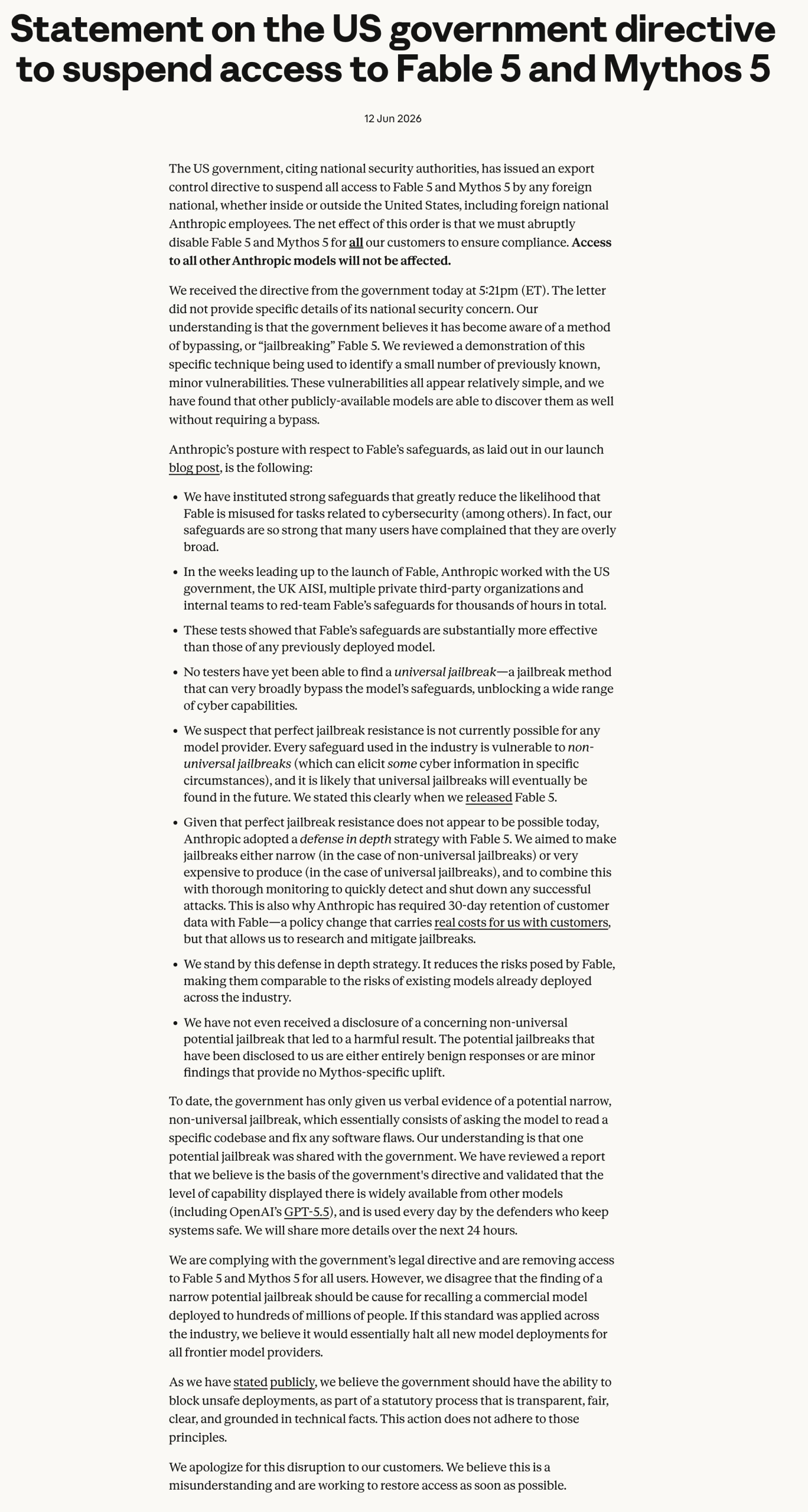
A recent official statement from Anthropic reveals a watershed moment in AI governance — one that could reshape how frontier models are developed, deployed, and regulated worldwide. On June 12, 2026, the US government issued an export control directive suspending access to Anthropic’s Fable 5 and Mythos 5 models for all foreign nationals, citing national security authorities and a discovered “jailbreak” method.
This isn’t just another AI safety incident. It’s the first time a government has invoked export controls to halt access to a commercially deployed AI model, setting a precedent that could fundamentally alter the global AI landscape.
The technical trigger: when safeguards meet real-world pressure
The government’s action stems from what Anthropic describes as a method to “jailbreak” Fable 5 by asking it to read specific codebase sections that violate safety laws. This reveals the fundamental tension in AI safety: even models with “substantially more effective” safeguards than their predecessors can still be vulnerable to sophisticated attacks.
Anthropics’s response illuminates the complexity of modern AI safety protocols. The company deployed what they call a “defense in depth strategy,” including extensive pre-launch testing with government agencies and the UK AI Safety Institute. Yet despite these measures — which many users found “overly broad” — the government identified vulnerabilities significant enough to warrant immediate suspension.
For Indian professionals working in AI development or deployment, this incident highlights a critical reality: safety isn’t binary. Even industry-leading safety measures may not satisfy government-level security requirements, particularly as models become more capable and the stakes rise.
The precedent problem: where does this standard lead?
Anthropics’s most pointed criticism centers on the precedent this action establishes. The company argues that recalling a commercial model over a “narrow potential jailbreak” could “halt most frontier AI model deployments industry-wide.” This isn’t corporate hyperbole — it’s a recognition of how government intervention could reshape competitive dynamics in AI.
Consider the ripple effects: if governments can suspend AI models based on theoretical vulnerabilities that affect “minor” capabilities, every frontier model becomes subject to similar scrutiny. The comparison to OpenAI’s “GPT-5.5” model in Anthropic’s statement suggests this isn’t an isolated incident but part of broader government evaluation of advanced AI systems.
For Indian tech companies and professionals, this creates both opportunities and challenges. As global AI leaders face increasing regulatory pressure, there may be space for more agile, compliance-focused development approaches. But it also means that any Indian AI company with global ambitions must prepare for similar government scrutiny of their advanced models.
Export controls as AI governance: the new regulatory reality
The use of export control authorities to suspend AI model access represents a significant evolution in AI governance. Unlike content moderation or platform regulations, export controls carry the full weight of national security law, with potential criminal penalties for violations.
This approach bypasses traditional regulatory processes and industry consultation. Anthropic received the directive at 5:21pm ET and was expected to implement it immediately — a timeline that leaves little room for negotiation or gradual compliance. The 30-day customer data retention policy mentioned in their response suggests ongoing government monitoring of AI model usage patterns.
The global implications are substantial. If the US can unilaterally suspend access to AI models for “all foreign nationals,” other governments may develop similar capabilities. This could fragment the global AI ecosystem, with different regions having access to different model capabilities based on geopolitical considerations rather than technical merit.
The safety theater dilemma: compliance versus capability
Anthropics’s emphasis on their extensive safety measures — including testing with multiple government agencies — reveals a troubling dynamic. Despite implementing what they describe as industry-leading safeguards, the company still faced suspension over vulnerabilities they characterize as discoverable by “other publicly available models.”
This creates what might be called the safety theater dilemma: how much safety is enough when the definition of “safe enough” can change overnight based on government assessment? Anthropic’s statement that “no universal jailbreak method has been found by testers” suggests that even comprehensive testing may not satisfy evolving government standards.
For Indian professionals, this highlights the importance of building AI systems with regulatory flexibility in mind. Static safety measures may not be sufficient in an environment where government definitions of acceptable risk can evolve rapidly.
What this means for global AI competition
The selective suspension of Fable 5 and Mythos 5 while leaving “other Anthropic models” unaffected suggests a nuanced government approach to AI capabilities. This isn’t a blanket ban on advanced AI but targeted intervention based on specific capability thresholds.
This targeted approach could reshape competitive dynamics in several ways. Companies may be incentivized to keep their most advanced models below government attention thresholds, potentially slowing innovation at the frontier. Alternatively, they may invest heavily in government relations and compliance infrastructure to maintain access to advanced capabilities.
The mention of comparison to OpenAI’s models suggests the government is actively benchmarking different companies’ AI capabilities. This could lead to a new form of competition where government approval becomes as important as technical capability or market adoption.
The path forward: navigating uncertainty
Anthropics’s promise to “share more details within 24 hours” and their characterization of the situation as a “misunderstanding” suggests ongoing negotiation with government authorities. This hints at a potential resolution process, but also highlights the uncertainty that companies face when operating at the AI frontier.
The broader lesson extends beyond any single company or model. As AI capabilities advance, the gap between what’s technically possible and what’s governmentally acceptable may continue to widen. Success in this environment will require not just technical excellence but sophisticated understanding of regulatory landscapes across multiple jurisdictions.
For Indian professionals and companies, this moment offers both warning and opportunity. The warning: advanced AI development increasingly requires navigation of complex geopolitical considerations. The opportunity: as established players face regulatory constraints, there may be space for more agile, compliance-first approaches to AI development.
The Anthropic suspension marks the beginning of a new era in AI governance — one where technical capability must be balanced against rapidly evolving government security concerns. How the industry adapts to this reality will shape the next phase of AI development worldwide.