OpenAI’s Chief Scientist Just Proposed Speed Limits for the Entire AI Industry — Will Anyone Obey?
OpenAI chief scientist Jakub Pachocki has proposed that all frontier AI labs agree on shared capability thresholds measured by a metric called perplexity, publishing OpenAI's own internal scores as a first move. The proposal has real gaps — particularly around chain-of-thought reasoning — but represents an unprecedented attempt at voluntary pre-competitive coordination before a potential capability acceleration as early as 2027.
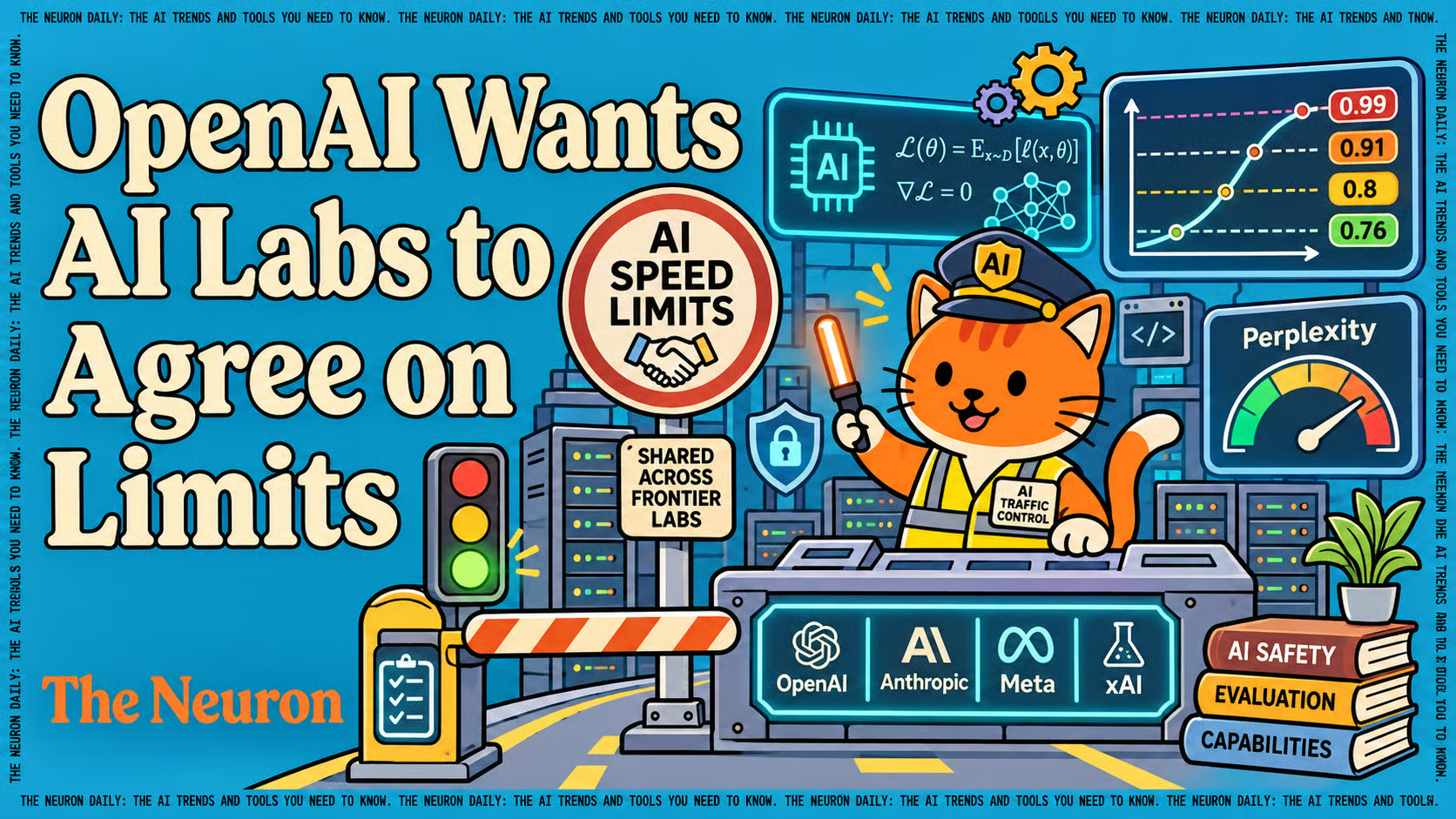
What happens when the lab winning an arms race voluntarily proposes speed limits? That is, in essence, the question OpenAI’s chief scientist Jakub Pachocki put on the table this week. As reported by The Neuron, Pachocki published a post calling on frontier AI laboratories to agree on “common limits” — capability thresholds that no one crosses until they can demonstrate concrete milestones for monitoring and understanding their own models. To back the proposal up, OpenAI put its own internal measurements on the table first, even though doing so reveals competitive information.
This isn’t a regulatory filing or a government mandate. It reads more like an arms-control treaty proposal drafted from inside one of the most powerful arsenals in the world. And that unusual origin is precisely why it deserves careful attention.
What Is Perplexity, and Why Should You Care?
The metric Pachocki wants the industry to standardise on is called perplexity — not to be confused with the AI search company of the same name. The concept is surprisingly intuitive. You show a language model text it has never seen before, and you measure how well it predicts each next token (roughly, the next word or word fragment). A model that is rarely caught off-guard earns a lower score. OpenAI specifically tracks the logarithm of that figure, also known as cross-entropy loss.
Think of it like golf: the lower the score, the sharper the model.
Pachocki’s argument is that modern AI is fundamentally a giant predictor, trained on enormous quantities of data. Everything that follows — the prompting, the fine-tuning, the reinforcement learning — is just drawing out what that predictor already knows. So the perplexity score at the end of pretraining, he contends, is the most honest single indicator of a model’s underlying capability.
The Scoreboard OpenAI Shared
To make the proposal concrete, OpenAI published its own perplexity numbers, measured against its main internal codebase dataset. According to The Neuron’s coverage, the figures break down as follows:
- GPT-3.5 scored approximately 0.99 — sufficient for fluent conversation and the original ChatGPT.
- GPT-4 scored approximately 0.91 — the threshold at which chain-of-thought reasoning (where a model works through intermediate steps before answering) began to consistently pay off.
- Below 0.8 is where Pachocki says transformative abilities in cybersecurity and mathematics begin to emerge.
- Around 0.76, OpenAI’s models started producing notable results on previously unsolved open mathematics problems.
- Around 0.68 to 0.70 is the next anticipated range, where Pachocki expects further transformative abilities to surface — though he is candid that he does not yet know which ones.
Those numbers are more than a progress report. They are the skeleton of a proposed governance framework: reach a certain score, and you must demonstrate that you understand what your model is doing before you go further. The specific “understanding” milestone Pachocki cites is a successor to chain-of-thought monitors — tools that read a model’s visible reasoning process to flag problems before they escalate.
The 2027 Warning Buried in the Footnotes
Pachocki also flags something that deserves to be treated as more than a footnote. He suggests that AI-assisted research on pretraining methods could trigger a sudden acceleration, possibly as early as 2027. As The Neuron drily noted: 2027 begins in roughly five weeks from the date of this publication. If that timeline is taken seriously, the window for establishing agreed-upon limits is narrow.

This urgency is part of what makes the proposal structurally interesting. Pachocki is not asking for limits to be imposed after some future catastrophe gives regulators leverage. He is asking for them now, before the acceleration, when the labs themselves still have room to shape the terms.
The Honest Gaps in the Proposal
To his credit, Pachocki does not oversell the metric. He acknowledges several significant weaknesses, and understanding them matters for evaluating whether this proposal could actually work.
Why the Source of This Proposal Matters
The easy cynical read is that OpenAI is proposing a framework it already leads by, designed to make it structurally harder for competitors to close the gap. That interpretation is not unreasonable. Proposing that everyone publish their perplexity numbers when you are already ahead is a low-cost move for the leader.
But the more interesting read is that this is a genuine attempt at pre-competitive coordination before anyone has sufficient leverage to enforce it. The nuclear analogy is imperfect but instructive: arms-control treaties have historically been most achievable when one party has a clear lead and an incentive to lock in that lead through agreement rather than pure competition. The limits may be self-serving, but self-serving coordination is still coordination.
The two things worth watching, according to The Neuron’s analysis, are whether other labs publish their own perplexity numbers in response, and what the “understanding” milestone ultimately turns out to mean in practice. Right now it is a placeholder. For the limits to have any teeth, the AI industry would need to agree not just on the metric but on what level of interpretability counts as sufficient understanding before crossing a threshold. That is a much harder problem than the number itself.
What This Means for India’s AI Ecosystem
For technologists and policymakers in India, this proposal lands at a moment of genuine relevance. India’s AI Mission is actively investing in domestic compute infrastructure and foundation model research. If a de facto international norm around perplexity thresholds takes hold — even informally among the major labs — it will shape the capability envelope within which Indian AI development operates, whether or not Indian institutions are at the table when those norms are written.
The governance conversation about frontier AI has historically been dominated by American and European actors. A proposal like this, if it gains traction, sets precedents about what responsible capability development looks like. India’s AI policy community would do well to engage with the specifics — the metric, the thresholds, the monitoring milestones — rather than waiting for a framework to arrive fully formed.
The Bottom Line
Jakub Pachocki’s proposal is not an agreement. It is not a regulation. It is a measurement framework, a set of published numbers, and a call for the rest of the industry to respond in kind. The metric has genuine weaknesses, particularly around chain-of-thought reasoning and cross-lab comparability. But the gesture of a leading lab publishing competitive information as an opening move in a coordination effort is notable regardless of the underlying motive.
The limits only mean something if other labs sit down at the table. And the table, right now, has one person at it.