Nvidia’s Five-Day U-Turn: What Jensen Huang’s Return Means for the AI Chip Race
Nvidia's board reinstated Jensen Huang as CEO just five days after rejecting his return, following political backing from the White House and a quarter worth $115.8 billion in revenue. The Neuron's analysis argues the full-stack chipmaker is stronger with Huang leading it through the inference-era AI race, though the board's independent investigation continues.
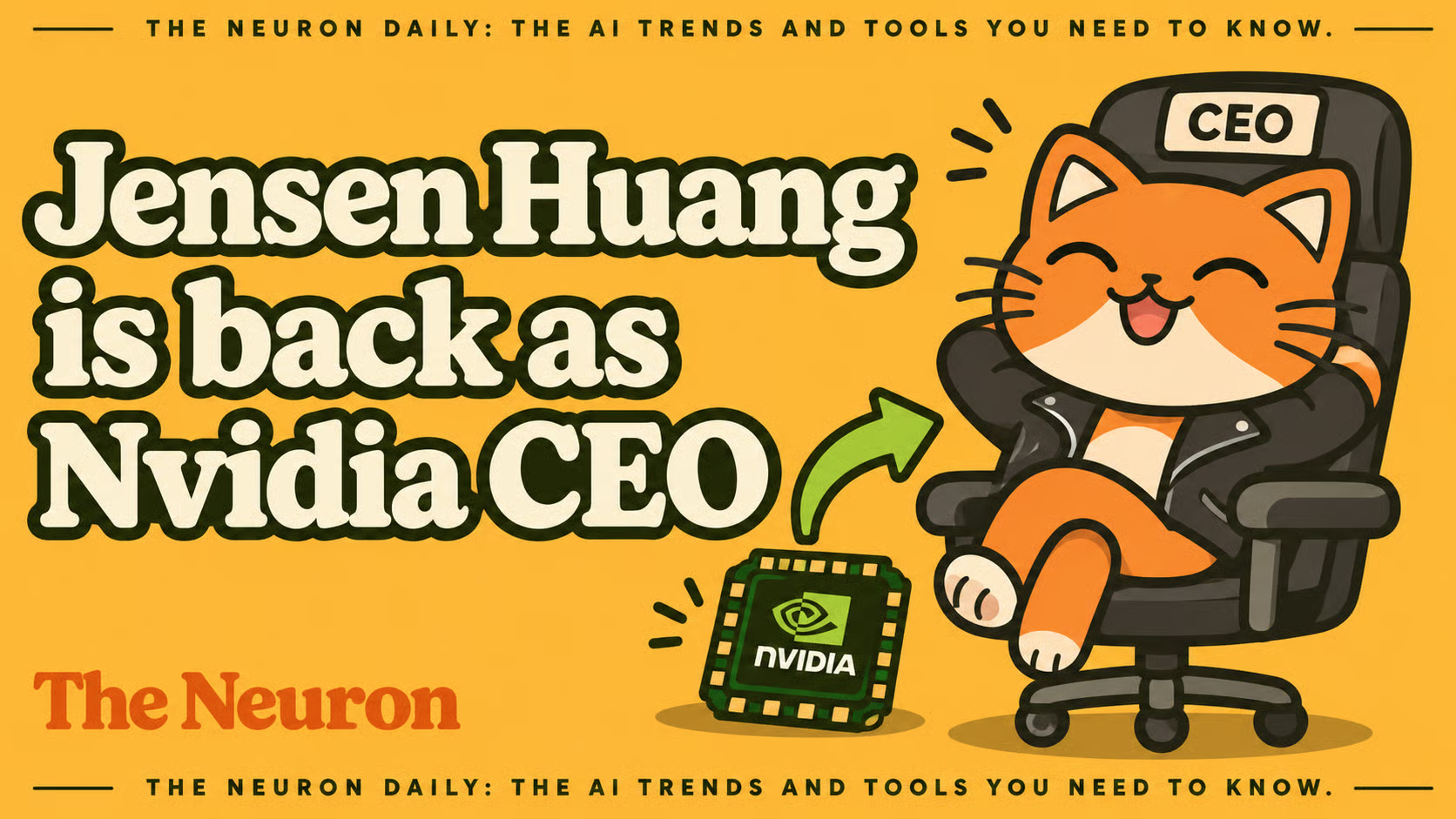
In one of the most dramatic boardroom reversals in recent technology history, Nvidia reinstated Jensen Huang as president, CEO, and board director on Sunday, November 22 — just five days after the same board had voted to reject his proposed return. The announcement came Monday, and the stock market responded with what can only be described as relief, with Nvidia shares jumping roughly 30% shortly after the opening bell. The Neuron, citing Nvidia’s official investor relations page, broke down the full timeline in its November 24 issue.
A Five-Day Whiplash: What Actually Happened
To understand why this reversal matters, you need to understand what preceded it. Earlier in November, Huang publicly acknowledged an affair, and reports emerged suggesting he may have been targeted by a foreign intelligence operation. Nvidia’s board opened an independent investigation, accepted his resignation, and elevated CFO Colette Kress to the role of interim CEO.
The sequence of events that followed was unusually compressed even by Silicon Valley standards:
- November 17: The board formally turned down Huang’s proposed return — the very same day Nvidia reported its quarterly results under Kress.
- November 22: The board reversed its decision, citing discussions with Huang and input from senior US officials. Kress retained her CFO title, and Harvey Jones remained board chair.
- November 23: Former US President Donald Trump publicly backed the return, stating the government has no evidence of wrongdoing. According to The Neuron, AP also reported that Vice President JD Vance was involved in discussions.
The political dimension here is striking. It is rare for a sitting administration to weigh in so directly on the internal governance of a publicly traded company. That the reversal came after senior US government officials engaged with the board suggests the national security framing around Huang’s situation was considered resolved — at least at the federal level — even as Nvidia’s independent investigation continues.
The Numbers Behind the Noise
One of the most important facts in this story is what Nvidia reported on November 17, the same day the board initially turned Huang down. According to The Neuron, Nvidia posted a quarter worth \$115.8 billion in revenue — up 103% year over year. That figure alone reframes the entire narrative.
Critics of the reinstatement might argue the board was swayed by stock pressure. Supporters would say those numbers prove Nvidia’s underlying business is operating at a scale that makes stability of leadership an existential concern, not merely a governance preference. The Neuron’s analysis puts it plainly: “not exactly the numbers of a company in crisis.”
It is worth noting, however, that the \$115.8 billion quarter ended before Huang resigned. It reflects the momentum he built, not the resilience of the company under a true succession. The honest reading is that Nvidia’s machine runs — but nobody has yet tested whether it runs as well without its chief architect.
Why Huang Is Considered Irreplaceable
The analytical case for reinstatement rests on what The Neuron calls the “full stack” argument. Nvidia does not merely sell graphics processing units. It manufactures the chips, the high-speed networking infrastructure that links thousands of them together, and the software ecosystem — primarily CUDA — that runs AI workloads on top of them. This vertical integration gives Nvidia the ability to reduce what customers pay at every layer of the AI compute stack.
That matters enormously right now because the economics of AI are shifting. Early AI investment was dominated by training costs — the enormous one-time expense of building a foundation model. Increasingly, the bill is coming from inference, meaning every single time a user queries a model, every API call, every generated response. Inference is a recurring cost at massive scale, and whoever can deliver it most efficiently wins.
Nvidia’s Vera Rubin architecture is the company’s answer to that challenge. According to The Neuron, Kress revealed during the November 17 earnings call that Vera Rubin brought in nearly \$20 billion in its first quarter of shipments alone. That is not a product struggling to find a market. For Indian readers tracking the AI infrastructure buildout — from hyperscalers investing in Indian data centres to domestic cloud providers scaling up — these chip dynamics determine what compute costs in rupees for years to come.

The Competitive Threat Nvidia Cannot Ignore
Even with Huang back, the competitive landscape has meaningfully tightened. Google’s custom TPU chips give the major cloud providers an alternative to Nvidia silicon for certain inference workloads. Amazon and Microsoft are developing their own accelerators. The moat Nvidia spent a decade building through CUDA lock-in is real but no longer absolute.
The Neuron’s analysis is bullish on Nvidia’s position precisely because Huang understands this threat better than any potential successor would. He has been making the “full stack” bet for years — the networking business, the software platform, the developer ecosystem — and changing that strategy mid-execution carries enormous risk. A new CEO, however capable, would spend the first year learning which battles are already won and which are still being fought.
For the Indian technology ecosystem, this matters in a specific way. Indian AI startups and enterprises are increasingly making infrastructure decisions — which cloud, which chip, which software stack — that will define their cost structures for a decade. Nvidia’s stability at the top makes those decisions marginally less risky.

What the Board Has Not Yet Explained
The most uncomfortable question hanging over this story is the simplest one: what changed between Tuesday’s no and Sunday’s yes?
The board has not provided a public answer. It cited “discussions with Huang and input from senior US officials,” but that is a description of process, not a substantive explanation. The independent investigation Nvidia opened when Huang resigned is reportedly still ongoing. Reinstatement, as The Neuron correctly notes, is not a final finding. It is not an exoneration.
This matters for two reasons. First, employees and shareholders deserve a clear account of what the investigation ultimately finds and what standards Nvidia will enforce going forward. Second, the speed of the reversal — five days, punctuated by explicit White House-level political involvement — sets a precedent that is worth scrutinising regardless of one’s view of Huang’s business value.
Huang is scheduled to sit for a transcribed interview with three House committees on December 1, with general counsel Tim Teter following on December 2. Huang is also listed as a witness at a Senate Banking Committee hearing on export controls on December 3. Those proceedings will likely surface more of the factual record than the board has volunteered.
The Road Ahead
For Nvidia, the immediate task is straightforward: execute. Vera Rubin is shipping. The inference wave is accelerating. The competitive pressure from custom silicon is real but not yet decisive. The company enters this period with Huang back at the helm, a CFO who successfully ran the company during a period of genuine uncertainty, and a revenue trajectory that most technology companies would consider a generational achievement.
For the broader AI industry — and for the Indian companies, investors, and developers building on top of this infrastructure — the Nvidia story is a reminder that the most consequential AI decisions are not always made inside a model. Sometimes they happen in a boardroom, over five turbulent days, with a stock chart and a White House phone call in the background.
“Nvidia is stronger with Huang at the helm.” — The Neuron, November 24, 2026
The business case for that conclusion is compelling. The governance questions it leaves unanswered are equally real.