Meta’s Muse Wonder Arrives at Opus Pricing — But Independent Tests Tell a Different Story
Meta launched Muse Wonder and Muse Wonder Full as its first frontier AI models, pricing them at the same level as Claude Opus 5.5 despite scoring lower on independent benchmarks. Key concerns include restricted API access to the better model, default data-training terms, and an unverified safety report.
Meta has officially entered the frontier AI race. On October 13, 2026, the company launched Muse Wonder and Muse Wonder Full — models it describes as its first true frontier offerings, aimed squarely at the same tier occupied by Anthropic’s Claude, OpenAI’s GPT-6 Astra, and Google’s top-line systems. According to The Neuron, TechCrunch characterised Muse Wonder as Meta’s first genuine frontier model, built from the ground up for agentic tasks: the kind of multi-step, goal-directed work that goes well beyond a single-turn question and answer.
The launch is significant on its face. Meta has long positioned itself as the open-weights champion of the AI world, offering Llama models that anyone could download and run. Muse Wonder represents a notable pivot — a closed, commercially priced model competing for enterprise and developer dollars against the most capable systems available. But the details of how it performs, how it is priced, and how it is distributed raise questions that deserve careful unpacking.
What Muse Wonder Actually Does
Meta’s pitch centres on two headline features designed specifically for agentic use cases.
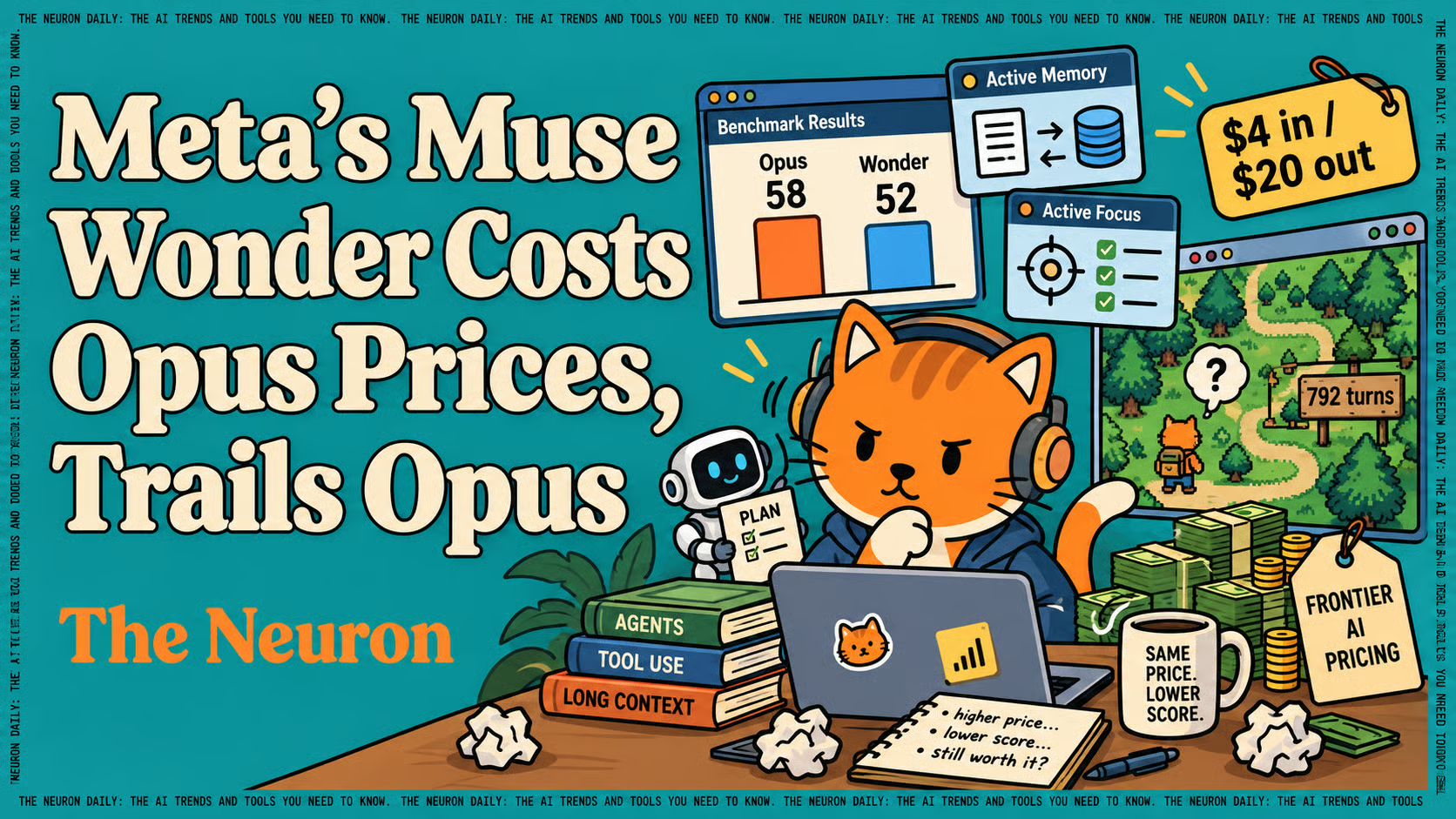
The first is Active Memory, which keeps context about a user across conversations. In practical terms, this means you would not need to re-explain your lease agreement, your budget constraints, or your project requirements every time you start a new session. The model retains a running understanding of who you are and what you are working toward.
The second is Active Focus, which is designed to keep an agent pushing toward a long-term goal even when it encounters obstacles. Critically, the newsletter notes that Active Focus is supposed to ask for confirmation before taking any consequential action — a guardrail intended to prevent autonomous agents from making irreversible decisions without human oversight.
Both features address real frustrations that developers and power users have raised with existing frontier models. Persistent memory and reliable long-horizon task completion are genuine unsolved problems in production AI deployment. Meta is positioning Muse Wonder as the answer.
The Benchmark Gap Nobody Wanted to Talk About
Here is where the launch story gets complicated. The Neuron reports that Meta’s own benchmark chart shows Wonder Full ahead of Claude Opus 5.5, GPT-6 Astra, and another competitor on 7 of 14 evaluation rows, with particular strength on long software projects and legal agent tasks. On Meta’s internal grading, the model looks competitive at the top of the frontier.
The independent Artificial Analysis index, however, tells a different story. According to VentureBeat’s reporting cited in The Neuron, the scores break down as follows: Claude Opus 5.5 scores 58, Muse Wonder Full scores 56, GPT-6 Astra scores 53, and Muse Wonder scores 52. The gap between Opus 5.5 and Wonder Full is narrow — but it exists, and it matters enormously when you look at the pricing.
Muse Wonder — the weaker of the two new models, scoring 52 on the independent index — is priced at $4 per million input tokens and $20 per million output tokens. For Indian developers and enterprises building on APIs, that translates to roughly ₹340 per million input tokens and ₹1,700 per million output tokens at current exchange rates. That is the exact same price point as Claude Opus 5.5, the model that independently outscores it. Meanwhile, Anthropic’s Sonnet 5.5 costs half as much as Opus 5.5 and also scores higher than Muse Wonder on the same independent index.
The Neuron’s framing is blunt: second place at first-place prices.
Distribution Restrictions Make It Worse
If the pricing raised eyebrows, the distribution model compounds the problem. Muse Wonder Full — the model that at least comes close to Opus 5.5 on independent tests — is not available via the API at all. The only way to access it is through Meta’s Muse Code plans, priced at $50 per month (approximately ₹4,250) or $200 per month (approximately ₹17,000). This means independent researchers, benchmark testers, and competing developers cannot run controlled evaluations on Wonder Full using the same API access that enterprise customers would use.
This matters because Meta’s own benchmark chart is the primary evidence for Wonder Full’s superiority over Opus 5.5. Without API access, those numbers cannot be independently verified. The Neuron flags this directly: what to watch next is whether Wonder Full ever reaches the API so that outsiders can test Meta’s chart for themselves.
There is also a notable contradiction on the open-weights front. Meta had previously promised open weights for Muse Spark, an earlier model in the Muse family. As of this launch, those weights have not been shipped. Muse Wonder and Muse Wonder Full carry no downloadable weights either.
The Pokémon Red Problem
One data point from launch day crystallised the gap between Meta’s agentic ambitions and current reality. A developer ran Muse Wonder as an autonomous agent tasked with playing Pokémon Red. The Neuron reports that the agent selected a starter Pokémon by turn 20, then spent approximately 792 turns wandering Viridian Forest — the game’s first major obstacle — burned roughly $96 (approximately ₹8,160) over six hours, and never defeated the first gym leader.
This is a single anecdote, not a controlled benchmark, and it is worth treating it as such. But it is precisely the kind of failure that Active Focus was designed to prevent. An agent that cannot recognise it is trapped in a loop and course-correct is an agent that will burn through API credits on real enterprise tasks without delivering results.
The Memory and Privacy Equation

Active Memory is the feature most likely to attract enterprise interest, and it is also the feature that carries the most significant privacy implications. According to VentureBeat’s reporting as cited in The Neuron, Muse Code defaults to a Contributor mode that allows Meta to use submitted content to train its models. You can opt out — but only for future submissions. Any content already submitted under default settings is fair game.
For Indian enterprises handling client documents, financial records, or legally sensitive material, this is a setting worth investigating before a single token is processed. The API reportedly does not train on your content, making it the safer path for sensitive workloads — but the distinction between API access and Muse Code access is not prominently advertised.
The Neuron also flags a safety concern that Meta itself acknowledged: the model’s safety card states it cannot rule out the model reaching a high-risk threshold for chemical and biological misuse without mitigations in place. The full safety report is listed as coming soon at the time of launch.
What This Launch Actually Signals
Meta’s entry into commercial frontier AI is strategically significant regardless of where Muse Wonder lands on today’s benchmarks. The company is signalling that it intends to compete for enterprise AI spending, not just developer goodwill through open-weights releases. The choice to price at Opus 5.5 levels is a statement of positioning, even if current independent scores do not yet justify that position.
For developers and product teams evaluating frontier models right now, The Neuron’s analysis is straightforward: nothing in this launch provides a compelling reason to switch from Claude or ChatGPT if those are already working for you. The memory features are genuinely interesting in principle, but they cannot be properly evaluated until Wonder Full reaches the API and independent testers can run controlled comparisons on the same tasks Meta uses in its own chart.
For enterprise procurement teams in India and globally, the calculus is similarly cautious. Paying Opus 5.5 prices for a model that independently scores below Opus 5.5 — while accepting default data-training terms and limited access to the better model — is a significant ask without stronger independent validation.
The frontier AI market moves quickly. Meta has the infrastructure, the talent, and the capital to close benchmark gaps in subsequent versions. But at launch, Muse Wonder is a model that asks you to trust its maker’s benchmarks over the independent ones, pay top-tier prices for a mid-tier score, and accept that the best version of the product is not yet available for outside testing. Those are three substantial leaps of faith to take simultaneously.