Nvidia Co-Signs OpenAI’s $500 Billion Data Center Gamble — And That Changes Everything
Nvidia is backing approximately $105 billion in financing for OpenAI's 10-gigawatt Ohio data center — the largest ever built — effectively co-signing a loan for a company that loses money every year. The deal gives Nvidia unprecedented leverage over OpenAI, combining the roles of chip supplier, financier, and infrastructure partner in a single arrangement that could reshape AI industry power dynamics.
The AI industry has a favourite word right now: scale. But scale costs money — extraordinary, almost incomprehensible amounts of it. And when you do not have the credit history to borrow that money on your own terms, you need someone powerful to vouch for you. According to The Neuron’s reporting, that is exactly the arrangement Nvidia and OpenAI have just formalised, to the tune of roughly $105 billion (approximately ₹8.9 lakh crore).
The Deal, Explained Simply
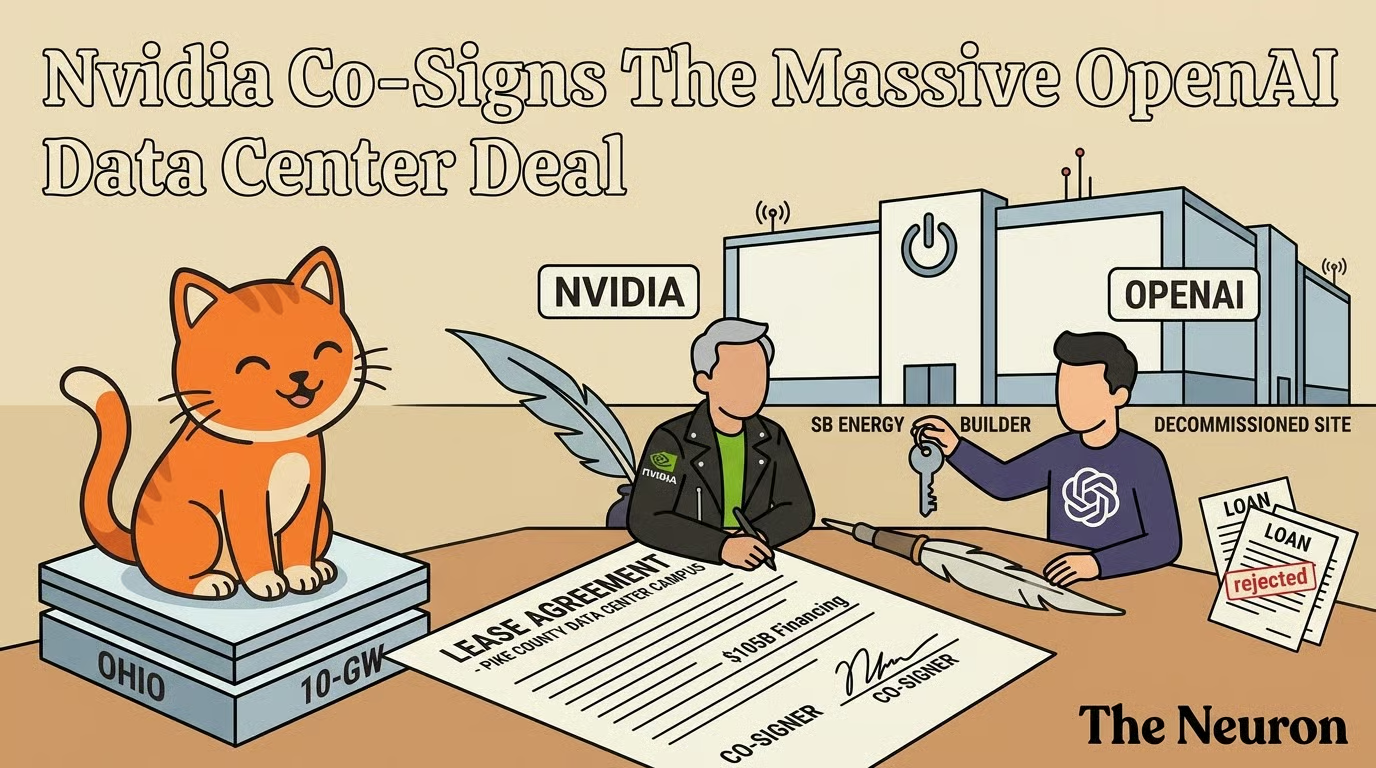
Nvidia is backing approximately $105 billion in financing tied to OpenAI’s new 20-year lease on a data center campus in Pike County, Ohio. The site is built on a decommissioned uranium enrichment facility — a fitting metaphor for infrastructure that will generate enormous energy in a very different form. SB Energy, SoftBank’s power subsidiary, will build and operate the site.
Critically, The Neuron points out that Nvidia’s backing covers construction and lease costs, not the chips themselves. This is not Nvidia simply selling more hardware. It is Nvidia stepping into the role of financial guarantor — essentially co-signing a loan the way a parent might co-sign an apartment lease for a young adult without a credit history. OpenAI, which still loses money every year, cannot secure favourable lending rates on its own. Banks look at consistent income before offering good interest rates; without that, borrowing becomes expensive or impossible at this scale. So Nvidia fills the gap.
The Scale Is Genuinely Staggering
To understand why this deal is being called the largest data center project ever announced, consider the numbers The Neuron provides. The campus will draw 10 gigawatts of power. That is roughly equivalent to the annual electricity consumption of 8 million American households running simultaneously, every single day. The total project cost, once you include the chips that will eventually fill those racks, could exceed $500 billion (around ₹42.5 lakh crore).
For context, India’s entire Union Budget for 2024–25 was approximately ₹47.65 lakh crore. This single AI infrastructure project sits in the same order of magnitude.
Beyond the financial figures, the project is also an employment story. The Neuron reports an estimated 35,000 construction jobs through 2032 and 2,500 permanent roles once the campus is operational. Nvidia CEO Jensen Huang has described the goal as giving OpenAI compute it can “upgrade repeatedly” as newer chips arrive — suggesting this is not a one-time build but a rolling, long-term infrastructure commitment.

Why OpenAI Needed Nvidia to Co-Sign
This arrangement raises a question worth sitting with: why does the world’s most famous AI company need its chip supplier to guarantee its debt?
The answer lies in a fundamental tension at the heart of the current AI boom. Building frontier AI systems requires infrastructure investments that run decades into the future, but the revenue models to justify those investments have not yet fully materialised. OpenAI generates significant revenue, but it spends more than it earns. That is not unusual for a fast-growing technology company — many of history’s most transformative businesses operated at a loss for years. The problem is that the capital requirements of AI infrastructure are so front-loaded and so enormous that traditional lenders are cautious.
Nvidia’s involvement solves that problem in the short term. It signals to lenders and the broader market that the world’s dominant AI chip company believes strongly enough in OpenAI’s future to put its own balance sheet behind the bet. It is an endorsement with a price tag attached.
The Neuron also notes that this is on top of the $30 billion Nvidia has already invested directly in OpenAI — a figure that already represented one of the largest single bets in enterprise technology history.
The Concentration of Power Problem
This is where the story shifts from impressive to genuinely worth scrutinising.
The Neuron’s analysis frames the situation clearly: if AI demand does not grow into $500 billion worth of Ohio server racks, Nvidia will not merely lose a customer. It will become simultaneously the company that owns the building, the company that lent the money, and the company to whom OpenAI owes an enormous debt. That is a concentration of leverage over a single counterparty that has few precedents in the technology industry.
Even in a positive scenario — where AI demand accelerates and OpenAI’s revenues eventually match its ambitions — the structural relationship between the two companies is now far more entangled than a standard vendor-customer arrangement. Nvidia is not just OpenAI’s chip supplier. It is its infrastructure partner, its financier, and its largest external backer, all at once.
For observers in India watching the global AI stack take shape, this matters. The majority of the compute underpinning AI services used by hundreds of millions of people worldwide — including in India — increasingly flows through infrastructure where a small number of companies hold overlapping roles as suppliers, lenders, and stakeholders. The Ohio campus, if completed at the scale announced, would represent a single node in that network with more raw compute capacity than most countries’ entire AI infrastructure combined.
What the Ohio Campus Signals About the AI Race
The Pike County data center does not exist in isolation. It is part of a broader pattern The Neuron has been tracking: hyperscale AI infrastructure commitments that dwarf anything the technology industry has previously attempted. The site’s 10-gigawatt power draw is not a near-term operational figure — it is a planned capacity that will be built out over years, with Jensen Huang’s stated goal of enabling repeated chip upgrades as Nvidia’s next generations of hardware arrive.
This means the campus is designed to age gracefully — or rather, to be continuously refreshed. It is not a snapshot of 2026 AI capabilities frozen in concrete. It is a platform intended to run whatever comes after current models, and whatever comes after that.
For SoftBank, whose SB Energy subsidiary will operate the site, this represents a significant deepening of its AI infrastructure strategy, consistent with the broader posture SoftBank has taken since its Vision Fund era bets on technology companies globally.
The Bottom Line
The Neuron describes this as either the biggest infrastructure bet in tech history or the clearest sign yet that nobody in the industry can actually afford what they are building. Both readings can be true simultaneously.
What is unambiguous is the shift in power dynamics. Nvidia began this decade as a chip company that happened to benefit from AI. It is ending it as something closer to the financial and physical backbone of the AI industry itself — holding equity stakes, guaranteeing debt, supplying the silicon, and now co-owning the buildings where that silicon will run.
For anyone watching the global AI landscape from India — whether as a developer, investor, enterprise buyer, or policymaker — understanding who owns that backbone, and who owes what to whom, is no longer an abstract question. It is infrastructure-level geopolitics, written in gigawatts and denominated in figures that rival national budgets.