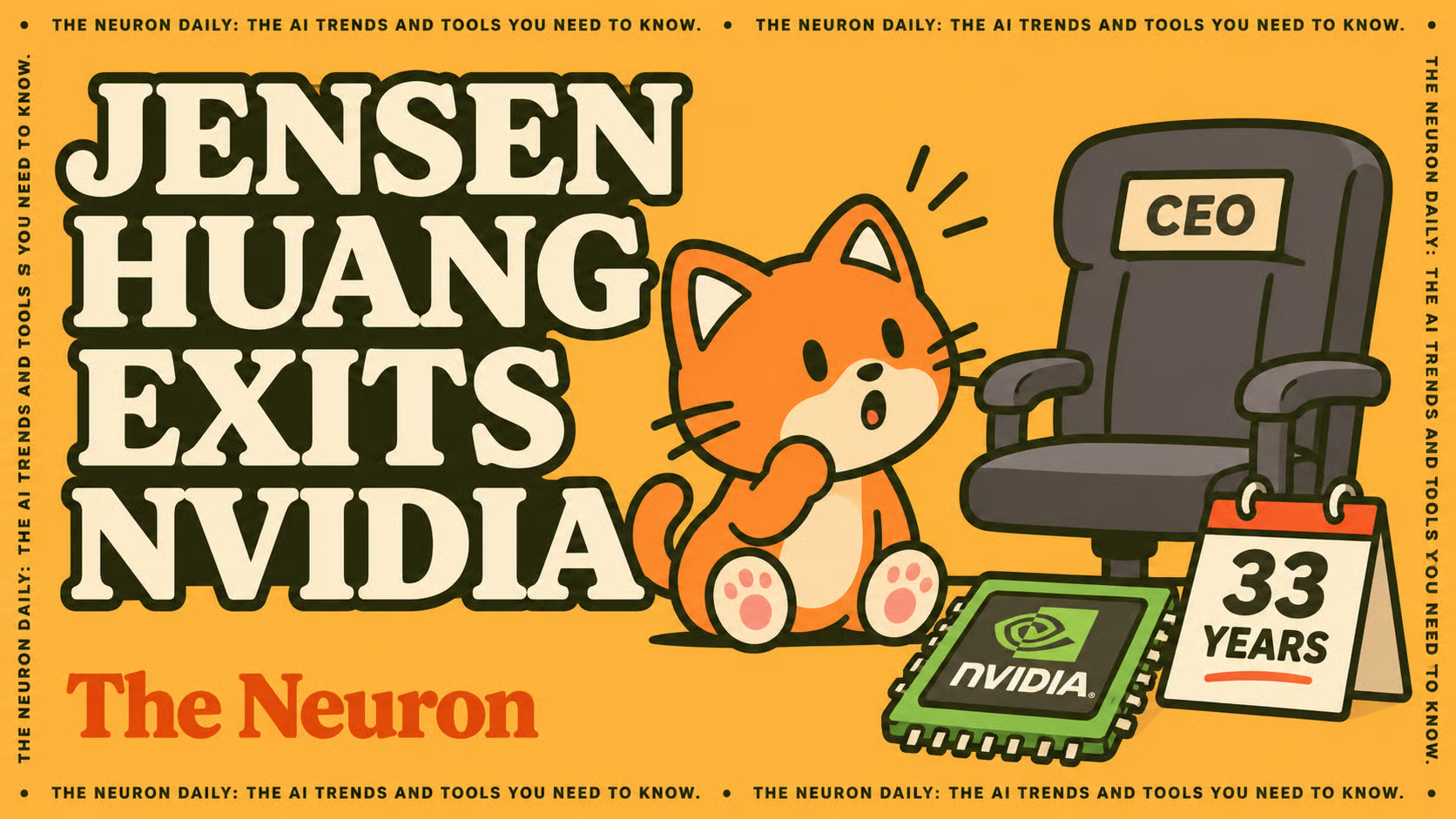
Jensen Huang Exits Nvidia After 33 Years: What a CEO’s Sudden Departure Means for the AI Chip Empire
Jensen Huang resigned as Nvidia CEO on November 13, 2026, just four days after admitting an affair amid a foreign intelligence investigation, handing the interim role to CFO Colette Kress. The Neuron reports that while Nvidia's CUDA ecosystem and 7.5 million developers provide deep structural resilience, the leadership vacuum and parallel DOJ probes introduce meaningful uncertainty heading into the company's November 17 earnings call.
On November 13, 2026, the AI world woke up to a headline that would have seemed unthinkable even a week earlier: Jensen Huang — co-founder, decades-long leader, and the most recognisable face in the semiconductor industry — had resigned as Nvidia’s CEO, effective immediately. According to The Neuron, the resignation followed four of the most turbulent days in the company’s history, compressing a career-ending sequence of events into a span shorter than most business trips.
A Timeline That Moved at Chip Speed
The sequence, as reported by The Neuron citing Nvidia’s SEC filing and a TechCrunch timeline, unfolded like this:
- November 8: Huang told employees he had been unfaithful to his wife. Nvidia’s board simultaneously opened an independent investigation into reports that he had been targeted by a foreign intelligence operation.
- November 11: The Wall Street Journal reported the board was preparing to remove him. The SEC filing confirms the board accepted his resignation that same day.
- November 12: Nvidia announced the leadership change publicly. Shares fell more than 13% in early trading. Huang agreed to testify before Congress.
Thirty-three years. One CEO. Four days from first admission to exit. That is the entire arc of a leadership transition at one of the most valuable technology companies on the planet.
Who Steps In — and Why It Matters
Nvidia’s CFO Colette Kress has been named interim CEO while the board searches for a permanent replacement. Director Harvey Jones becomes the board’s first-ever chair. Because Huang co-founded Nvidia in 1993, this marks the first CEO change in the company’s entire history. There is no internal successor who has been groomed publicly, no obvious heir apparent who has been managing business units in Huang’s shadow. That gap is part of what unsettled markets.
The first real test of Kress’s tenure arrives almost immediately — Tuesday, November 17, when Nvidia reports quarterly earnings. The Neuron flags three things worth listening for in that call: whether customer orders hold at their recent pace, what Kress signals about the China market, and any early hint of who the permanent CEO pick might be.
The National Security Dimension
The resignation is not purely a corporate governance story. According to New York Times reporting cited by The Neuron, U.S. officials believe the woman at the centre of Huang’s admitted affair works for Chinese intelligence. She is also reportedly an executive at Megaspeed, a cloud company that has been investigated over whether it helped Chinese firms circumvent chip export controls — the very export controls that Nvidia’s chips sit at the heart of.
Two important caveats stand alongside those allegations. Nvidia’s board has stated it has no reason to believe national security or company secrets were actually compromised. The woman’s alleged intelligence role has not been officially confirmed. Governance professors quoted by TechCrunch told the outlet they are unaware of any precedent for a CEO caught up in a suspected honeypot operation — spy-speak for a relationship cultivated to get close to someone with strategic influence or access.
Separate from the personal conduct questions, The Neuron notes that U.S. Department of Justice investigations involving Nvidia, Megaspeed, and server manufacturer Supermicro cover potential antitrust and chip-smuggling issues. These are parallel threads, not the same story, but they share a common backdrop: the geopolitical contest over advanced semiconductor access.
The CUDA Moat — and Why Customers Won’t Simply Walk Away
For Indian enterprises, AI labs, and developers who have built infrastructure on Nvidia hardware, the more immediately practical question is: does any of this change the technology calculus?
The Neuron’s own analyst Corey Noles argues the answer is probably no in the long run, but the transition period carries real friction. His central point concerns CUDA — Nvidia’s proprietary software layer that lets developers write programs for its graphics processing units. Nvidia’s 2026 annual report reports more than 7.5 million developers using CUDA globally. That is not a user base you can migrate overnight.
The analogy Noles uses is sharp: imagine a finance team that has built every model, every report, and every workflow inside a single spreadsheet application. Switching to a competitor means rewriting every formula and retraining every person, and you cannot pause the quarter to do it. The boss leaving does not change the plumbing. The plumbing is CUDA, and CUDA stays.
This is Nvidia’s deepest structural advantage, and it does not resign along with its founder. AI labs, cloud providers, and enterprise customers that have spent years optimising their codebases for Nvidia hardware face enormous switching costs regardless of who sits in the CEO’s chair.
The Slower Risk: Customers Planning Their Exit
That said, Noles identifies a subtler danger that is worth watching. Customers who continue buying Nvidia chips today may simultaneously be accelerating plans to reduce dependence on the company in the future. The uncertainty created by a leadership vacuum, an active DOJ investigation, and national security scrutiny gives procurement and infrastructure teams a reason to diversify — even if they do not act immediately.
The Atlantic, also cited by The Neuron, raises a structural concern: Nvidia does not merely sell chips to AI labs. It also holds financial stakes in some of those same labs. That dual role as supplier and investor means instability at Nvidia could wobble multiple points in the AI development loop simultaneously. The newsletter is careful to frame this as an argument rather than a forecast, and that distinction is worth preserving.
What Investors and the Industry Should Watch

Noles’s watch list for the months ahead covers four areas:
- 1. Product delivery — Can Nvidia’s engineering and product teams maintain their roadmap cadence without the founder who has been the company’s strategic north star for over three decades?
- 2. Leadership retention — Senior executives often reassess when a founder exits abruptly. Whether key technical and business leaders stay is a leading indicator of stability.
- 3. Licensing terms — CUDA’s terms govern how the ecosystem operates. Any shift in licensing, pricing, or access conditions would send ripples across every company built on Nvidia’s software stack.
- 4. Investment pace — Nvidia’s role as a financial backer of AI labs is as strategically significant as its role as a chip supplier. Watch for any cooling in that activity.
For Indian AI startups and enterprises, many of which rely on Nvidia GPUs accessed through cloud providers or through direct procurement, the near-term message is straightforward: the hardware works the same way it did last week. Longer term, the leadership transition is a reason to understand your own exposure to any single vendor’s decisions on pricing and access — without necessarily acting on that understanding immediately.

The Bigger Picture
Jensen Huang built Nvidia from a graphics card company into the infrastructure layer of the artificial intelligence era. The company’s chips power the training runs that produced the large language models now embedded in products used by hundreds of millions of people. Its valuation reflects not just present revenue but the expectation that AI infrastructure spending will compound for years.
None of that underlying demand disappears because a CEO resigned. What changes is the certainty premium investors and customers attached to the idea that the person who understood every dimension of that strategy — technical, commercial, geopolitical — was still in the building.
As The Neuron puts it: a CEO can leave in a day. The ecosystem built around his company cannot. That gap between executive departure and structural consequence is exactly where the next chapter of Nvidia’s story will be written — starting with earnings on November 17.