A Fleet of AI Agents Runs This Sales Rep’s Day Before He Even Opens His Laptop — Here’s What That Looks Like
An Anthropic Japan BDR published a detailed account of how he automated lead routing, CRM updates, and email drafting using a named fleet of Claude agents called the Nakama. The design — one agent per job, shared memory, and scheduled background runs — offers a concrete template for Indian sales teams, though limitations around Indian-language support, USD pricing, and integration with tools like Zoho and Tally need honest evaluation before adoption.
What Changed: A Sales Rep Who Automated His Entire Morning Routine
Anthropic’s resources page recently published a detailed account of how a Business Development Representative on the company’s Japan team rebuilt his daily workflow using a fleet of Claude agents — titled How an Anthropic Japan Business Development Representative Runs His Day. It is one of the more grounded, step-by-step descriptions of AI-assisted work that has appeared from a major AI company — not from an engineer, but from a sales professional who describes himself as non-technical.
Before the agents, he was spending a couple of hours each morning manually routing and qualifying leads, writing emails in Japanese or English, and updating the CRM — often a day or more behind. Now, according to the account, his agents prepare most of that work before his day starts. He reviews it.
This is worth unpacking carefully, because it describes something many Indian sales teams — inside SaaS companies, manufacturing exporters, banking and NBFC distribution arms — are attempting to build right now, usually with far less structure.
The Fleet: One Agent, One Job
The key design principle described in the article is simple: every agent has exactly one clearly defined responsibility. The BDR named his fleet the Nakama — Japanese for “the crew” — and built five working agents plus one coordinator.
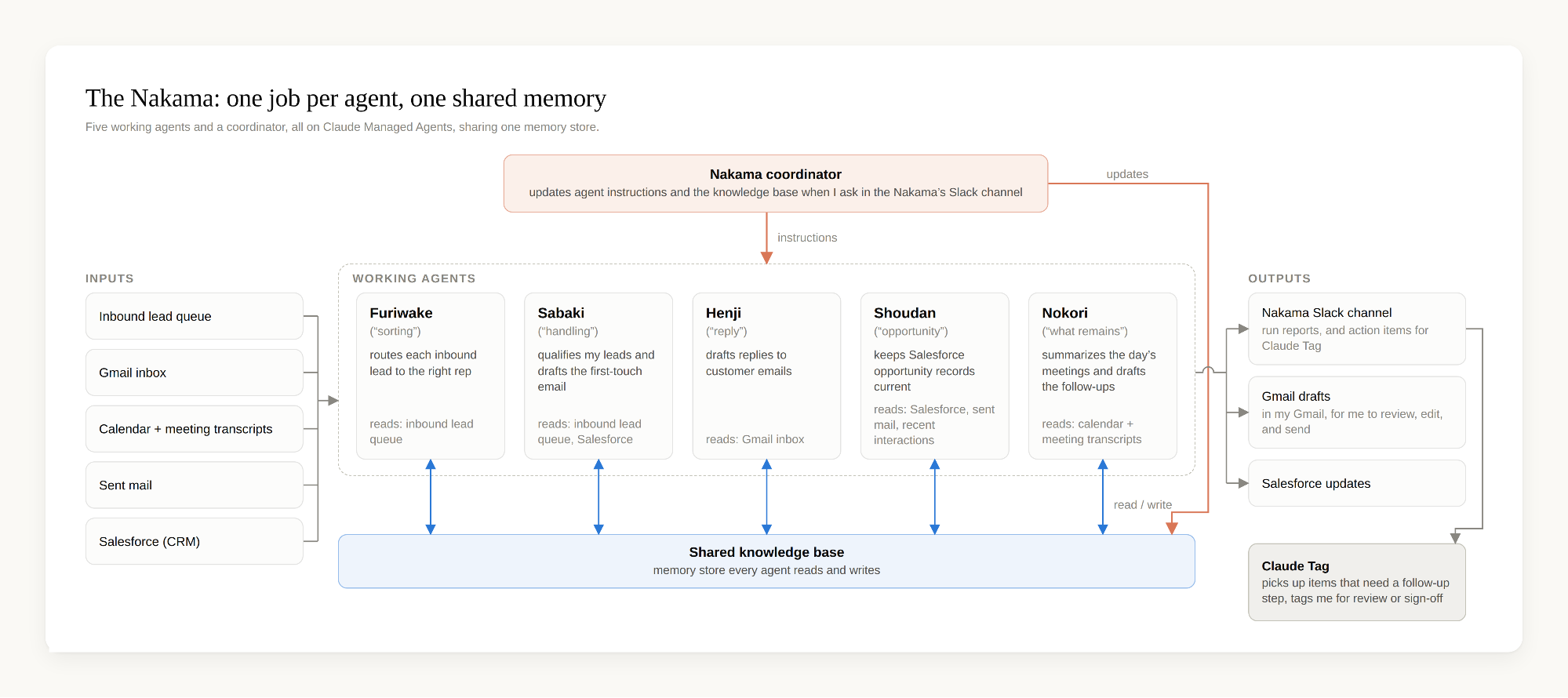
Here is what each agent does, as described in the source:
- Furiwake (“sorting”) reads the daily inbound lead queue, routes each lead to the right rep, checks who is in office that day, and posts a Slack report once the handoff is done — before anyone’s day begins.
- Sabaki (“handling”) takes leads assigned to this rep specifically, qualifies them against preset criteria, drafts a first-touch email, and updates the lead record in Salesforce.
- Henji (“reply”) scans the inbox hourly for customer emails and prepares a draft reply in Japanese or English depending on the thread.
- Shoudan (“opportunity”) reads recent customer interactions and pushes updates into Salesforce so records stay current without manual entry.
- Nokori (“what remains”) runs at the end of the day, reads meeting transcripts from the calendar, summarises each meeting, and drafts follow-up emails.
- A coordinator agent manages the fleet itself: it monitors a dedicated Slack channel for plain-language instructions, then updates each agent’s system prompt and shared knowledge base accordingly.
All agents share a single memory store. When the rep corrects a phrasing in one agent’s draft, every other agent picks up that correction in its next run. According to the article, the fleet saves approximately 60 hours of manual work per week when measured against the time each task would have taken manually.
How It Was Moved to Claude Managed Agents
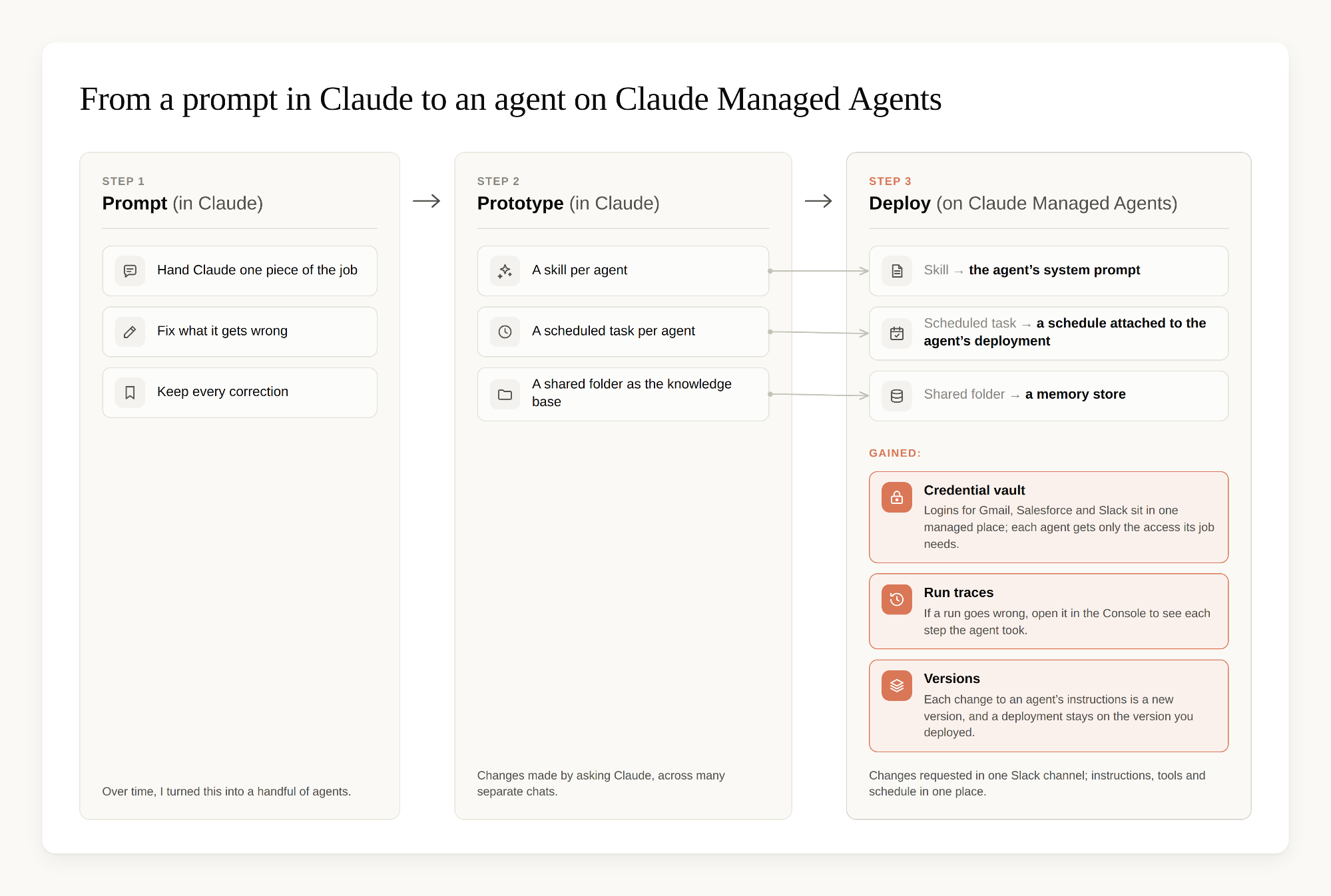
The BDR first prototyped his setup directly inside Claude using skills, scheduled tasks, and a shared folder on his laptop as the knowledge base. He then moved it to Claude Managed Agents — described by Anthropic as managed agent infrastructure on the Claude Platform — once the number of agents became hard to track.
The article notes three specific advantages Managed Agents added:
- 1. Background execution. Agents run on their schedule whether the laptop is open or not. If a run goes wrong, each step is visible in the Console.
- 2. Shared memory. Every agent reads and writes the same memory store, so corrections and research learnings propagate across the entire fleet automatically.
- 3. Credential vaults. Access to email and Salesforce is stored in managed vaults with scoped permissions. Each agent only sees the credentials its specific job requires.
The article also describes an “advisor strategy” for the email-reply agent Henji: because it runs hourly throughout the day, running it on Opus (Anthropic’s larger model) every time would be the most expensive option. Instead, Henji runs on Sonnet, Anthropic’s smaller model, and escalates to Opus only when it reaches a decision it cannot handle. Furiwake and Shoudan — which follow a written rulebook — also run on Sonnet. The agents that require more judgment, like Sabaki and the coordinator, run on Opus.
What Overflow Looks Like: Claude Tag in Slack
Some items from the Nakama require a follow-up step that goes beyond a draft — figuring out an upgrade path, escalating to another team, or waiting on a customer reply. For those, according to the article, the agents post the action item to the Slack channel and tag @Claude, which is Claude configured as a member of the Slack workspace.
Claude picks up the request in the thread, lays out options, drafts what is needed, and tags the rep when human sign-off is required. It also sets reminders for itself to follow up on specific dates, checks whether the customer replied or whether a deal desk ticket was resolved, and posts an update in the same thread.
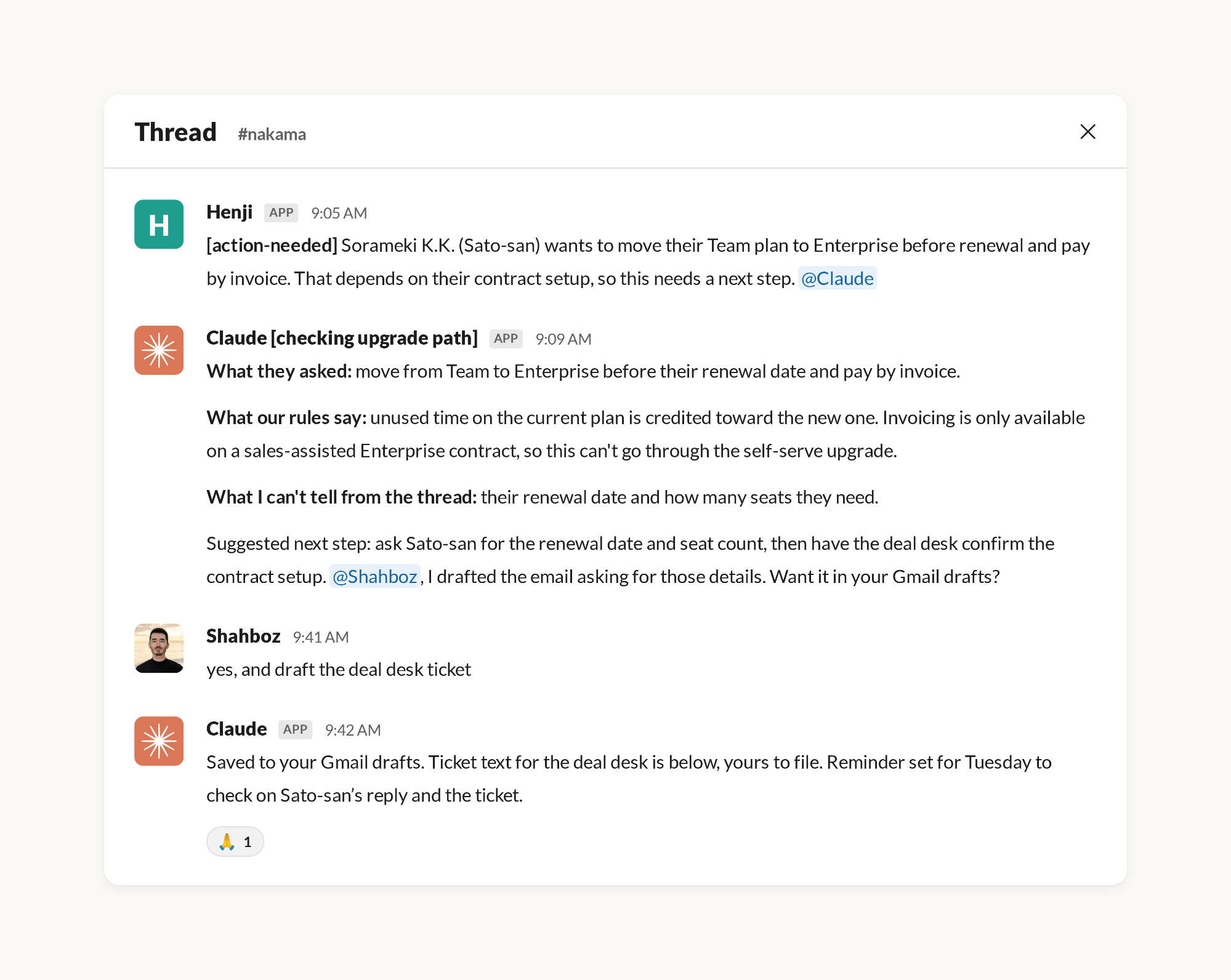
For Indian teams familiar with using WhatsApp Business or Slack for sales coordination, this pattern — where an agent participates in a channel like a team member and escalates to a human only when necessary — is the closest real-world description of what “human-in-the-loop” automation actually looks like in a sales context.
An Indian Business Scenario: B2B SaaS Inside Sales Team
Consider a mid-sized Indian SaaS company headquartered in Bengaluru that sells accounting software to SMEs across tier-2 cities. The inside sales team receives 80–120 inbound demo requests per day from the website, LinkedIn, and partner referrals. Currently, two executives spend the first two hours of every morning manually checking the CRM (Zoho CRM, in this case), assigning leads by region, and writing the first outreach email — often using a template that is slightly out of date.
A fleet modelled on the Nakama design could handle the morning routing automatically: a Furiwake-equivalent reads new Zoho CRM entries, checks rep availability, and assigns leads before 9 AM. A Sabaki-equivalent drafts a first email personalised to the prospect’s industry. A Nokori-equivalent scans meeting notes from the day and drafts follow-ups by evening. The inside sales executives review and send — instead of compose and chase.
The design principle holds in Hindi or Marathi just as well as in Japanese: one agent, one clearly scoped job, one shared knowledge base.
Limitations and Honest Tradeoffs
Before you build toward this setup, there are several things to consider honestly.
What to Watch For
If you want to experiment with a version of this for your team, the article suggests starting in Claude directly — using skills and scheduled tasks — before moving to Managed Agents. Prototype with one agent for one job: lead routing or CRM update or first-email draft. Not all three at once.
The more important design decision is one you can make before touching any tool: write a clear, one-paragraph description of what each task involves, what the input is, what the output should be, and what the exceptions are. That clarity is what makes the difference between an agent that saves 60 hours a week and one that produces drafts you can never trust.
Watch for Anthropic’s expansion of Managed Agents out of beta, and watch for whether Claude Tag becomes available for Indian Slack workspaces without a US billing requirement. Those two developments, more than any individual feature, will determine how accessible this architecture is for Indian teams building outside the Salesforce-Gmail stack.