Why Your AI Agent Forgets Everything — And How to Give It a Permanent Memory
Every LLM starts from zero on each call — agent memory is an external layer that decides what gets stored, retrieved, and forgotten across sessions. The n8n blog post by Cognee's Veljko Kovac explains the architecture options (vector databases, knowledge graphs, hybrid systems) and how to implement them in n8n workflows, with honest tradeoffs relevant to Indian businesses using tools like Zoho, Tally, and non-English data.
Your AI-powered support agent handled a customer complaint on Monday. On Wednesday, the same customer writes back with a follow-up. The agent has no idea what happened Monday. It starts from scratch, asks the customer to repeat themselves, and the customer — understandably — gets frustrated.
This is not a bug. It is the default behaviour of every large language model in existence. And if you are building any kind of business automation on top of an LLM, this is the single most important architectural fact you need to understand.
Veljko Kovac, Head of Field Development Engineering at Cognee (an open-source agent memory platform), has published a detailed technical guide on the n8n blog that explains exactly how this works and how to fix it. The full post is available at blog.n8n.io. What follows is a plain-language breakdown of that architecture, grounded in an Indian business context.
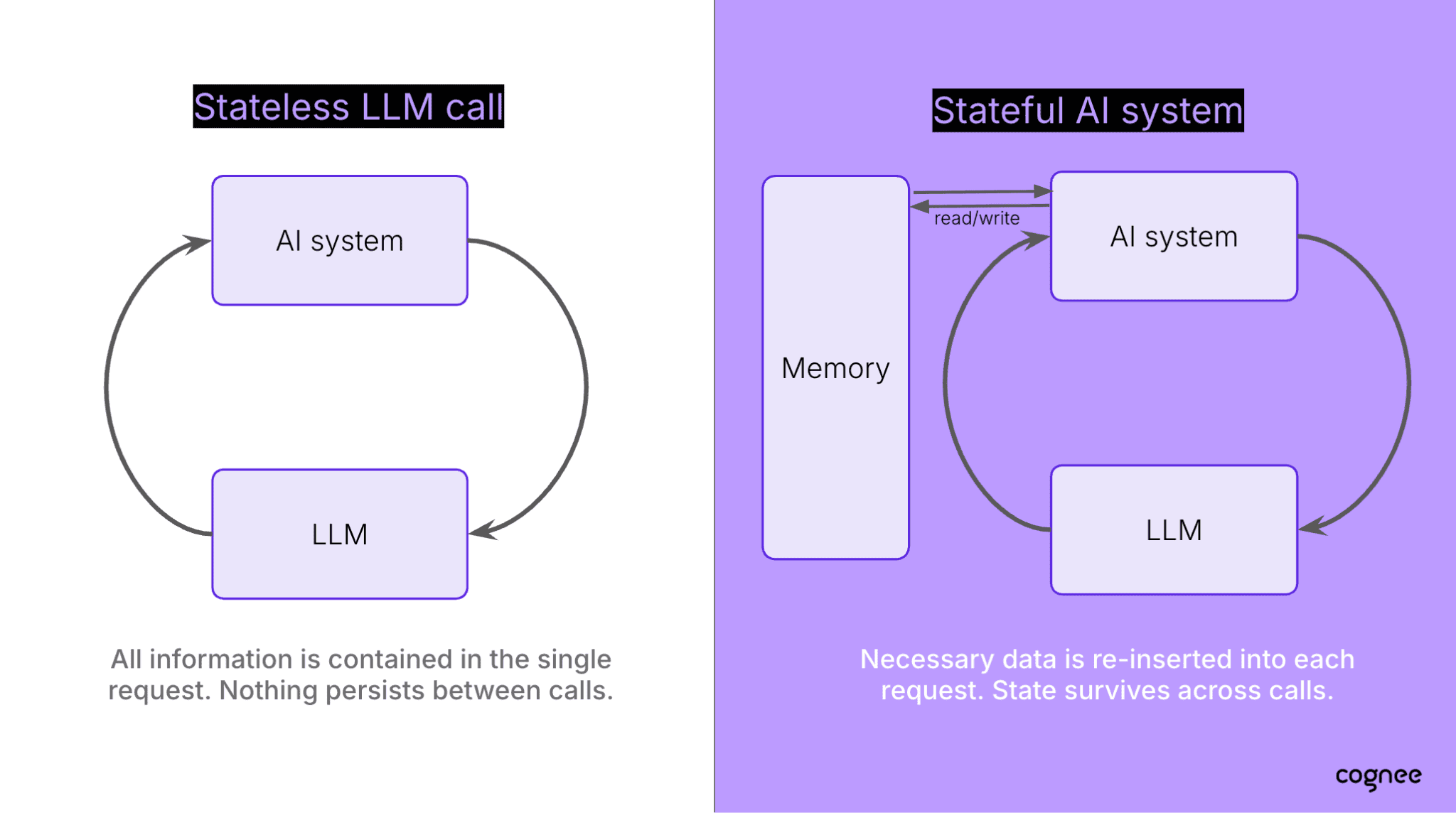
Every LLM Call Starts from Zero
According to the n8n blog post by Kovac, an LLM has no memory of its own. Each request is fully independent: the model reads the prompt, returns a response, and retains nothing. The second request is treated as if the first never happened.
For a one-shot question — “What is the GST rate on software services?” — this is fine. But the moment your workflow runs repeatedly, or your agent handles multi-turn conversations, this statelessness becomes a serious operational problem.
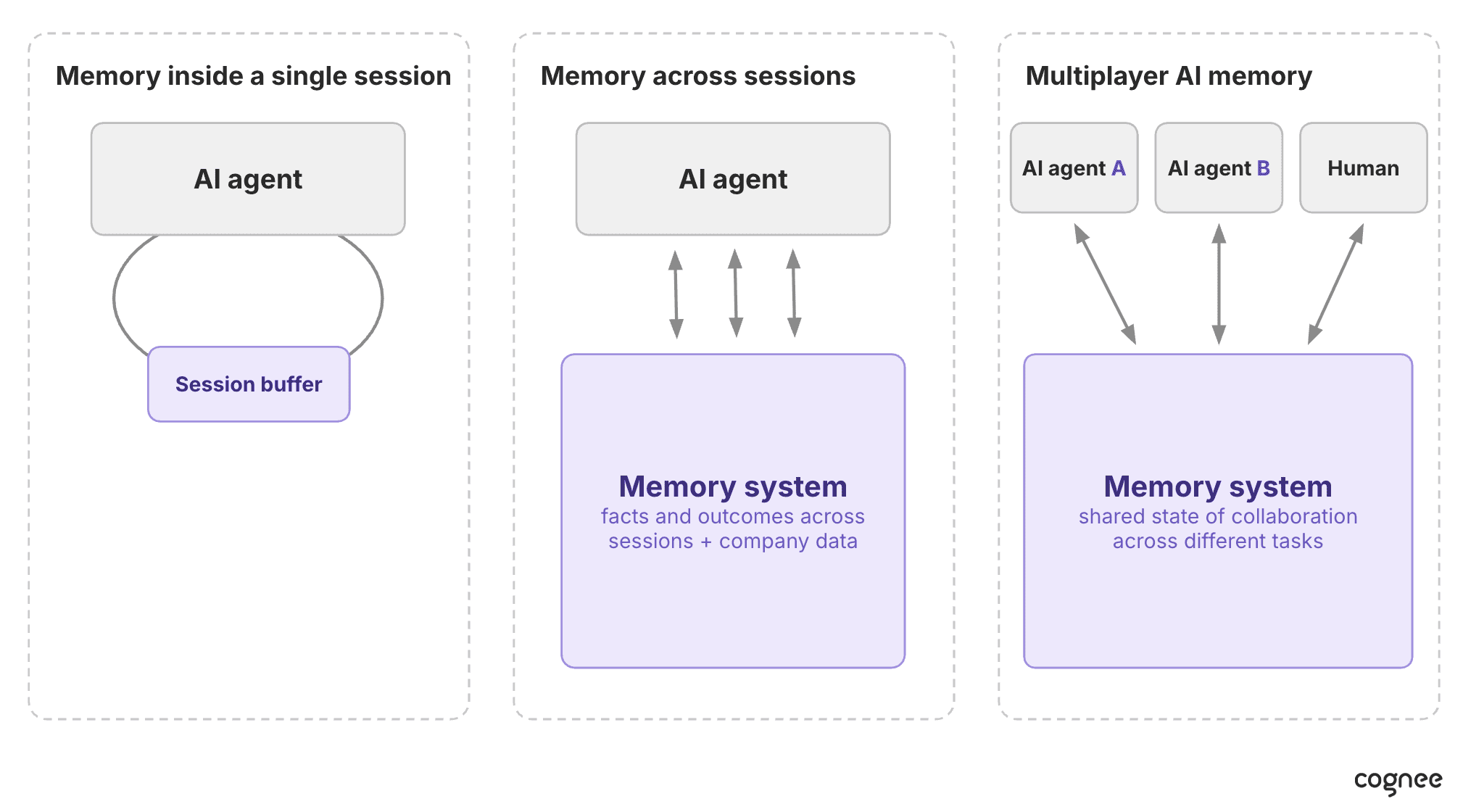
The honest answer, as Kovac puts it, is that memory lives outside the model. The agent stores what it learns in an external layer, retrieves the relevant parts before each call, and feeds them back into the prompt. How well you design that external layer determines whether your agent is useful over time or merely impressive in a demo.
Short-Term vs Long-Term Memory: A Practical Split
Kovac describes two timescales at which agent memory operates, and they are typically built as separate components.
RAG Is Not the Same as Agent Memory
This is a distinction that trips up a lot of non-technical decision-makers in India who have heard the term RAG (Retrieval-Augmented Generation) and assume it solves the memory problem. It does not — not fully.
The n8n post lays out four distinct concepts in a comparison table that is worth understanding:
- LLM memory (model weights): What the model learned during training. General knowledge, compressed patterns. Cannot reflect your business or your customers.
- Context engineering: Choosing what goes into the prompt for a particular call. Expensive at scale; disappears when the session ends.
- RAG: Retrieves from an existing knowledge source (documents, a database) and adds it to the prompt. Critically, RAG reads but does not write back. It will not remember what the user asked last week or which fix already failed.
- Agent memory: Starts where the agent writes back. It captures new facts, preferences, and outcomes as it works, and retrieves them later.
The illustrative example Kovac gives is a sales assistant: RAG can pull this quarter’s revenue numbers from a report, but only agent memory can remember that this particular user always wants EU figures broken down by country and displayed in euros.
The Architecture Options — and Their Honest Tradeoffs
Once you accept that memory is an external layer, you have to choose what kind of data store backs it. The n8n post covers four main architectures:
Memory Has to Be Managed, Not Just Accumulated
One of the most practically important points in the post is that a memory layer that only grows gets worse over time. Facts change, preferences shift, and stale entries start competing with correct ones.
Kovac identifies three active management processes any serious memory system must support:
- 1. Consolidation — periodically turning raw entries into fewer, higher-level records (summaries, derived facts) while keeping a trail to the originals.
- 2. Updating — when a fact changes, keeping time information so the agent can answer both “what is true now?” and “what did we believe in March?”
- 3. Forgetting — an explicit, deliberate operation to remove stale data, corrections, or deletion requests. This is separate from the softer job of letting less useful memories fade in relevance.
The post also notes that the best systems learn from use: if an answer gets confirmed, the memories behind it gain weight; if it gets corrected, the misleading ones drop.
What This Looks Like for an Indian Business: A Concrete Scenario
Imagine a mid-sized B2B distributor in Pune — let us call them a packaging materials supplier with around 200 active wholesale accounts. They use n8n to automate their order follow-up workflow.
Without agent memory, every time a sales coordinator triggers the workflow to draft a follow-up email for a particular account, the workflow knows nothing about that account’s history. It drafts something generic.
With the two-pattern approach described in the n8n post, this changes significantly:
Limitations You Should Know Before You Build
If you are evaluating this architecture for an Indian business context, there are several honest constraints to keep in mind.
Where to Start Experimenting
If you run workflows in n8n today, the most practical first step is to look at any workflow that executes on a schedule or handles recurring customer interactions. Ask: what would this workflow need to remember from its last run to do its job better this time?
Start with the simpler pattern — a shared Postgres table or Airtable base logging key outputs — before committing to a full knowledge graph architecture. The n8n post is candid that hybrid systems covering exact IDs, relationships, fuzzy matching, and time-aware queries need more components to set up and run. That complexity is justified at scale, but it is not where most teams should begin.
The more important shift is conceptual: stop thinking of your AI agent as a smart tool that answers questions, and start thinking of it as a system that accumulates context over time. The model is the reasoning engine. The memory layer is the institutional knowledge. You need both.